How to Choose the Perfect Speakers for Your Home Theater is often misunderstood—even by serious buyers.
Most people assume premium brands alone guarantee a cinematic experience. But the truth is, even a ₹20L+ system can underperform if the speaker selection and layout are not engineered correctly.
In high-end home cinema, speakers are not just products—they are part of a precision-designed acoustic system.
Table of Contents
The Common Problem (What People Get Wrong)
When clients ask How to Choose the Perfect Speakers for Your Home Theater, they usually focus on:
Brand reputation
Wattage and specs
Number of speakers
But this approach leads to three major issues:
❌ Mismatch between room and speaker capability
❌ Poor seat-to-seat consistency
❌ Collapsed surround immersion
A Sonus Faber or Martin Logan system in a poorly designed room will never deliver its true potential.
The biggest mistake? Treating speakers as standalone products instead of a coordinated system.
What Makes How to Choose the Perfect Speakers for Your Home Theater Different
It’s Not About Brand—It’s About System Design
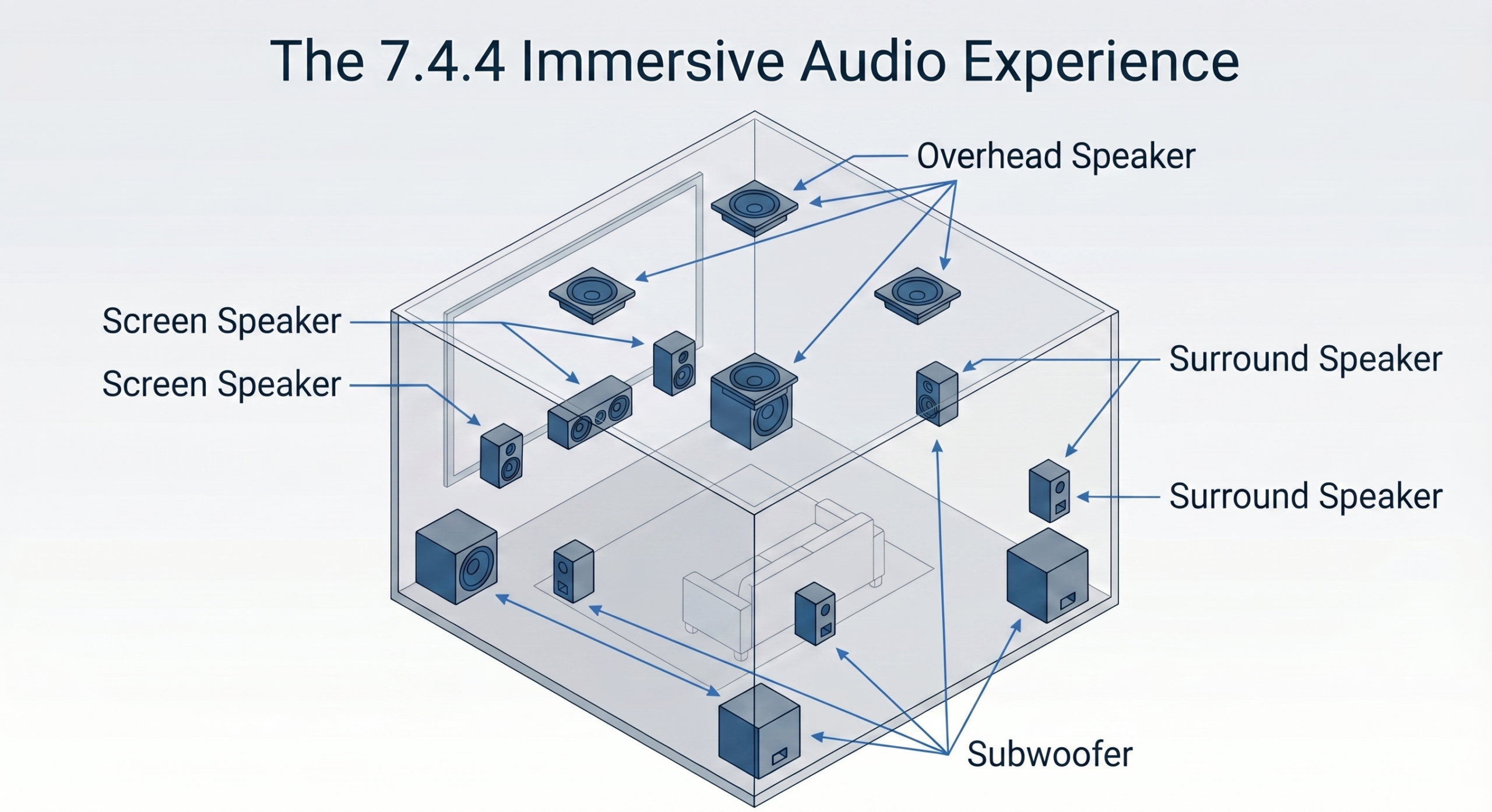
When done correctly, speaker selection follows a structured methodology:
1. Start with Screen Channel Alignment
Left, Center, Right must align with the screen image
Dialogue should come exactly from the actor’s position
2. Define Surround Zones
Side and rear speakers must create directional accuracy
Every seat—not just the center—should experience correct imaging
3. Bridge the Gap with Wide Speakers
Premium systems use front wides
This eliminates the “audio gap” between front and surround
4. Build the 3D Sound Dome
Height and ceiling speakers create vertical immersion
Placement depends on ceiling height and seating layout
👉 “Experience the Science of Sound.” Visit India’s premier Reference Level Experience Center in Tamil Nadu. [Krix Home Cinema Experience Center]
Speaker Selection Goes Beyond Specs
High-end speaker selection is based on measurable performance:
Directivity (Off-axis response) → How sound spreads in the room
SPL Capability → Can it hit cinema-level peaks without distortion
Phase Consistency → Ensures precise sound imaging
You can explore how immersive sound is standardized here:
Real-World Insight (India Context)
In India, especially in cities like Chennai, Madurai, or Coimbatore, we see recurring challenges:
Typical Room Constraints
Room sizes: 120–300 sq.ft
Low ceiling heights
Multi-purpose usage (living room + cinema)
Common Buyer Mistakes
Choosing bookshelf speakers for large rooms
Ignoring acoustic treatment
Mixing brands in LCR or Subwoofers
Reality Check
A ₹15L system with proper design will outperform a ₹25L system without it.
This is what separates: 👉 A “good system” from a reference-level experience
Is It Worth It?
If you’re asking How to Choose the Perfect Speakers for Your Home Theater, you’re likely investing seriously.
Here’s the truth:
✔ Yes, it’s worth it—if done correctly
❌ No, if treated as a product purchase
A well-designed system delivers:
Effortless clarity at any volume
Seamless 360° sound movement
True cinematic emotional impact
Conclusion
How to Choose the Perfect Speakers for Your Home Theater is not about picking the most expensive brand.
It’s about:
Engineering
Placement
Calibration
System synergy
The difference between an average room and a breathtaking cinema lies in design intelligence—not product price.
If you’re planning a serious home theater, focus on system design—not just speakers.
Paul Joseph Klattan is the Founder and Lead Designer of SMART Home Cinema, and a certified Level 3 professional under the Home Acoustics Alliance (HAA). He specializes in designing and calibrating reference-level private cinemas with a strong focus on acoustic accuracy, measurement-driven performance, and immersive sound reproduction. With deep expertise in tools like Room EQ Wizard (REW), Joseph applies advanced techniques such as frequency response analysis, time and RT60 decay optimization to achieve precise sound control within the room. His approach prioritizes engineering and calibration over conventional aesthetic-driven setups. He has worked extensively with premium cinema audio brands including Krix, Sonus faber, XTZ, delivering high-performance home cinema solutions across Tamil Nadu and throughout India.
The Seat Everyone Gets Wrong {#the-seat-everyone-gets-wrong}
Most people sit in the wrong spot in a home theater — and the worst part is, they never find out.
Table of Contents
They spend lakhs on speakers. They pick premium brands. They trust the salesperson.
And then they sit down, press play — and wonder why it doesn’t quite feel like that demo they heard at the showroom.
The room is fine. The speakers are fine. The seating position is the problem.
This is one of the most overlooked variables in home theater design — not just in India, but globally. Yet it is arguably the single factor that determines whether a ₹30 lakh system sounds extraordinary or merely adequate.
“You can have the world’s finest speakers, but if you’re sitting in the wrong spot, you’re experiencing a fraction of what the system can do.”
What the “Money Seat” Actually Means {#what-the-money-seat-actually-means}
The Reference Seating Position — Where Everything Is Designed To Converge
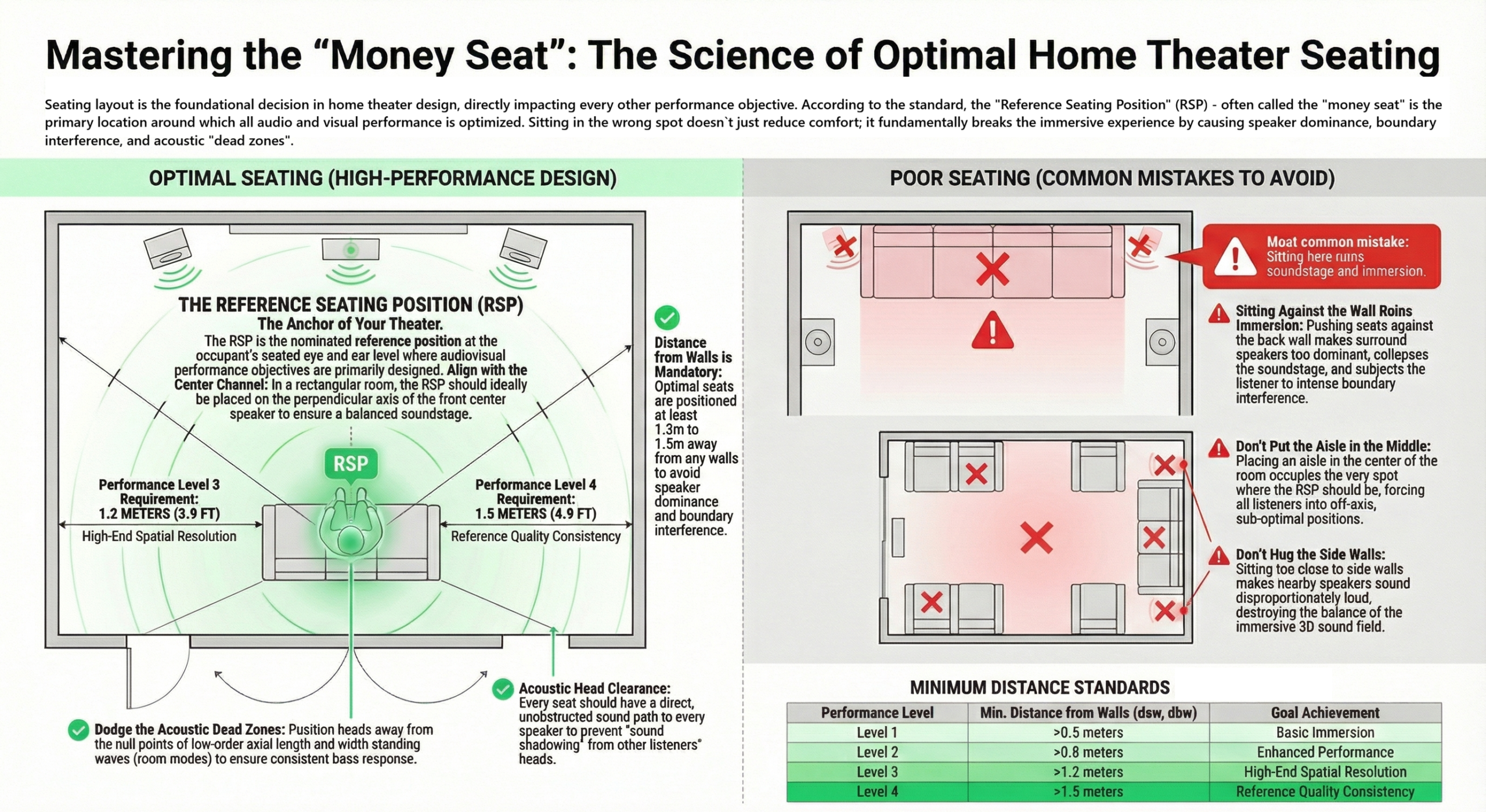
Professional home theater design is built around a specific concept: the Reference Seating Position (RSP).
This is the single nominated seat — at seated ear level — where the entire audiovisual experience is engineered to converge perfectly.
Think of it as the apex of a triangle the designer has drawn between your ears and the speaker array.
For this to work correctly, the RSP must sit on the perpendicular axis of the front center speaker. When it does, dialogue locks to the screen, effects feel grounded in physical space, and music becomes three-dimensional.
When it doesn’t — even by half a meter — the experience begins to fragment.
This isn’t opinion. It’s geometry.
The Listening Area — Consistency Across Every Seat
Beyond the RSP, every other seat in the room forms what designers call the Listening Area — a defined perimeter running through the middle of the outermost listeners’ heads.
The design challenge: recreating the RSP experience as closely as possible across every seat.
This is where speaker count, placement angles, and row height interact in ways most buyers never anticipate when they’re just picking a sofa configuration from a catalogue.
The Wall Trap: Why Your Back Row Is Ruining Everything {#the-wall-trap}
Proximity to Walls and the Surround Dominance Problem
Here is a mistake that appears in nearly every self-designed home theater in India:
The rear seating row is pushed against the back wall.
It feels natural. It maximises floor space. It looks clean on a floor plan.
It destroys Bass & surround sound.
When listeners sit too close to a rear or side wall, the surround speakers — which are designed to create an enveloping, ambient field — suddenly become dominant point sources. Instead of sound washing around you, a surround speaker feels like it’s right next to your ear.
The cinematic illusion collapses instantly.
Minimum Distances That Actually Matter
Performance-level standards used by certified design professionals specify minimum distances from walls based on system ambition:
Performance Level
Minimum Distance from Side & Back Walls
Entry-Level
> 0.5 metres
Mid-Level
> 0.8 metres
High-Performance
> 1.2 metres
Reference-Grade
> 1.5 metres
Most Indian home theaters — even expensive ones — violate the minimum distance for their stated performance level.
If your integrator has never discussed wall proximity with you in this context, that is a significant gap in the design conversation.
Room Modes — The Invisible Enemy Beneath Your Feet {#room-modes}
Why Certain Seats Feel Bass-Heavy and Others Feel Thin
Every rectangular room — and most Indian home theaters are rectangular — has acoustic resonance patterns called room modes or standing waves.
These are frequencies at which sound bounces between parallel walls and reinforces or cancels itself at specific points in the room.
Sit at a reinforcement node: bass sounds bloated, powerful, almost overwhelming.
Sit at a null point: bass disappears. The same subwoofer, the same room, a different chair position — and the experience is unrecognizable.
This is why two people sitting in the same home theater, just one row apart, can have completely different bass experiences. Neither the speaker nor the amplifier changed. The listening position did.
Designing around room modes requires acoustic analysis — not guesswork — and is one of the most technically demanding aspects of high-performance theater design.
External Reference: Dolby’s room acoustics guidance covers how standing waves impact cinema calibration at a professional level.
The India Problem: Rooms Built for Living, Not Listening {#the-india-problem}
How Indian Architecture Challenges Home Theater Design
Premium home theater buyers in India face a distinct challenge: most residential spaces — even in luxury apartments and villas — are not acoustically conceived.
Rooms are either too wide or too narrow relative to their length. Floor plans are optimised for aesthetics, ventilation, and vastu — not for speaker geometry.
These constraints are not insurmountable. But they demand a higher level of design intelligence, not just premium product selection.
A Krix or Sonus Faber loudspeaker placed incorrectly in an unconsidered room will underperform relative to a mid-range speaker installed with precision in a properly designed space.
The hardware is only as good as the environment it operates within.
Multi-Row Seating and the Occlusion Problem
In larger dedicated theaters — a growing trend in South Indian luxury homes — multi-row seating introduces a specific acoustic risk: occlusion.
When seat backs are too high, they physically block the direct sound path of surround and height speakers to listeners in rows behind them.
The solution professional designers use: tiered seating on risers, with precise calculation of seat back height relative to speaker mounting angles.
In some configurations, surround speakers may need to be slightly elevated or repositioned to maintain a clear line-of-sight from every seat to every speaker — without losing the directional intent of the mix.
Expert Perspective: Design First, Speakers Second {#expert-perspective}
Why Most People Sit in the Wrong Spot in a Home Theater — And Who’s Responsible
The honest answer? The conversation was never had.
Most home theater projects in India begin with a product discussion:
Which brand?
How many speakers?
What’s the amplifier power?
Almost none begin with:
Where will the RSP be relative to the front wall?
How does the room’s modal behavior affect bass seat selection?
What speaker count is required to maintain imaging consistency across all rows?
These are not exotic questions. They are foundational ones.
Brands like XTZ Speakers provide measurement-grade tools specifically to analyze room acoustic behavior before installation begins. Krix loudspeakers are engineered to perform within acoustically controlled environments — their dispersion patterns and driver configurations assume a degree of room consideration.
A speaker designed for precision will reveal an imprecise room far more mercilessly than a forgiving consumer product.
Calibration Is Not a Substitute for Correct Seating
Many integrators lean on automatic room correction software — Dirac, Audyssey, YPAO — as a fix-all.
Calibration is a tool. It cannot move your chair.
Room correction can compensate for certain frequency irregularities. It cannot fix a seat placed at a room mode null. It cannot resolve surround speaker dominance caused by a chair pressed against a back wall. It cannot reconstruct a blocked line-of-sight from a high-backed seat to a height speaker.
The technology is powerful. Its limits are real.
External Reference: THX’s certification standards detail the acoustic performance benchmarks that define professional-grade home theater environments.
Is Getting This Right Worth the Effort? {#is-it-worth-it}
For casual entertainment rooms: probably not. A well-placed soundbar and a good screen will serve perfectly well.
For a dedicated home theater designed to deliver a genuine reference-grade experience: absolutely, without question.
The buyers who invest ₹20–60 lakh in a home theater system and then experience consistent disappointment are almost always dealing with a seating and room design problem — not a speaker or electronics problem.
The buyers who find themselves genuinely moved by their home theater — who feel the impact of a film, the space of a concert, the weight of an explosion — are almost always in rooms where this work was done correctly.
The difference in cost between a poorly designed system and a correctly designed one of equivalent specification is often negligible.
The difference in outcome is everything.
External Reference: Acoustic Sciences Corporation (ASC) publishes extensive research on how listening position affects perceived audio quality in room environments.
Conclusion {#conclusion}
Most people sit in the wrong spot in a home theater. Not because they made a careless choice — but because nobody told them this question existed.
The home theater industry, particularly at the premium end, has long focused the conversation on hardware: drivers, amplifiers, decoding formats, screen resolution. These matter. But they are the final layer of a design stack that begins with the room and the position of the listener within it.
A reference-grade system is not defined by its most expensive component. It is defined by how precisely every variable — room geometry, speaker placement, seating position, acoustic treatment — has been considered and resolved in relation to every other.
That is the discipline. That is the standard. That is what separates a home theater that impresses on a spec sheet from one that moves you every time you sit down.
One Final Thought
If you’re planning a serious home theater, focus on system design — not just speakers.
The right seat, in the right room, with the right speaker geometry, will outperform any combination of premium hardware placed without intent.
Talk to someone who starts the conversation with your room — not with a product catalogue.
Paul Joseph Klattan is the Founder and Lead Designer of SMART Home Cinema, and a certified Level 3 professional under the Home Acoustics Alliance (HAA). He specializes in designing and calibrating reference-level private cinemas with a strong focus on acoustic accuracy, measurement-driven performance, and immersive sound reproduction. With deep expertise in tools like Room EQ Wizard (REW), Joseph applies advanced techniques such as frequency response analysis, time and RT60 decay optimization to achieve precise sound control within the room. His approach prioritizes engineering and calibration over conventional aesthetic-driven setups. He has worked extensively with premium cinema audio brands including Krix, Sonus faber, XTZ, delivering high-performance home cinema solutions across Tamil Nadu and throughout India.