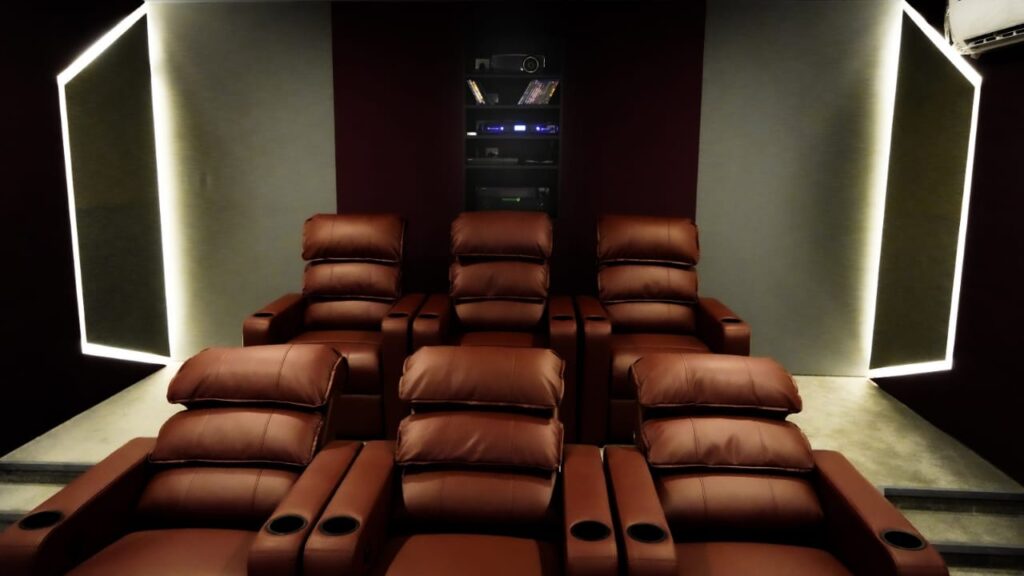
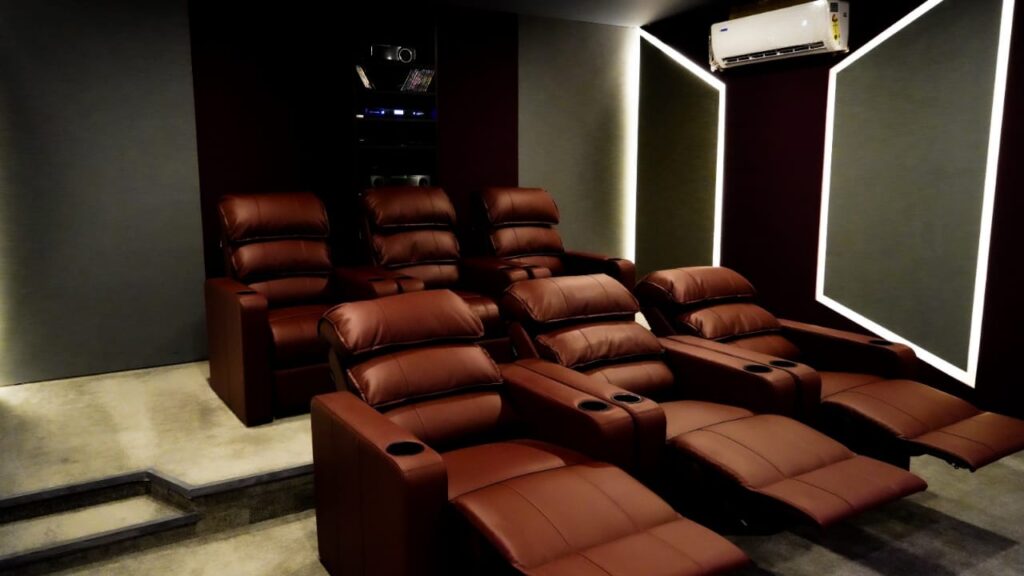
Why Reference Level 105dB Home Cinema is Harder to Reach is a question that barely gets asked — yet it is the most important question any serious home theater buyer should be asking right now.
Most people walk into this journey believing they need the right screen, the right projector, and the right speakers. They spend months researching brands, comparing wattage figures, and building wishlists. Then they finish the room, hit play on their favourite film — and feel vaguely disappointed without quite knowing why.
The room sounds loud. It sounds expensive. But it does not sound like a cinema.
This post explains exactly why that happens, and what separating a genuine reference-level home cinema from a very costly audio system actually requires.
Table of Contents
What Reference Level Actually Means {#what-reference-level-actually-means}
Before anything else, let us establish a clear baseline.
Reference level, as defined by Dolby Laboratories and upheld by THX Ltd., is a specific two-tier acoustic standard — and most buyers only know half of it.
The complete reference level specification is:
- Main speakers (all channels): 105dB SPL peak at the primary listening position
- Subwoofer / LFE channel: 115dB SPL peak at the primary listening position
That 10dB difference between the two figures is not a rounding error. It is a deliberate design standard that reflects how film sound mixers treat low-frequency effects — explosions, impacts, rumbles, seismic events — as a physically separate and dramatically more powerful element of the soundtrack.
Dialogue sits around 85dB in this standard. Full dynamic range is preserved exactly as the mixing engineer intended at those targets.
This is not a volume preference. It is not “loud.” It is an engineering target that governs how films are actually mixed — and unless your room hits and sustains both targets cleanly, you are not hearing what the director approved.
The figures 105dB and 115dB both sound achievable on paper. Many receivers quote 110W per channel. Many speakers claim 93dB sensitivity. Many subwoofers claim 500W of amplification. The math looks comfortable.
It is not. Especially for the subwoofer.
The Common Misconception — and Why It Costs You {#the-common-misconception}
“I have a 7.1.4 Atmos system with good speakers. That should be enough.”
This is the single most expensive misunderstanding in premium home theater.
Reference level is not about having enough speakers or enough watts. It is about a system — room, acoustics, electronics, speakers, and calibration — working together with zero compromise at any point in the chain.
Here is what gets overlooked:
- Peak vs. continuous power: A film’s dynamic range can demand 20dB peaks above its average. That 110W receiver is working at roughly 1,000W equivalent during peak transients — and most consumer electronics cannot sustain that cleanly.
- The subwoofer standard is 115dB — not 105dB: The LFE channel carries a +10dB advantage in the reference spec precisely because bass requires vastly more acoustic energy to reproduce physically. Most residential subwoofers are not engineered to reach and sustain 115dB cleanly in a real room. This is where the system most commonly falls apart.
- Room gain vs. room loss: In a poorly treated room, low-frequency energy accumulates unpredictably. Some seats get too much bass. Some get almost none. Neither is reference level.
- SPL at the seat, not at the speaker: Sensitivity ratings are measured in free-field lab conditions at 1 metre. Your listening seat is 3–5 metres away. Every doubling of distance costs roughly 6dB. The math changes dramatically.
The result: buyers spend ₹25–60 lakhs on components, move into a room that has never been acoustically designed, and wonder why the experience feels unresolved.
What Makes Reference Level 105dB Harder to Reach Than People Think {#what-makes-it-harder}
Why Reference Level 105dB Home Cinema is Harder to Reach comes down to six compounding factors — each one capable of erasing your investment independently.
1. Room Volume and Dimensions
THX certified cinema rooms operate within specific volume envelopes. A room that is too small creates standing wave problems. A room that is too large demands more acoustic power than residential electronics can cleanly deliver.
Indian luxury homes often allocate 300–450 sq ft for a home theater. This is workable — but only if the room is designed for cinema from the slab up, not retrofitted into a spare bedroom.
2. Speaker Sensitivity and True Headroom
Here is where brands like Krix Speakers — purpose-built for cinema environments — earn their position. Krix systems are designed and manufactured to THX standards with sensitivity ratings suited to achieving true reference output without strain.
A speaker that clips or compresses at 95dB cannot be driven to 105dB peaks without audible distortion, regardless of amplifier power. Headroom — the space between a speaker’s comfortable operating range and its absolute maximum — is where real cinema performance lives.
3. Amplifier Quality Under Load
Professional-grade multichannel amplifiers behave very differently from AV receivers when asked to deliver sustained high-output passages. Current delivery, power supply reserves, and thermal management all affect whether your system sounds controlled and dynamic — or compressed and fatiguing — at reference levels.
4. The 115dB Subwoofer Requirement — the Hardest Target in the Entire Spec
If the 105dB speaker target is difficult, the 115dB subwoofer reference target is where most home cinema builds — regardless of budget — quietly fail.
Here is why this number is so demanding:
Low frequencies require exponentially more acoustic energy to reproduce at high levels than mid or high frequencies. A subwoofer delivering clean 115dB peaks at 20–80Hz, sustained across the dynamic range of a modern film mix, needs exceptional driver excursion capability, a very high-headroom amplifier, and an enclosure that does not give up at the worst moment.
Most consumer and even enthusiast-grade subwoofers are rated at a single frequency (typically 80Hz or higher) under ideal conditions. Real cinema bass extends down to 20Hz and below. At those frequencies, achieving 115dB in a residential room without port noise, driver bottoming, or amplifier clipping requires engineering that very few residential products actually deliver.
What actually reaches the 115dB subwoofer standard:
- High-excursion, large-diameter drivers (typically 15″ or 18″ for cinema use) capable of moving significant air at low frequencies
- Amplifiers with genuine peak power reserves — not marketing wattage — often 1,000W or above for a single unit
- Proper subwoofer placement that leverages room gain without creating uneven distribution
- In many cases, multiple subwoofers positioned strategically to smooth out room mode issues and distribute bass energy more evenly across all seats
Krix cinema subwoofers are engineered for exactly this specification—built on the same professional cinema DNA as their main channel speakers, designed to deliver clean 115dB peaks without strain or distortion.
For those who want to experience how true reference-level performance feels in a real environment, you can visit our Krix Home Cinema Experience Center
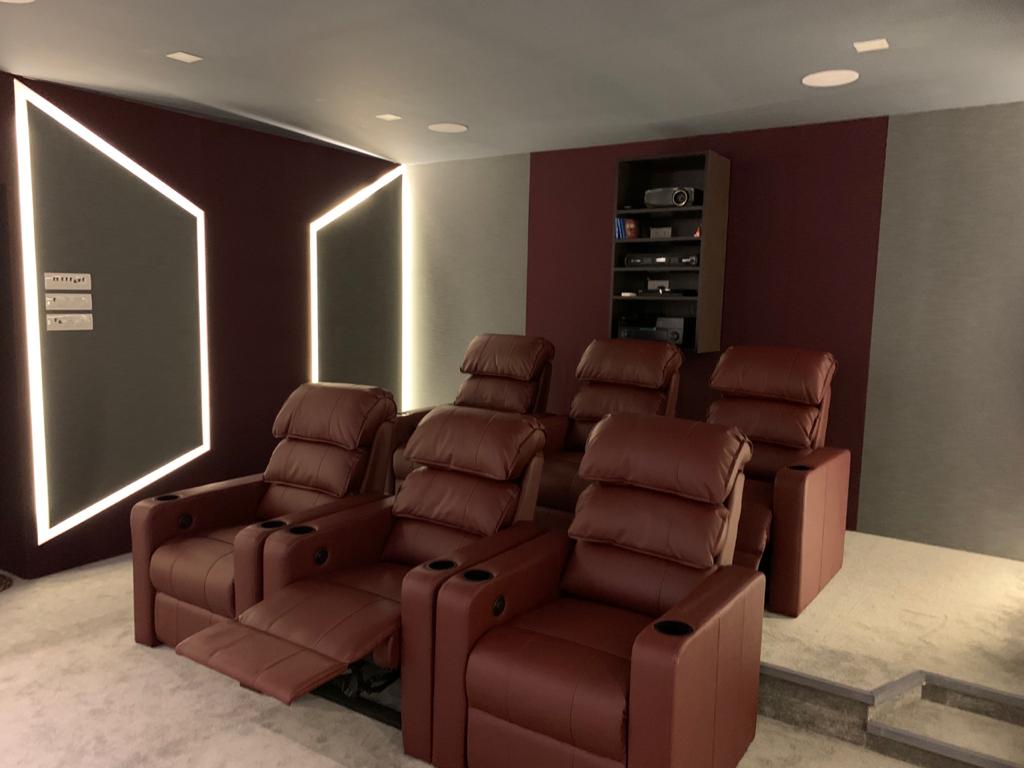
Getting clean, extended bass to 20Hz at reference level in a residential room is arguably the hardest single engineering challenge in home cinema design. Placement, room modes, crossover alignment, phase alignment, and subwoofer quantity all interact in ways that almost always require measurement tools and professional calibration to resolve correctly.
5. Acoustic Treatment and Room Response
An untreated room can easily show ±15–20dB of frequency variation from seat to seat. Reference calibration assumes a relatively flat, controlled acoustic environment as its starting point. Without treatment — absorption panels, bass trapping, diffusion — no amount of DSP correction can fully compensate.
6. Professional Calibration with Measurement Tools
A calibration performed by ear or by a generic auto-EQ system is not reference calibration. True reference level calibration uses precision measurement microphones, full-band RTA analysis, time-domain measurement, and methodical adjustment. It typically takes a full day by itself.
The India Context — Room Reality vs. Showroom Promise {#india-context}
India’s premium home theater market has grown substantially over the past five years. While metros like Mumbai, Bengaluru, Hyderabad, and Chennai lead the trend, cities such as Madurai, Coimbatore, Salem, and Tiruppur are rapidly adopting dedicated home theater spaces in premium residences.
The challenge is that most of these rooms are designed architecturally — not acoustically.
Common mistakes seen in Indian premium home theater builds:
- Parallel walls with no acoustic break, creating flutter echo and comb filtering
- Marble or tiled floors that reflect high-frequency energy directly back to the listener
- HVAC systems with insufficient acoustic isolation, creating noise floor issues that prevent clean dialogue reproduction
- Electrical supply without proper conditioning, introducing ground hum into sensitive electronics
The showroom experience that sold the buyer on a system was almost certainly in a purpose-built demonstration room — treated, calibrated, and tuned over years. Replicating that experience requires bringing those conditions to your home.
Home Theater Design Guide — SMART-Home-Cinema-Reference-Guide.pdf
Expert Perspective: Calibration Is the Real Product {#expert-perspective}
Here is a perspective that rarely appears in product reviews or brand marketing: the most important purchase decision in a reference home cinema is not which speaker you buy — it is who designs and calibrates your system.
Consider two scenarios:
Scenario A: A buyer sources world-class speakers, a high-end AV processor, and premium amplifiers. The room is a converted guest bedroom. No acoustic design is done. The system is calibrated using the receiver’s auto-EQ function. Total spend: ₹40 lakhs.
Scenario B: A buyer invests in purpose-built cinema speakers matched to their room volume, sources appropriately specified electronics, and engages a certified installation specialist to design the room acoustics and perform full reference calibration. Total spend: ₹30 lakhs.
Scenario B will sound measurably and perceptibly better — every time.
This is because system design multiplies the performance of every component inside it. A Krix speaker in a properly designed, acoustically treated, and calibrated room will outperform a more expensive speaker in an untreated room. Physics is not negotiable.
According to the THX certification program, certified installers are trained specifically to bridge the gap between equipment specification and real-world performance. That training is not incidental — it is the product.
The Calibration Process Matters
A proper calibration for a reference-level system covers:
- SPL calibration at the primary and secondary seats — verifying 105dB peaks across all main channels
- Subwoofer SPL verification — confirming the LFE channel reaches and sustains 115dB peaks cleanly without distortion or compression
- Frequency response measurement and correction using professional tools like REW (Room EQ Wizard) across the full 20Hz–20kHz range
- Subwoofer integration and phase alignment — ensuring bass transitions seamlessly from subwoofer to mains at the crossover point
- Delay and time alignment across all channels
- Bass management optimisation including subwoofer placement verification and room mode correction
- Dynamic range verification — confirming the complete system can reach and hold both reference targets simultaneously under real program material
This process cannot be shortcut. And it cannot be done without a certified professional who has done it dozens of times.
Is Pursuing Reference Level Worth It? {#is-it-worth-it}
Honestly — for the right buyer, yes. Unequivocally.
A genuine reference-level home cinema is not simply a loud or impressive room. It is an acoustically accurate one. Films reveal detail — spatial depth, micro-dynamic nuance, low-frequency texture — that simply does not exist in less capable systems. The experience is qualitatively different, not just quantitatively louder.
But the question should be reframed: “Is it worth pursuing reference level without committing to the full system design process?”
The answer to that is no.
Half measures in home cinema are expensive disappointments. A reference-level speaker system in an undesigned room is not a reference-level system — it is a misallocated budget.
If you are planning a serious home theater investment, the decision tree should look like this:
- Start with room design — dimensions, acoustic treatment, isolation
- Specify electronics to the room — sensitivity-matched speakers, appropriately rated amplification
- Engage certified expertise — design, installation, and calibration by specialists
- Invest in components last — the right products for a designed system, not products hoping the system works around them
Conclusion {#conclusion}
Why Reference Level 105dB Home Cinema is Harder to Reach than most buyers expect comes down to a single truth: it is a system achievement, not a product achievement.
And the full reference standard — 105dB for main speakers, 115dB for the subwoofer — is a two-part target that demands every element of your system, your room, and your calibration to be right simultaneously.
The gap between an expensive home theater and a genuinely reference-calibrated one is almost never the brand of speaker on the wall. It is almost always the quality of the design and calibration work that surrounds them — particularly when it comes to achieving clean, sustained 115dB bass that you feel as much as you hear.
The cinema experience that moves you in a THX-certified commercial theater — the physical weight of a film’s soundtrack, the effortless clarity at volume, the sense of space — exists because trained engineers designed and calibrated that room to an exact standard.
Your home deserves the same thinking.
Ready to Plan Yours?
If you are planning a serious home theater, the most valuable conversation you can have is not about which speakers to choose — it is about how to design the room around them.
Talk to a certified installation specialist before you finalise any product decisions. The right sequence matters more than the right brand.
Schedule your exclusive demo experience on WhatsApp: