SMART Home Cinema · Engineering Series
The Architecture of Immersive Audio:
India’s Definitive Technical Guide
From flat surround to a three-dimensional soundstage — everything you need to understand object-based rendering, speaker geometry, and reference-level home cinema design.
Close your eyes in a world-class cinema. A helicopter doesn’t just pan left-to-right — it lifts from behind you, crosses overhead, and dissolves into rain falling from every direction. That spatial precision, that sense of physical presence, is what immersive audio engineers. And for the first time in history, it is reproducible inside your home.
This guide draws from the CEDIA/CTA-RP22 engineering standards — the global benchmark for reference home cinema design — to explain immersive audio from first principles. Whether you are planning a dedicated screening room in Mumbai, a media lounge in Bengaluru, or a multi-purpose home theater in Chennai, these are the technical foundations that separate a satisfying system from a transcendent one.
“The goal of immersive audio is not to impress — it is to disappear. The moment you notice the speakers, the illusion has failed.”
Section 01What Is Immersive Audio — and Why Does It Matter?
Conventional surround sound — the 5.1 and 7.1 configurations that defined home theater for two decades — operates on a single horizontal plane. Speakers circle the listener at ear level, creating a convincing panorama in the X and Y axes. But the real world is not flat. Rain falls downward. Helicopters ascend. Thunder rolls through the atmosphere above you.
Immersive audio introduces the Z-axis: height. By adding speakers elevated on walls and mounted overhead on the ceiling, modern systems construct a true spherical soundstage. The listener is no longer surrounded — they are enveloped.
Formally defined by CEDIA standards, immersive audio is engineered to faithfully deliver the artistic intent of content creators, placing the listener physically inside an artificial environment. The two principal commercial formats — Dolby Atmos and DTS:X — have been adopted by virtually every major streaming platform, Blu-ray release, and Hollywood studio. Today, if you are watching premium content without a capable system, you are hearing a fraction of what the filmmaker intended.
Section 02Decoding the Nomenclature: What Does 7.4.4 Actually Mean?
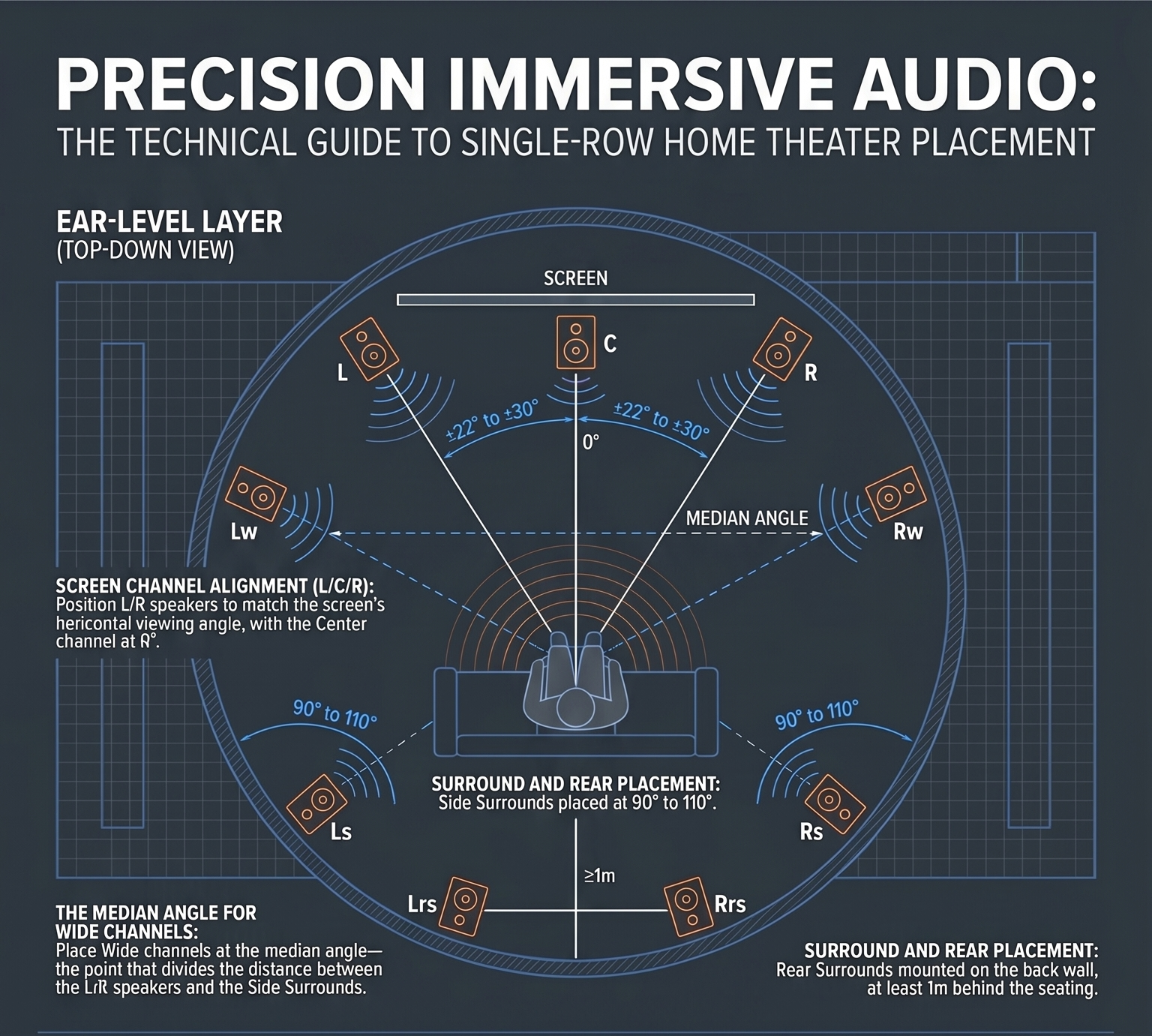
Walk into any high-end AV showroom in India and you will encounter configurations like 9.4.4, 7.1.6, or 13.4.8. This three-digit notation is not marketing shorthand — it is a precise engineering specification defined by CEDIA/CTA-RP22.
Key Insight
A 7.4.4 system has seven listener-level speakers, four subwoofers, and four upper-layer speakers — 15 physical drivers total. The subwoofer count exceeding “.1” reflects multiple units driven from a single LFE channel for room acoustic optimization, not separate channels. This distinction matters enormously when specifying a processor.
Section 03Channel-Based vs. Object-Based Audio: The Paradigm Shift
Understanding the difference between these two rendering philosophies is the single most important technical concept for any serious home cinema enthusiast. It determines why reference-grade processors cost what they do — and why the gap in performance is not merely incremental but architectural.
| Dimension | Channel-Based Audio | Object-Based Audio |
|---|---|---|
| Core concept | Sounds locked to fixed speaker positions | Sounds defined as 3D coordinates in metadata |
| Scalability | Degrades if your layout doesn’t match | Scales 6–34 speakers |
| Spatial precision | Fixed to predefined zones | Continuous — any location in 3D space |
| Missing speakers | Information lost or poorly imaged | Renderer redistributes to adjacent speakers |
| Artistic intent | Approximated | Faithfully reproduced |
| Examples | PCM 5.1, DTS-HD MA 7.1 | Dolby Atmos, DTS:X, Auro-3D |
With a channel-based mix, the engineer makes a decision: “this sound goes to the left surround speaker.” If your room has no left surround speaker, or if it is in a different position than the reference, the image suffers. With object-based audio, the engineer says: “this sound exists at coordinate (–0.6, 0.3, 0.8) in 3D space.” The processor then calculates mathematically — in real time — how your specific arrangement of speakers should reproduce that position.
This is why a high-end Trinnov Altitude or StormAudio ISP processor — which performs this computation with acoustic calibration data of your actual room and speaker positions — produces a fundamentally superior spatial image compared to a mass-market AV receiver attempting the same algorithm without that precision data.
Want to hear the difference firsthand? SMART Home Cinema’s Krix Experience Center in Tamil Nadu is one of the few rooms in India where you can audition object-based rendering against channel-based on properly engineered hardware. Book a private demonstration →
Section 04Beds & Active Objects: Anatomy of a Modern Soundtrack
Every Dolby Atmos or DTS:X soundtrack is a hybrid composition of two distinct audio element types. Understanding this architecture explains why some speakers in your system may remain silent during certain content — and why that is perfectly intentional.
Why Do Some Speakers Go Silent?
This is among the most common questions from enthusiasts who invest in elaborate speaker configurations and then notice certain channels remaining dormant. The answer is straightforward once you understand rendering:
Native content vs. upmixing: A music recording mastered in 7.1.4 channel-based audio will leave your “Wide” or “Top Middle” speakers silent because no data was authored for those positions. Those speakers will activate only if you engage an upmixer (like Dolby Surround or DTS Neural:X) to synthesize content for them — or if the source material is object-based and the mix actually places elements in those zones.
This is also why more speakers improve the system even when they’re not always active. When objects are authored at positions between your physical speakers, a 13-channel system resolves them with greater precision than a 9-channel system — smoother panning, more accurate phantom imaging, higher spatial resolution.
Section 05The CEDIA RP22 Performance Levels: Where Does Your System Stand?
CEDIA’s RP22 standard defines four performance levels for immersive audio rooms. These are not marketing tiers — they are engineering benchmarks that define minimum speaker counts, SPL targets, acoustic treatment requirements, and rendering specifications. In India’s rapidly growing luxury AV market, understanding these levels separates an informed buyer from one who pays reference prices for a mid-tier outcome.
Section 06Engineering a Reference System: The Hardware Imperative
Object-based audio’s promise — that the same soundtrack reproduces faithfully across any speaker configuration — is only as good as the hardware executing the math. Three component categories determine whether your system merely plays immersive audio or renders it at reference quality.
The Object Audio Renderer (OAR)
The processor is the brain of an immersive system. Consumer AV receivers use simplified rendering engines, often approximating object positions with pre-programmed panning tables. Reference-grade processors like the Trinnov Altitude series and StormAudio ISP Elite perform continuous, room-aware spatial computation — factoring in your exact speaker positions measured by a calibration microphone to render objects to within centimetres of their authored coordinates.
Acoustic Output: SPL, Bandwidth, and Timbre Matching
A spatially perfect rendering collapses if the speakers themselves color the sound differently across channels. Reference immersive systems require every speaker — from the front left to the top centre overhead — to be timbre-matched: identical tonal character so that a sound moving from one to another is perceived as continuous motion, not a series of discrete relays.
Brands achieving this at the performance level required for RP22 Level 3–4 rooms include:
Visual-Acoustic Alignment
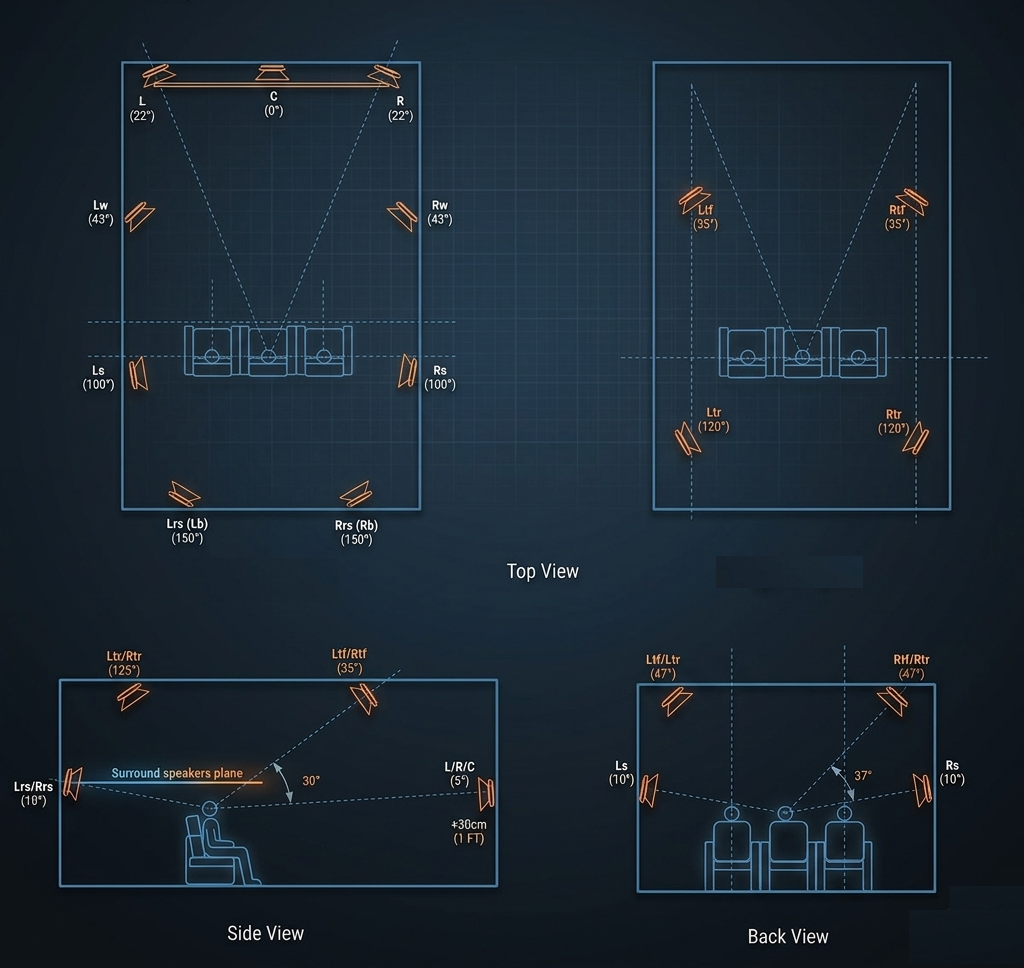
A consideration often overlooked in India’s home cinema market: screen size directly governs the placement of your front speaker array. The Left, Centre, and Right channels must be positioned so dialogue and on-screen effects emanate precisely from their visual source. Projection systems — particularly Sony and JVC laser projectors at 4K resolution — enable screen sizes large enough to match the angular relationships that professional mixing engineers design to. A 65-inch flat panel with a 9.4.4 speaker layout is, acoustically speaking, a mismatch.
India Market Note
India’s premium home cinema segment is expanding rapidly in Tier 1 cities and select Tier 2 markets. Increasingly, discerning buyers in Hyderabad, Pune, and Chennai are specifying Performance Level 3–4 systems rather than traditional “surround sound upgrades.” The investment in a reference-level room is not incremental over a high-end consumer setup — it is a categorically different product, requiring design from acoustic first principles.
Section 07Key Questions Before You Specify Your System
For buyers considering a serious investment in immersive audio, the specification process should begin well before any hardware is selected. These are the decisions that cascade into every downstream component choice:
Room dimensions and architecture. The ratio of room length, width, and height governs your practical speaker count and placement geometry. A room under 25 m² cannot physically accommodate the speaker spacing required for Performance Level 4 without acoustic compromises. This is not a limitation of budget — it is physics.
Primary content type. Cinematic content (Blu-ray, 4K UHD, streaming) is authored with object-based mixes optimized for large speaker arrays. Music content — even on Atmos Music platforms like Apple Music Spatial Audio — uses a more conservative height object deployment. A system optimized purely for cinema may deliver a different musical experience than one tuned for a hybrid cinema-music room.
Acoustic treatment vs. acoustic design. Treatment (panels, diffusers, bass traps) addresses a room that already exists. Acoustic design shapes the room during construction or renovation to eliminate problems before they exist. Reference-level rooms require the latter. If you are at the planning stage, this is where the highest-ROI decisions are made.
Integration with the rest of the home. In India’s residential market, custom home cinemas increasingly coexist with smart home ecosystems — Crestron, Control4, and Lutron integrations that govern lighting scenes, HVAC quiet modes, and motorized seating. Specifying these at the AV design stage eliminates costly retrofits.
Experience Center · Tamil Nadu
Hear What a Properly Engineered Immersive Room Actually Sounds Like
Theory only goes so far. At the SMART Home Cinema Experience Center in Tamil Nadu, Levels 1 and 2 of the RP22 standard are fully realised — giving you a calibrated, honest benchmark to hear immersive audio done right before specifying your own system.
Book a Private Demonstration Download Our Design GuideNo sales pressure. Serious enthusiasts and architects welcome. · Chennai · Madurai · Coimbatore · Bengaluru · Hyderabad · Across South India & Pan-India projects.
Frequently Asked Questions
What is immersive audio in a home theater?
Immersive audio is a 3D sound technology that places speakers not only around you at ear level but also elevated on walls and overhead on the ceiling, creating a true spherical soundstage. Unlike traditional surround sound, it uses object-based rendering (Dolby Atmos or DTS:X) to position individual sounds anywhere in three-dimensional space — making you feel physically present inside the scene rather than seated in front of it.
What is the difference between 7.1 and 7.1.4 surround sound?
A 7.1 system uses seven listener-level speakers plus one subwoofer on a flat horizontal plane. A 7.1.4 system adds four independent overhead or height speakers, delivering a true three-dimensional sound field. The third number in any speaker configuration always refers to upper-layer (height or ceiling) channels. This addition is what moves a system from surround sound into immersive audio territory.
What is object-based audio and why is it better than channel-based?
Channel-based audio locks each sound to a fixed speaker position; if your layout doesn’t exactly match the mix, the image degrades. Object-based audio (Dolby Atmos, DTS:X) assigns 3D spatial coordinates to each sound element as metadata. A high-performance processor like a Trinnov Altitude then mathematically calculates how your specific speaker arrangement should reproduce that position — in real time — preserving the sound designer’s exact artistic intent regardless of how many speakers you have.
How many speakers do I need for immersive audio?
A minimum of 9 speakers (7.1.2) is recommended to begin experiencing immersive audio meaningfully. For reference-level performance matching CEDIA RP22 Performance Level 3 or 4 standards, systems typically range from 9.4.4 to 13.4.6 or beyond, with multiple subwoofers for flat bass response and independent overhead speakers for maximum spatial resolution. The right count for your room is determined by room geometry, not budget alone.
Is Dolby Atmos worth it for a home theater in India?
Yes — the vast majority of premium Blu-ray, 4K UHD, and OTT content on Netflix, Amazon Prime Video, and Apple TV+ is now mastered in Dolby Atmos. In India, where streaming consumption of premium content is among the fastest growing globally, investing in a properly engineered Atmos system ensures you are experiencing content as the filmmaker intended. A well-designed Atmos room is not a luxury — it is the technically correct playback environment for modern content.
What do Trinnov and StormAudio do that a normal AV receiver cannot?
Consumer AV receivers use simplified, fixed rendering algorithms to approximate object positions. Processors like the Trinnov Altitude and StormAudio ISP Elite perform continuous, room-aware spatial computation using acoustic measurements of your actual room — speaker positions, distances, and room impulse responses — to render 3D objects with centimetre-level precision. They also handle significantly more simultaneous object tracks and apply time-domain correction that consumer receivers cannot execute at sufficient resolution. The difference is audible and measurable.
Where can I experience a reference-level immersive audio system in India?
SMART Home Cinema operates a dedicated immersive audio experience center in Tamil Nadu, engineered to CEDIA RP22 Level 1 and Level 2 standards — giving visitors a properly calibrated environment to hear immersive audio as it is designed to be heard. It is one of the few facilities in India where you can experience object-based rendering on correctly specified hardware before committing to your own installation. Private demonstrations are available by appointment at no cost.