Table of Contents
Home Cinema Speaker Placement Guide
Introduction
Designing a high-performance home cinema is not about adding more speakers—it is about placing them correctly. Even premium speakers will underperform if placement, angles, and alignment are not executed with precision.
Designing a high-performance home theater that does justice to immersive audio formats like Dolby Atmos®, DTS:X® Pro, and Auro-3D® requires more than just buying high-quality gear; it requires a strategic approach to speaker placement. While these technologies all have different requirements for locating speakers beyond a standard 7.1 setup, following a logical set of rules can help reconcile these differences for an optimal experience
This guide focuses specifically on small theaters with a single row of listeners, which represents the most critical and performance-sensitive segment in private home cinema design. The goal is to achieve reference-level imaging, tonal balance, and spatial accuracy using scientifically grounded placement principles.
1.Defining the Reference Seating Position (RSP) or Main Listening Position (MLP)
Before placing any speaker, establish the RSP—typically the center seat in the single row.
All speaker placement, angles, delays, and calibration decisions must be referenced to this point.
Key Principle:
- If the RSP is wrong, the entire system alignment will be compromised.
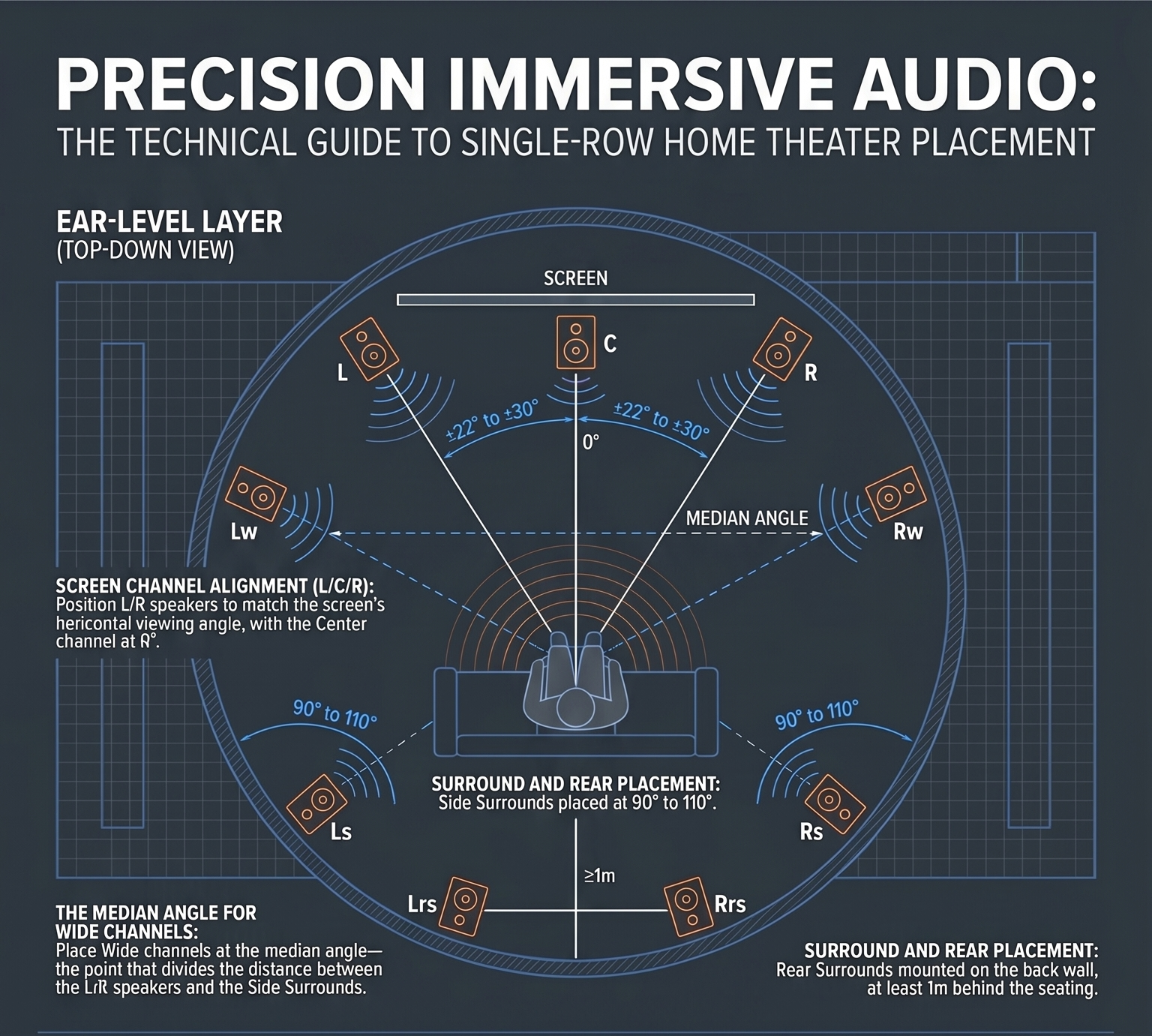
2. Front Stage Speaker Placement (LCR)
The front stage is responsible for dialogue clarity, imaging, and screen anchoring.
2.1 Left and Right Speakers
- Horizontal angle from LRP: ±22° to ±30°
- Height: Tweeter aligned with ear height at RSP
- Orientation: Directly aimed at the listener (toe-in required)
Why this matters: Proper angular separation ensures accurate stereo imaging and seamless panning across the screen
2.2 Center Channel
- Position: Exactly at 0° (center of screen)
- Height: Ideally same acoustic height as L/R tweeters
- If placed below screen: apply upward tilt toward ear level
Critical Note: The center channel must not be treated as secondary—it carries the majority of dialogue and must match tonal characteristics of L/R.
2.3 Acoustically Transparent (AT) Screen Advantage
For best results:
- Place LCR speakers behind an acoustically transparent screen
- Maintain identical height and alignment across all three speakers
This creates a true cinematic experience where sound originates from the screen itself
3. Subwoofer Placement (Low Frequency System)
Low frequencies are highly affected by room modes, making placement critical.
3.1 Recommended Configuration
- Minimum: 2 subwoofers
- Ideal placement for small rooms:
- Front wall (symmetrical)
- Midpoints of opposing walls (if feasible)
3.2 Key Objective
- Achieve uniform bass response at RSP
- Minimize peaks and nulls caused by room interaction
Important: Subwoofer placement must be validated through measurement (REW or equivalent)—visual symmetry alone is not sufficient.
4. Surround Speaker Placement (Side Surrounds)
Surround speakers create envelopment and spatial immersion.
4.1 Placement Guidelines
- Angle from RSP: 90° to 110°
- Height: Ear level to +20 cm (slightly above ear height)
- Orientation: Direct or slightly diffused depending on speaker design
4.2 Distance Consideration
- Maintain equal distance from RSP where possible
- Avoid placing too close to listeners to prevent localization
Key Insight: In a single-row theater, side surrounds must balance localization vs envelopment—too direct feels distracting, too diffuse reduces immersion.
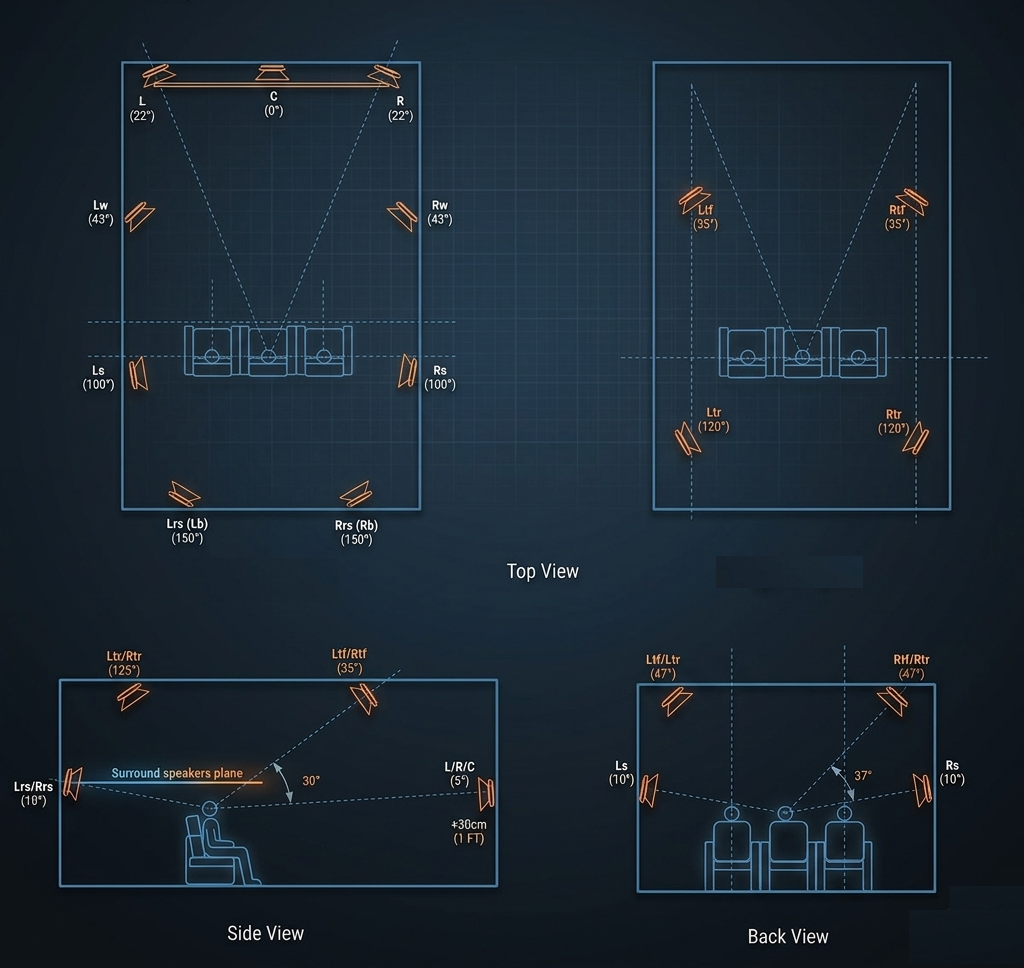
5. Overhead / Height Speaker Placement (Atmos Layer)
Height speakers add the third dimension (vertical immersion).
5.1 Configuration (Recommended)
- Minimum: 2 (Top Middle)
- Preferred: 4 (Top Front + Top Rear)
5.2 Placement Angles
- Top Front: 30° to 55° in front of RSP
- Top Rear: 30° to 55° behind RSP
5.3 Alignment
- Maintain symmetry across left and right channels
- Ensure equal distance from RSP for time alignment accuracy
Important: Height speakers must not be placed randomly on the ceiling—incorrect placement destroys spatial accuracy.
6. Speaker Distance, Delay & Time Alignment
Physical placement alone is not enough. All speakers must be:
- Distance matched to RSP
- Delay aligned using processor/DSP
- Phase coherent with subwoofers
Outcome:
- Accurate arrival time
- Precise imaging
- Cohesive sound field
7. Acoustic Considerations (Non-Negotiable)
Speaker placement works only when supported by proper acoustics.
7.1 First Reflection Points
- Treat side walls and ceiling reflection points
- Prevent comb filtering and imaging blur
7.2 Bass Control
- Use bass traps to manage low-frequency decay
- Target controlled RT60 values
7.3 Front Wall Treatment
- Absorptive or baffle wall design improves:
- Clarity
- Low-frequency integration7.3 Front Wall Treatment
7.4 Why Most Indian Home Theater Rooms Struggle with Acoustics
Acoustic treatment is often misunderstood and incorrectly implemented in many home theaters. In fact, improper treatment can degrade performance by over-absorbing critical frequencies or ignoring low-frequency behavior. If you want a deeper technical understanding of why this happens, read our detailed analysis on why most treated rooms fail to deliver accurate sound reproduction:
https://smartcinemas.in/blog/why-most-home-theater-rooms-sound-worse-after-treatment/
8. Common Mistakes to Avoid
- Placing speakers based on room convenience instead of angles
- Ignoring ear height alignment
- Using a single subwoofer in a critical listening room
- Incorrect surround height (too high or too low)
- Random Atmos placement without angular reference
- Skipping measurement and calibration
9. Final Calibration (Critical Step)
After placement:
- Perform acoustic measurements (REW, etc.)
- Adjust crossover, delay, and EQ
- Validate frequency response and time alignment
Result: A system that is not just installed—but engineered and verified.
Conclusion
In a small home theater with a single row, precision matters more than scale. Proper speaker placement ensures that every seat—especially the reference seat—delivers a balanced, immersive, and accurate cinematic experience.
This is the difference between:
- A room with speakers
- And a reference-level home cinema
FAQ
What is the most important reference point for speaker placement in a home theater?
The Reference Seating Position (RSP)—typically the center seat in a single-row theater—is the most critical factor. All speaker angles, distances, delays, and calibration must be aligned to this point to achieve accurate imaging and tonal balance.
Why are speaker angles more important than room symmetry?
Room symmetry alone does not guarantee correct sound reproduction. Angular placement relative to the LRP (e.g., ±22°–30° for L/R, 90°–110° for surrounds) ensures proper sound staging, imaging, and panning accuracy, which are essential for a reference-level experience.
Can I achieve good bass performance with a single subwoofer?
In most rooms, a single subwoofer leads to uneven bass response with peaks and nulls. Using at least two subwoofers, properly placed and calibrated, helps achieve consistent low-frequency performance at the listening position
How high should surround speakers be in a single-row home theater?
Surround speakers should be placed at ear level or slightly above (up to ~20 cm). Placing them too high reduces envelopment and creates a disconnected sound field, especially in a single-row setup
What is the biggest mistake in Dolby Atmos speaker placement?
The most common mistake is random ceiling placement without angular reference. Height speakers must follow defined angles (typically 30°–55° from the listener) to create accurate vertical imaging and proper 3D sound movement.
Is speaker placement enough, or is calibration also required?
Speaker placement is only the first step. A true home cinema requires measurement-driven calibration, including:
Distance and delay alignment
Crossover optimization
Frequency response correction
Without calibration, even correctly placed speakers will not perform at their full potential.
What happens if surround speakers are placed too close to the listener?
If placed too close, surround speakers become localized, breaking immersion. Proper distance and level calibration are required to maintain an enveloping sound field
How important is toe-in for front speakers?
Toe-in is critical for achieving accurate imaging and high-frequency clarity. Speakers should typically be aimed directly at the Listening Reference Point for optimal performance.
Should front speakers be placed behind an acoustically transparent screen?
Yes, placing LCR speakers behind an acoustically transparent screen ensures proper alignment with on-screen visuals, creating a more realistic and immersive cinematic experience.