Why RT60 Matters: Real Home Theater Acoustic Treatment Case Study (300–500ms) is something most home theater buyers completely overlook.
In India, the focus is usually on speakers, amplifiers, and brands. But the real difference between an average system and a reference-level experience comes down to one critical factor—RT60 (decay time).
In this real project, we didn’t rely on guesswork. We measured, treated, and optimized the room to achieve full-band RT60 between 300ms and 500ms, which aligns with global best practices.
Table of Contents
The Common Problem in Indian Home Theaters
Most home theaters in India suffer from the same issue:
👉 No proper acoustic design
Typical outcomes:
- Echo-heavy rooms or Dead Room
- Boomy, uncontrolled bass
- Poor dialogue clarity
- Listener fatigue
Even expensive systems fail to deliver because the room is not designed for sound.
Why RT60 Matters: Real Home Theater Case Study (300–500ms)
RT60 refers to the time it takes for sound to decay by 60 dB in a room.
In simple terms:
- High RT60 → sound lingers → muddy audio
- Low RT60 → controlled decay → clarity & precision
For home theaters, the ideal range is:
👉 300ms to 500ms across frequencies
This is exactly what we targeted—and achieved—in this project.
Before vs After: Measured Performance (Real Data)
Before Acoustic Treatment:
- Average RT60: ~644ms
- Significant ringing in low frequencies
- Uneven decay across spectrum
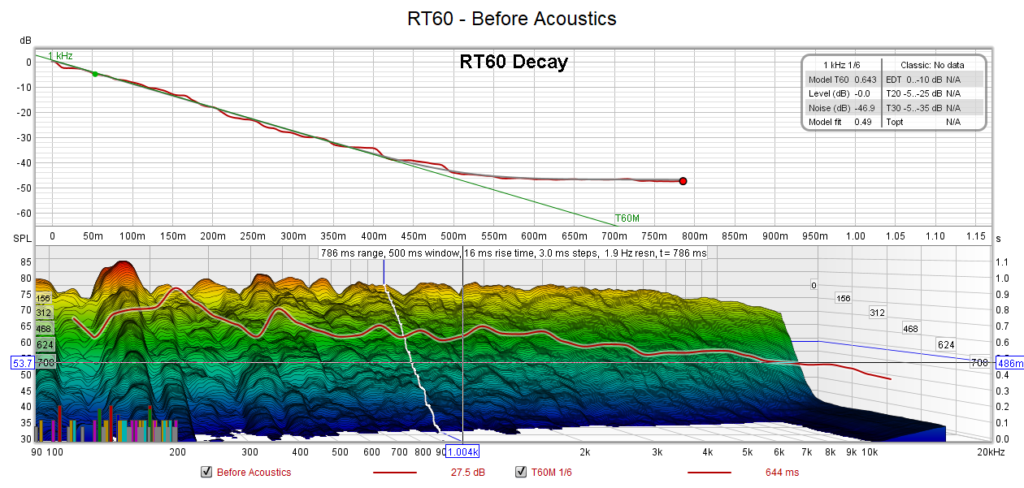
RT60 – Before Acoustic Treatement Measurement using REW (Room Eq Wizard)
After Acoustic Treatment:
- RT60 reduced to: ~300–350ms
- Achieved full-band control within 300–500ms
- Much smoother decay curve

RT60 – After Acoustic Treatment Measurement using REW (Room Eq Wizard)
What changed in real listening?
- Dialogue became clear and focused
- Bass became tight and controlled
- Surround effects felt precise and immersive
- Listening fatigue reduced significantly
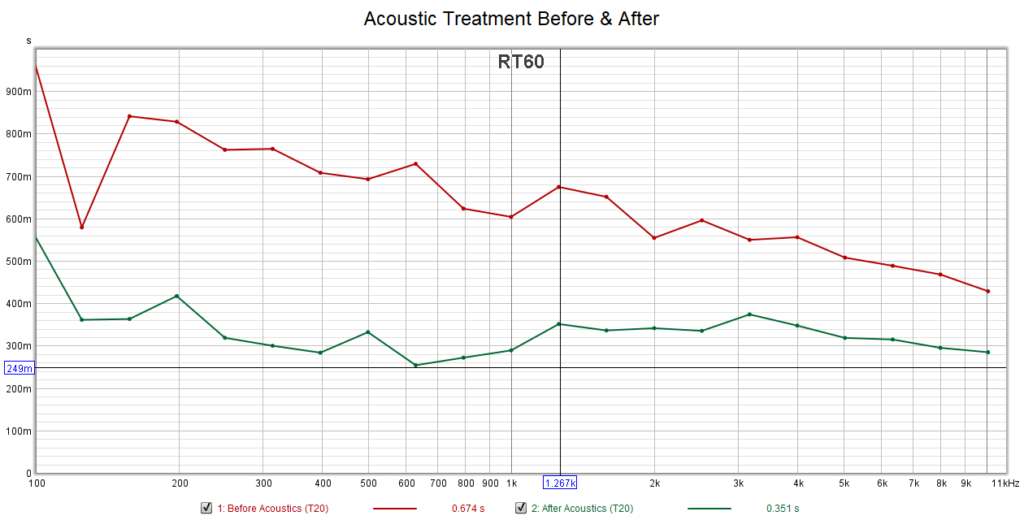
RT60 Before vs After Acoustic Treatment Graph Comparison
What We Did Differently
In many Indian home theaters, a common approach is using multi-layer acoustic treatments (3-layer, 6-layer panels). While this may reduce reflections, it often leads to an over-damped or “dead” room, where the sound loses its natural energy and spatial depth. Checkout here Home Theater Acoustic Design: Why “Pretty” Home Cinemas Often Fail for More details
Instead of over-treating the room, we followed a balanced acoustic strategy.
Absorbers
- Controlled early reflections
- Improved mid and high frequency clarity
🔹 Bass Traps
- Reduced low-frequency buildup
- Controlled room modes
🔹 3D Diffusers (GreatSound Panels)
- Maintained natural ambience
- Prevented “dead room” effect
👉 The goal was not to kill sound—but to shape it intelligently.
Clarity Improvement
Clarity is where the difference becomes obvious.
Measured Results:
- Before: ~5.7 dB
- After: ~11 dB
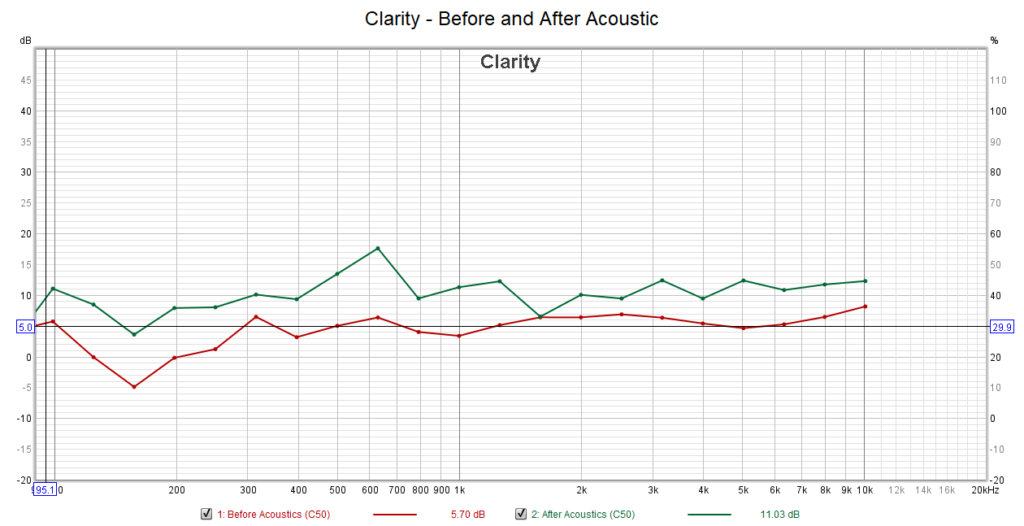
Clarity – Before vs After Acoustic Treatment Graph Comparison
What this means:
- Dialogue intelligibility improved drastically
- Fine details became audible
- Better separation between sound elements
This is the difference between hearing sound and understanding it clearly.
Expert Perspective
Professionally designed theaters focus on measurable parameters:
Key benchmarks:
- RT60: 250–500ms
- Balanced frequency decay
- Controlled reflections
- Consistent performance across seats
Is This Level of Performance Necessary?
✔ Yes, if:
- You want a true cinematic experience
- You value clarity and immersion
- You are investing in a premium system
❌ No, if:
- You are fine with basic sound
- You prioritize aesthetics over performance
Conclusion
Why RT60 Matters: Real Home Theater Case Study (300–500ms) clearly shows one thing:
👉 Great sound is not about equipment—it’s about engineering the room.
This project proves that with the right acoustic strategy:
- Performance improves dramatically
- Systems reach their true potential
- The experience becomes cinematic, not just loud
Frequently Asked Questions (FAQ)
What is RT60 and why is it important in a home theater?
RT60 is the time it takes for sound to decay by 60 dB in a room. It directly impacts clarity, dialogue intelligibility, and overall listening comfort. A well-controlled RT60 ensures the sound is precise rather than echoey or muddy.
What is the ideal RT60 for a home theater?
For most home theaters, the ideal RT60 range is between 250ms and 500ms across frequencies. This range provides a balance between clarity and natural ambience, similar to professional cinema environments.
How did RT60 improve in this real home theater case study (300–500ms)?
In this project, RT60 was reduced from approximately 644ms to around 300–350ms using a combination of absorbers, bass traps, and diffusers from GreatSound Acoustic. This resulted in tighter bass, clearer dialogue, and a more immersive experience
Why do many home theaters in India sound “dead” after acoustic treatment?
Many setups use heavy multi-layer acoustic panels (3-layer or 6-layer designs), which over-absorb sound. This removes natural reflections, making the room feel dull and lifeless instead of balanced and immersive
What is the difference between absorption and diffusion in acoustics?
Absorption reduces unwanted reflections and controls echo, while diffusion scatters sound evenly to maintain a natural sense of space. A proper home theater uses both to achieve balanced acoustics without over-damping the room.
How does acoustic treatment affect dialogue clarity (C50)?
Acoustic treatment improves clarity by reducing reflections and controlling decay. In this case study, clarity (C50) improved from ~5.7 dB to ~11 dB, making speech more intelligible and enhancing overall detail in the audio.

Leave a Reply