Author: sales.smartcinemas

  • The Hidden Problem with Speaker Sensitivity Ratings: Why SPL Calculations Go Wrong?

    The Hidden Problem with Speaker Sensitivity Ratings: Why SPL Calculations Go Wrong?

    Speaker Sensitivity SPL Calculation: The Hidden 5 dB Error
    SMART Home Cinema ยท Engineering Series

    One loudspeaker. Two published numbers. Three decibels apart. Only one of them belongs in a design calculation โ€” and choosing wrong costs you eight times the amplifier.

    CEDIA/CTA-RP22 & ANSI/CTA-2034 Referenced

    Every speaker sensitivity SPL calculation starts with one number copied from a specification sheet. If that number is the wrong kind of number, everything downstream is wrong โ€” the amplifier size, the headroom, and the moment the system runs out of both.

    Most specification sheets print a single sensitivity figure and never say what kind it is. A small number of manufacturers print two figures for the same loudspeaker, three decibels apart. Only one of the two belongs in a calculation.

    Three decibels sounds like a rounding error. In amplifier terms it is exactly double.

    What does speaker sensitivity actually mean?

    Speaker sensitivity is how much sound pressure a loudspeaker produces at one metre when a defined electrical input is applied. It is written as a decibel value with two conditions attached โ€” the input and the distance. For example: 90 dB (2.83 V / 1 m).

    The international measurement standard, IEC 60268-5, defines it more strictly than the market does. Three of its requirements almost never survive into a consumer specification sheet:

    • Sensitivity is defined within a stated frequency band. The band must be declared. A figure averaged across a broad band is not the same figure as a single reading at one frequency.
    • It is measured in free-field or half-space free-field conditions. Free field means an anechoic environment, where sound pressure falls with distance according to the inverse square law. Half space means the loudspeaker is flush with a large reflecting surface โ€” a baffle wall, for example.
    • Measurement uncertainty must be declared. The standard requires the frequency range over which total measurement error stays within ยฑ2 dB to be stated alongside the result.

    The standard also requires the mounting condition to be described with the results. Free-standing, on a standard baffle, or flush in a reflecting plane โ€” each produces a different number from the same loudspeaker.

    A sensitivity figure quoted without its measurement conditions is not a specification. It is a number.

    Why does one loudspeaker have two different sensitivity numbers?

    Because a room adds output the loudspeaker did not produce, and a handful of manufacturers are transparent enough to report both figures.

    Paradigm is one of them. Their Founder 120H is published at 95 dB in-room and 92 dB anechoic. The same 3 dB gap appears across their range and across product generations โ€” 91/88, 92/89, 89/86. Both figures printed, both labelled, nothing hidden.

    That consistency is itself informative. An identical 3 dB gap across separate product families is not a series of individual room measurements. It is a house assumption applied to the anechoic result โ€” reasonable engineering shorthand, and unusable as a design input for your room.

    Manufacturers are candid about how large the gap can get. Dynaudio’s published engineering explainer states that in-room sensitivity ratings can be up to six decibels above an anechoic measurement, and that measurements must be carried out uniformly to be comparable at all.

    3 dB
    Typical published gap between in-room and anechoic
    6 dB
    Upper end of the gap, per manufacturer statement
    Amplifier power hidden by every 3 dB

    So a buyer comparing a 95 dB loudspeaker against a 92 dB loudspeaker may be comparing the same loudspeaker.

    Which sensitivity number should an SPL calculation use?

    The anechoic figure. Always. This is not a preference โ€” it is what the design standards specify.

    CEDIA/CTA-RP22, the immersive audio design recommended practice, is the only objective performance framework the industry has. Where it defines how to predict sound pressure level at a seat, its wording is explicit: the maximum predicted SPL difference is calculated using anechoic propagation loss.

    RP22 in turn depends normatively on ANSI/CTA-2034, the standard method of measurement for in-home loudspeakers. That standard contains a section titled Estimating In-Room Response from Anechoic Data, and an appendix for calculating maximum usable SPL in a non-anechoic environment.

    Read those two facts together and the logic is settled. The standards treat anechoic as the measured input and in-room as the derived output. A manufacturer publishing only an in-room number has published somebody’s answer and withheld the question.

    What about room gain โ€” isn’t it real?

    It is entirely real. It is also a property of the room, not of the loudspeaker โ€” frequency-dependent, position-dependent, and strongest below the room’s transition frequency, which RP22 places between roughly 150 Hz and 500 Hz in small rooms. Below that point the room dominates through boundary loading and modes. Above it, what reaches the seat is governed mainly by the loudspeaker’s own on-axis and off-axis behaviour.

    Reflected energy still adds level across the whole band. It simply adds a different amount in every room, at every seat, at every frequency. That is exactly why the two belong in separate columns. Anechoic sensitivity is a property you can carry from one project to the next. Room gain has to be measured in the room it belongs to.

    One objection worth answering

    In a real room the measured loss with distance is less than 6 dB per doubling, because reflected energy fills in behind the direct sound. That is true, and it is precisely why RP22 specifies anechoic propagation loss. Designing to the free-field figure produces a prediction that is conservative, repeatable, and comparable between two different rooms and two different designers.

    Whatever the room gives back is margin. It is not budget.

    Most systems that disappoint were not built with the wrong equipment. They were built from the right equipment and the wrong number โ€” and the shortfall only appears when the soundtrack demands everything at once.

    Have your specification checked before you commit →

    How much amplifier power does each 3 dB actually cost?

    Exactly double. Every time. This is the part of the arithmetic that surprises people, so it is worth seeing laid out.

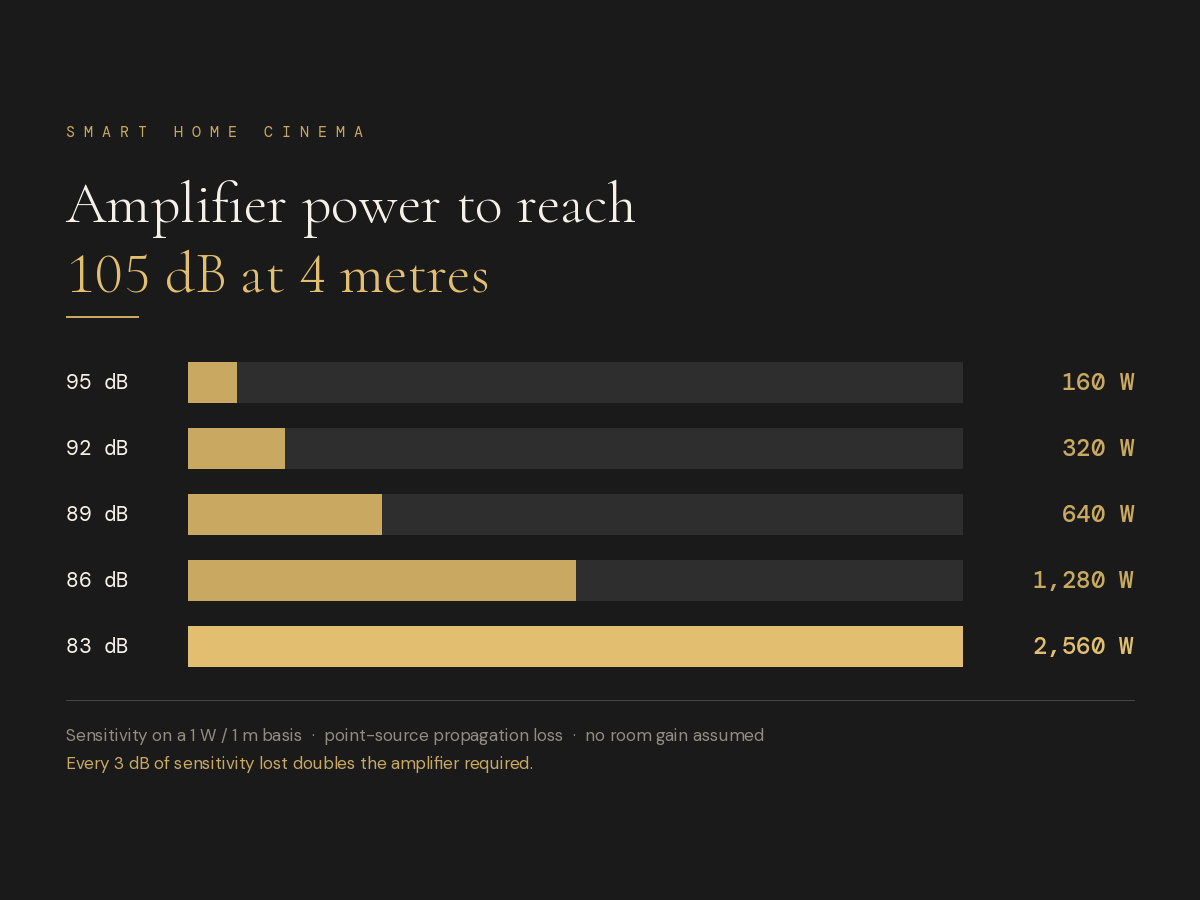
    Take a realistic dedicated room. Target 105 dB peak at the reference seating position โ€” Dolby’s reference alignment for a main channel. Seating distance from the screen wall: 4 metres, typical of a dedicated room in a South Indian villa.

    A point-source loudspeaker loses 6 dB for every doubling of distance. From 1 metre to 4 metres that is 12 dB. So the loudspeaker must produce 105 + 12 = 117 dB at one metre.

    Here is what that requires, across the sensitivity range you will actually encounter on spec sheets:

    Amplifier power to reach 105 dB at 4 metres
    95 dB
    160 W
    92 dB
    320 W
    89 dB
    640 W
    86 dB
    1,280 W
    83 dB
    2,560 W
    Sensitivity stated on a 1 W / 1 m basis. Point-source propagation loss, no room gain assumed. Twelve decibels of sensitivity is sixteen times the amplifier.
    Sensitivity (1 W / 1 m) Required at 1 m Amplifier power Relative to 95 dB
    95 dB117 dB160 W
    92 dB117 dB320 W
    89 dB117 dB640 W
    86 dB117 dB1,280 W
    83 dB117 dB2,560 W16×
    Calculated for 105 dB peak at 4 metres. Figures rounded; each 3 dB step is exactly a doubling of power.

    Nine decibels โ€” the distance between a well-engineered loudspeaker and an ordinary one โ€” is eight times the amplifier. This is why sensitivity is not a specification to skim past. It is the single number that sets the cost of everything downstream of it.

    How does a 5 dB error happen in practice?

    Not through carelessness. Through two small, reasonable-looking assumptions stacked on top of each other.

    Consider a loudspeaker whose specification sheet leads with 91 dB. That figure is the in-room number, and the loudspeaker is a 4-ohm design. Here is what happens to it on the way to an honest calculation:

    One number, two deductions
    91 dB
    The headline figure on the specification sheet โ€” measured in a room
    ≈ 400 W
    ↓ −2 dB   room reinforcement removed
    89 dB
    The anechoic figure — the loudspeaker alone, at 2.83 volts
    ≈ 640 W
    ↓ −3 dB   2.83 V into 4 ohms is 2 watts, not 1
    86 dB
    The figure that belongs in the calculation — 1 watt, 1 metre, free field
    ≈ 1,280 W
    Net effect: the designer specifies a 400 W channel. The honest requirement is 1,280 W. Three times the amplifier, invisible on the page.

    What the undersized amplifier actually delivers

    Follow it through. 400 watts into 4 ohms is 40 volts. Measured against the 2.83 V reference, that is 23 dB of gain. Added to the true anechoic sensitivity of 89 dB, output at one metre is 112 dB. Subtract the 12 dB of distance loss and the seat receives 100 dB.

    The target was 105 dB. The system lands 5 dB short of reference โ€” before any allowance for power compression, and before anyone checks whether the amplifier holds its rating into the loudspeaker’s impedance minimum.

    Five decibels is not a rounding error. RP22 notes that deviations in tonal balance of as little as one or two decibels can profoundly affect the audibility of sound effects and the character of music. A 5 dB shortfall in headroom is not a slightly quieter system. It is a different system.

    Why does 2.83 volts matter more than one watt?

    Because a loudspeaker is a voltage-driven device, and quoting power conceals the impedance.

    2.83 volts delivers exactly one watt into 8 ohms. The two units are interchangeable at 8 ohms and nowhere else. Below 8 ohms the same voltage delivers more power โ€” so the sensitivity figure improves without the loudspeaker being any more efficient.

    Nominal impedance2.83 V deliversTo compare on a 1 W basis
    16 ohms0.50 Wadd 3 dB
    8 ohms1.00 Wno change
    6 ohms1.34 Wsubtract 1.25 dB
    4 ohms2.00 Wsubtract 3 dB
    This single conversion accounts for the larger half of the 5 dB error above โ€” and it takes ten seconds.

    Nominal impedance deserves its own scrutiny

    Under the IEC method, a loudspeaker labelled 8 ohms should not fall below 6.4 ohms; one labelled 4 ohms should not fall below 3.2 ohms. Independent measurement regularly finds loudspeakers marketed as “compatible with 8 ohms” whose real minimum sits closer to 3 ohms, with an effective load lower still across much of the audio band.

    The sensitivity figure in those cases is usually honest. The impedance label is generous. Read the minimum, not the nominal โ€” that is the number your amplifier has to survive.

    What a good specification sheet looks like

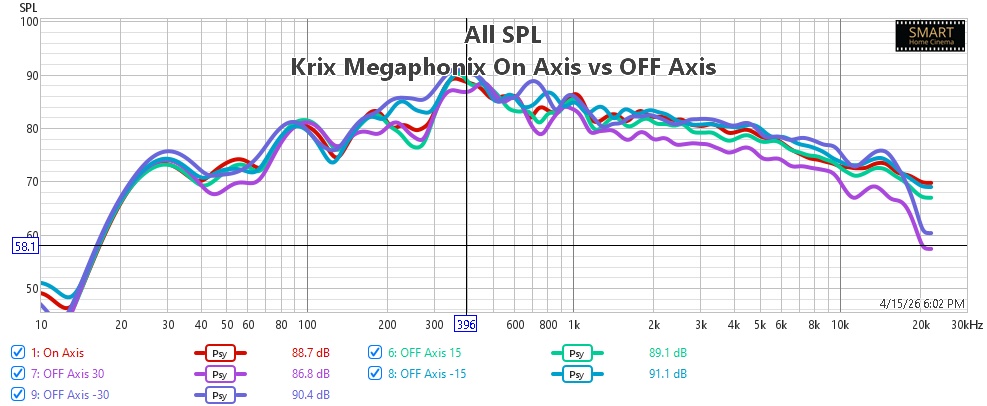
    The loudspeakers in our own reference room are Krix. Their sheet publishes the Megaphonix at 95 dB (2.83 V / 1 m) with 8-ohm nominal impedance. Because it is 8 ohms, that figure is the same on either basis โ€” no conversion needed. Voltage stated, impedance stated, nothing for the designer to guess.

    One thing the sheet does not state is the measurement environment. We have asked. Until we have that answer in writing we design our own rooms from the conservative reading โ€” treating the published figure as though the room contributed nothing. If it turns out to be anechoic, every system we have specified simply has more headroom than we allowed for.

    That is the discipline this article is arguing for, applied to our own brand: convert what you can, ask what you cannot, and let the unknown work in the client’s favour rather than against it.

    What does speaker sensitivity not tell you?

    Four things, and each one needs its own data.

    It does not tell you maximum SPL

    Sensitivity is a small-signal measurement. Maximum output is separately standardised: AES75-2022 measures maximum linear sound levels using M-Noise, a signal derived from analysis of hundreds of music recordings, raising level in 3 dB steps until the loudspeaker stops responding linearly. Power handling is not maximum SPL either โ€” ANSI/CTA-2034 states plainly that it determines audio performance, not a loudspeaker’s ability to survive a given input signal.

    It does not hold at high output

    As a voice coil heats, its resistance rises, the amplifier delivers less power into it, and sensitivity falls. Copper’s resistance climbs roughly 0.4% per degree Celsius; a coil rising from 20 ยฐC to 200 ยฐC loses close to 5 dB. In home cinema this is a sustained-output concern for a hard-driven centre channel rather than a headline effect โ€” but in a passive multi-way loudspeaker the shifting coil resistance also moves the crossover point, which changes tonal balance and not merely level.

    It does not tell you anything about quality

    Sensitivity says nothing about tonal accuracy, off-axis behaviour, distortion or coloration. Off-axis behaviour is what actually fills a multi-seat room, which is the entire reason ANSI/CTA-2034 measures directivity at all โ€” because on-axis response and a single sensitivity figure do not predict how a loudspeaker sounds in a room.

    It does not tell you what your room will do

    Two identical loudspeakers in two Madurai rooms with different construction will measure differently at the seat. That part is measured, never predicted. Acoustic treatment is what makes the room’s contribution consistent enough to design around.

    How should an integrator read a sensitivity specification?

    Six checks, in order. They take under a minute per loudspeaker.

    1. Is it anechoic or in-room? If the sheet does not say, assume in-room and ask the manufacturer.
    2. Is it voltage or power? 2.83 V / 1 m is the useful form.
    3. What is the nominal impedance? Convert to a one-watt basis before comparing across brands.
    4. What is the minimum impedance? Not the nominal. This is what the amplifier actually sees.
    5. Which frequency band? A band-limited average and a single-frequency reading are different numbers.
    6. Is there separate maximum SPL data? Sensitivity plus power handling is not an output figure.

    If any of the first four is missing, the specification cannot be used for design. It can only be used for marketing.

    For how these figures map onto defined performance targets, see our guide to immersive audio system architecture and CEDIA RP22 performance levels.

    What it looks like when the arithmetic is respected

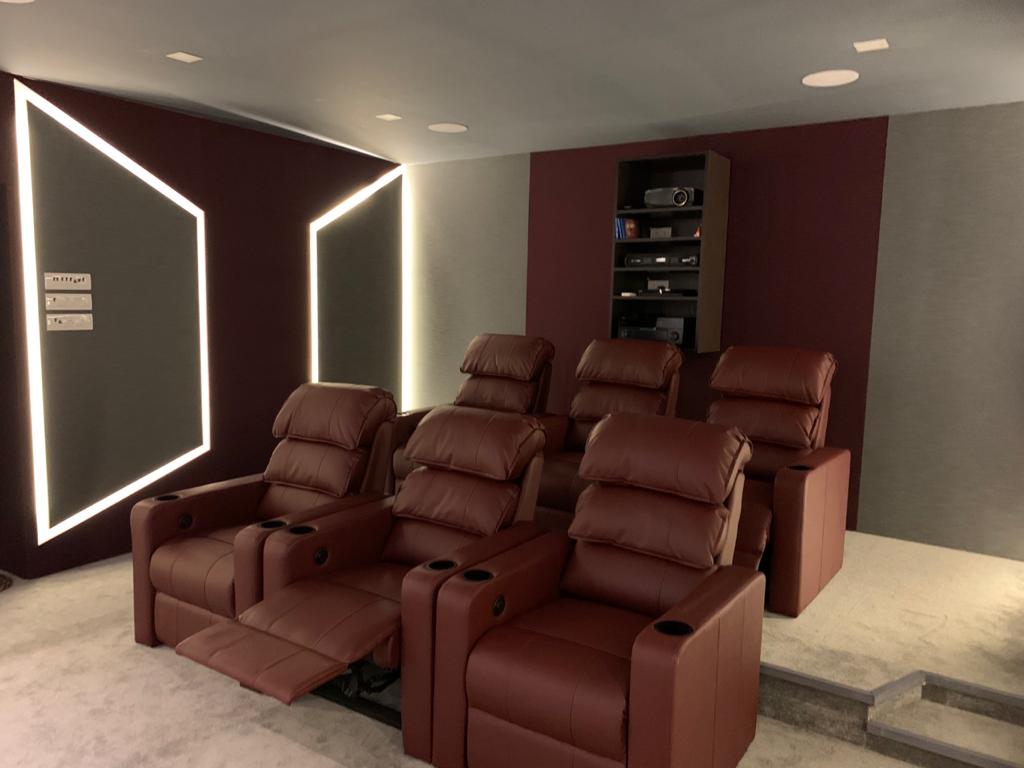
    Our Krix Reference Level Experience Center in Anna Nagar, Madurai exists partly to close the gap between what a calculation predicts and what a room delivers.

    The reference system there was measured with a miniDSP UMIK-1 and REW across all six seats. Peak level reached 124.7 dB LZpeak. C-weighted maximum short-term level varied by 3.1 dB across the six seats.

    124.7 dB
    LZpeak, measured, reference system
    3.1 dB
    Seat-to-seat LCSmax variation, six seats
    6
    Seats measured, not extrapolated

    The experience centre is CEDIA RP22 Level 1–2 compliant, and is one of the few properly calibrated immersive audio environments in South India. Reference-level home cinema design across South India starts at โ‚น50 lakhs, because the engineering that closes a 5 dB gap is design work rather than a product choice.

    Frequently Asked Questions

    Is higher speaker sensitivity always better?

    No. Sensitivity tells you how much amplifier power a loudspeaker needs, not how well it performs. A highly sensitive loudspeaker can still have uneven frequency response, poor off-axis behaviour or high distortion. Use sensitivity for amplifier matching and system headroom, never as a measure of quality.

    What is the difference between anechoic and in-room speaker sensitivity?

    Anechoic sensitivity is measured in a reflection-free environment and describes the loudspeaker alone. In-room sensitivity includes the reinforcement a room contributes, typically 2 to 6 dB. Design calculations must use the anechoic figure, with room gain added separately as its own declared term.

    Should I use 1W/1m or 2.83V/1m for speaker sensitivity calculations?

    Use 2.83 V / 1 m where available, because it removes impedance from the comparison. The two units are identical at 8 ohms only. For a 4-ohm loudspeaker, subtract 3 dB from the 2.83 V figure to obtain the one-watt equivalent. For 6 ohms, subtract 1.25 dB.

    How much amplifier power do I need to reach reference level?

    It depends on sensitivity, impedance and seating distance, not room size alone. At 4 metres, reaching 105 dB peaks needs about 160 watts from a 95 dB (1W/1m) loudspeaker, about 640 watts from an 89 dB loudspeaker, and about 2,560 watts from an 83 dB loudspeaker. Every 3 dB of sensitivity lost doubles the amplifier required.

    Why does SPL drop 6 dB when listening distance doubles?

    Because a conventional loudspeaker radiates as a point source, spreading energy over a spherical wavefront. CEDIA/CTA-RP22 defines this as a quartering of sound pressure, or minus 6 dB, for every doubling of distance. Line-source loudspeakers behave differently, losing 3 dB per doubling in free field.

    Does acoustic treatment reduce my speaker’s effective sensitivity?

    A well-treated room measures closer to the anechoic figure than an untreated one, because there is less reflected energy adding to the direct sound. This is a reason to design from the anechoic number rather than an argument against treatment. A treated room delivers cleaner and far more predictable output at the same level.

    Can a loudspeaker specification sheet be wrong?

    Rarely wrong, frequently incomplete. Independent laboratory measurements of loudspeakers from manufacturers who publish anechoic figures have returned results around 2 dB below the published claim, using a stated measurement weighting different from the manufacturer’s. The more useful question is not whether the number is wrong, but whether the sheet tells you enough to convert it.

    The number decides the room

    A speaker sensitivity SPL calculation is only as good as the kind of number it begins with. The design standards compute from anechoic data. Most specification sheets publish in-room data. The gap between them, compounded by an unconverted impedance, is routinely 5 dB โ€” the difference between a system that reaches reference level and one that runs out of headroom exactly when the soundtrack needs it most.

    Getting this right costs nothing at the design stage. Getting it wrong costs an amplifier, and occasionally a loudspeaker.

    A room designed around the correct numbers behaves the way the prediction said it would. That is not luck. It is arithmetic, done before anything is bought.

    Discuss Your Project on WhatsApp →
    Paul Joseph Klattan
    HAA Level 3 Certified | ISF Certified | Trinnov Certified
    Founder, SMART Home Cinema ยท Madurai, Tamil Nadu

    Paul designs reference-level home cinema across South India using a measurement-first method โ€” REW, RT60 analysis and verified SPL data at every seat rather than manufacturer claims alone. Every system is predicted on paper before it is built, then measured to confirm the prediction held.

  • Why Acoustic Panel Placement Isn’t Random: Understanding First Reflection Points

    SMART Home Cinema ยท Engineering Series

    First reflection points: why panel positions are calculated, not chosen

    In a home cinema, a panel on the wrong part of the wall is decoration. Here is how the correct position is worked out โ€” and why the back row needs a different answer to the front row.

    Worked Example ยท Mirror-Image Method

    First reflection points are the reason two identical rooms, fitted with identical panels, can sound completely different. The points are not a matter of taste or symmetry. They are geometry, they can be calculated to the inch before anything is built, and they move the moment a seat moves.

    Most acoustic treatment in Indian home cinema rooms is installed without anyone working them out. The panels are real, the material is real, and the positions are guesses. This article is about how the positions are actually derived โ€” and what a room loses when they are not.

    Why is most of what you hear not the speaker?

    In an untreated room, most of the sound energy reaching your seat has bounced off something first. The direct sound โ€” the part that travels straight from the driver to your ear โ€” is the minority of what arrives, and in a small, hard-surfaced room it is a small minority.

    You do not hear those reflections as separate events. They arrive within a few thousandths of a second of the direct sound, and your ear fuses them into one. What they do instead is change what you hear: detail smears, dialogue loses its edge, voices drift away from the actor’s mouth on screen, and the sense of space collapses.

    So reflection control is not a refinement applied after the system already sounds good. It is most of the sound.

    How is a first reflection point found?

    Hang a mirror on the side wall of your cinema and sit down. You will see the speaker reflected at exactly one spot on the glass. That spot โ€” and only that spot โ€” is where sound from that speaker bounces off that wall into your ear. Slide the mirror along the wall and the reflection appears somewhere else on it. Move your head and the spot moves too.

    Sound obeys the same rule. Angle in equals angle out.

    How a first-reflection point is located Section through a home cinema. The speaker’s mirror image is shown above the ceiling. A straight line from that mirror image to the listener’s ear crosses the ceiling at 8 feet 3 inches from the front wall, which is the reflection point. The real sound path runs from the speaker up to that point and back down to the ear. How a reflection point is found Section through the room. The bounce point is not chosen — it is where the geometry puts it. MIRROR SPACE (above the ceiling) Mirror image of the speaker same distance above the ceiling as the real one sits below it direct sound angle in angle out Speaker Listener’s ear Reflection point — 8′-3″ from the front wall A panel here works. A panel two feet away does not. room 26′-8″ long · ceiling 11′-0″ · worked example
    The reflection point is not chosen. It is where the straight line from the speaker’s mirror image to your ear crosses the surface.

    Two things follow from this, and they are the whole argument:

    1. The point can be calculated to the inch, before anything is built.
    2. It is a different point for every combination of speaker and seat.

    Why do row 1 and row 2 need different panel positions?

    Take a worked example. 26′-8″ long, 16′-0″ wide, 11′-0″ ceiling. Two rows, the back row on a 1′-2″ riser.

    Ceiling bounce, measured from the front wall
    PathDistance from front wall
    Front stage โ†’ row 18′-3″
    Front stage โ†’ row 212′-4″
    Separation4′-1″

    Those two points are 4′-1″ apart. That is not a rounding error; it is wider than the panel.

    Now consider the two things people usually do:

    • Cloud centred over the seating. This is the intuitive choice, because that is where people sit. It catches neither point. Both rows keep an untreated ceiling bounce.
    • Panels centred on row 1’s point. The front row is treated. The back row is not. Same room, same system, same evening โ€” and the back row gets a narrower image and less intelligible dialogue than the front. Clients notice this. They usually describe it as “the sofa sounds better than the recliners” and assume it is the seats.

    The band has to be dimensioned to hold both points, plus the panel width around each. In this room that means a ceiling band running 8′-0″ to 12′-6″ from the front wall, with the front edge fixed on the drawing rather than centred by eye.

    Two seating rows produce two separate ceiling reflection points Section through a home cinema with two rows. Sound from the front speakers reaches row one via a ceiling bounce 8 feet 3 inches from the front wall, and reaches row two via a separate bounce at 12 feet 4 inches. The calculated treatment band spans 8 feet to 12 feet 6 inches and holds both. A cloud placed over the seating instead catches neither point. Row 1 and row 2 do not share a reflection point Two seats, one front stage, two different bounce points on the ceiling — 4′-1″ apart. cloud placed “over the seats” — catches neither point Calculated band: 8′-0″ to 12′-6″ front edge fixed on the drawing 8′-3″ 12′-4″ riser 1′-2″ LCR + screen Row 1 Row 2 11′-0″ 26′-8″ · front wall → rear wall · worked example
    One front stage, two seats, two separate bounce points 4′-1″ apart. A cloud placed “over the seats” catches neither.

    How many reflection points does one room actually have?

    The ceiling was the simple case. Every hard surface gets the same treatment, for every speaker, for every seat.

    On the right-hand side wall of that same room, taking the centre seat of each row and the three front channels only:

    Side-wall reflection points, from the front wall
    Reflecting speakerRow 1 pointRow 2 point
    Left10′-0″14′-1″
    Centre8′-3″11′-6″
    Right4′-7″6′-1″

    Six points spread across a 9′-6″ band. Not a patch beside the speaker, which is where side-wall panels usually end up.

    Six first-reflection points along one side wall Plan view of a home cinema. Plan view looking down, front wall at the left, so the audience faces left and the wall shown at the top of the drawing is the listener’s right-hand wall. The left, centre and right speakers each reflect off that wall into the centre seat of row one and the centre seat of row two, giving six points between 4 feet 7 inches and 14 feet 1 inch from the front wall. The points span 9 feet 6 inches; the treated band, sized to the panel module, runs 4 feet 6 inches to 14 feet 3 inches, or 9 feet 9 inches. One side wall. Three speakers. Two rows. Six points. Plan view. The zone to be treated is a band the length of the seating, not a patch beside the speaker. the usual guess treated band 4′-6″–14′-3″ (9′-9″) points span 9′-6″ 4′-7″ 6′-1″ 8′-3″ 10′-0″ 11′-6″ 14′-1″ row 1 row 2 R C L Row 1 Row 2 opposite side wall — the mirror set, shifted Centre seats only. Add the outer seats in each row and this one wall carries 18 points. Room 26′-8″ × 16′-0″ · worked example.
    Three front channels reflecting off one side wall into two rows. The six points span 9′-6″. The treated band, sized to the panel module, runs 4′-6″ to 14′-3″ โ€” 9′-9″.

    The points have a height as well as a position

    Everything above locates points along the length of the wall. They also sit at a height, and the height moves for the same reason the position does.

    Where the speaker and the ear are level, the reflection point sits at that same height. Row 1 is at seated ear height, so all three of its side-wall points land at 3′-6″. Row 2 is on a riser, so its ear is above the speaker and its points climb: 3′-9″ from the nearest channel, 4′-1″ from the centre, 4′-3″ from the furthest.

    That spread — 3′-6″ to 4′-3″, nine inches across the six points — is why a side-wall band has a dimensioned height and not just a dimensioned length. Nine inches is easily covered. Raise the riser, add a third row, or bring in height channels, and the spread grows until a band whose height was chosen by eye starts missing the points at its edges.

    Add the outer seats and that one wall carries 18 points. Across the four reflecting surfaces:

    18
    Left wall
    18
    Right wall
    18
    Ceiling
    18
    Floor
    72
    Total, front three channels only

    And that is the front three channels alone, before the surround and height layers are counted.

    Nobody holds 72 coordinates in their head on site. That is the entire practical reason we draw the room first.

    Most rooms are not treated badly. They are treated without ever having been drawn โ€” panel positions decided on site, on the day, by eye. The reflection points existed either way; nobody worked out where they were.

    Send us your room dimensions on WhatsApp โ†’

    Position is half the job. Depth is the other half.

    A panel in exactly the right place, made too shallow, still fails. It absorbs the top of the band and reflects everything underneath, which tilts the room’s tonal balance rather than correcting it.

    The variable that matters is not the panel’s thickness. It is the effective depth โ€” panel thickness plus the air gap behind it. A porous absorber works by slowing moving air, and air moves fastest at a distance from a hard wall, not at its face. Mount the same panel on battens and you move it out into that faster-moving air, where it behaves closer to a thicker panel than it measures.

    Deeper reaches lower, and the relationship is close to inverse: double the effective depth and you roughly halve the frequency the absorber still controls. The figures below are the trade’s working approximations for specifying, not measurements โ€” what a given panel actually does depends on the material’s flow resistivity and how it is mounted, and the only ways to know are its own test data or a measurement of the finished room.

    Effective depth against lowest useful frequency
    Effective depthControls down to approximately
    50 mm500 Hz
    100 mm250 Hz
    125 mm200 Hz
    150 mm167 Hz
    200 mm125 Hz

    A 100 mm panel screwed flat to the wall gives 100 mm of effective depth and controls to roughly 250 Hz. The same panel on 50 mm battens gives 150 mm, and reaches about 167 Hz โ€” a third lower, from the same panel. Doubling the effective depth halves the frequency, so a full octave costs a batten as deep as the panel itself. That decision โ€” battens rather than adhesive โ€” is the step most installations skip. The panels are identical. The mounting is not.

    Which is why effective depth belongs on the drawing and not only on the panel spec. It changes how far the assembly stands off the wall, and that has to be coordinated with the finish, the skirting and the seating line before anything is ordered.

    What about diffusers?

    Scattering devices follow the same logic through a different mechanism. The depth of a diffuser’s wells sets the lowest frequency it scatters; everything below that passes as though the device were a flat wall. A shallow diffuser is not a failed diffuser โ€” it is a device with a high cut-off, and it belongs on surfaces where only the upper band needs scattering. A deeper one belongs where the scattering has to reach further down. Depth is a placement decision, not a quality grade.

    One thing carries across only partly. Behind a solid, rigid-backed diffuser an air gap changes nothing you can hear: the wells are already the depth, and a rigid back on battens scatters the same as one on adhesive. That holds only for a solid back. A slotted or open-backed device with a cavity behind it becomes a resonant absorber as well as a scatterer, and then the gap is an acoustic decision rather than a styling one. Which of the two you are holding is worth establishing before the batten depth is fixed.

    Why is it wrong to absorb everything?

    This is where a lot of rooms fail in the opposite direction. Covering every surface in absorption is not the safe option. Your brain expects a room to sound like a room; strip the reflections out completely and the result is oppressive and airless, voices lose body, and the sound collapses inward as though you were wearing headphones.

    There is no coverage percentage that answers this. Coverage is solved backward from the room’s target decay time, then checked surface by surface. You start from the decay the finished room has to achieve, work out how much absorption that volume needs to reach it, distribute that across the surfaces carrying reflection points, and verify the result by measurement rather than by area.

    Two rooms of identical floor area can need very different quantities. A room with a plastered ceiling, a tiled floor and glass down one wall starts from a completely different place than one with carpet, a fabric ceiling and masonry. A percentage rule cannot see that difference. A decay target can.

    Distribution matters as much as quantity. A room can carry the right total absorption and still have one bare wall doing all the damage, because a reflection point left untreated is untreated regardless of what the rest of the room is doing.

    The rules that follow

    • Ceiling first reflections are absorbed, always. A ceiling bounce arrives at both ears at the same instant, so it pulls the image into a narrow band above the screen instead of spreading it across the front wall.
    • The centre of the back wall is absorbed. A scattering panel directly behind the main seat collapses the rear image.
    • Scattering belongs in the rear portion of the room, roughly from halfway back, not immediately behind the speakers.
    • Absorption and scattering are interleaved through that rear section. All-soft-at-the-front, all-hard-at-the-back is a well-known layout and a poor one.
    • The front half is symmetric, left to right. First-reflection treatment on one side wall is matched on the other. Asymmetric absorption at the reflection points pulls the image toward the harder side, and it is one of the fastest ways to lose a centred image on a system that measures well otherwise.
    • The rear half does not have to match. Scattering behind the seating can differ side to side. Feeding both ears an identical scattering pattern narrows the sense of width, and the rear half is the one place in the room where deliberate difference helps rather than hurts.
    • Floor bounce is the one reflection point you cannot put a panel on. Carpet over underlay is the only treatment the floor can carry, and it is thin โ€” 12โ€“13 mm of carpet on 10 mm of underlay is about 23 mm of effective depth, which by the rule above means meaningful absorption only from roughly 1 kHz upward. That is not the whole floor bounce. It is the part carrying consonants and image focus, which is why a hard-floor cinema is fighting the room from the first day and why carpet is not optional. The rest of the floor bounce is not absorbed at all. It shows up as a cancellation notch, and in a room of these proportions that notch falls somewhere in the 300 to 500 Hz region โ€” well below anything carpet touches. Its frequency is set by the speaker’s height and the ear’s height, which means it can be placed but not removed. That makes both heights a decision taken on the drawing rather than a consequence of whatever furniture arrives.
    • Absorptive panels are hung as matched pairs. A single panel hanging alone is visible, and it is usually the sign of a count that was fitted rather than designed.
    Which surfaces are absorbed, scattered, and left reflective Section through a home cinema showing the job of each surface. The ceiling absorbs across the first-reflection band and scatters from three quarters of the room length back. The side walls absorb across the reflection band, then interleave scattering and reflective sections from about halfway back. Front and rear corners carry low-frequency traps, the front wall absorbs behind the screen, the rear wall absorbs at its centre and scatters outboard, and the floor is carpet over underlay, which absorbs only the upper part of the floor bounce. Not everything gets absorbed Each surface has a job. A room covered wall to wall in absorption fails for the opposite reason. CEILING absorb the reflection band scatter — from ¾ of the room length SIDE WALL absorb — reflection band 4′-0″ tall · 2′ to 6′ above floor live scatter live scatter scatter interleaved with live from halfway back — never one solid block bass trap FRONT WALL absorb behind the screen bass trap REAR WALL absorb at centre, scatter outboard FLOOR — carpet and underlay reach only the top of the band, about 1 kHz up row 1 row 2 absorb scatter leave live low-frequency trap Front wall on the left. Proportions indicative; every band is dimensioned on the room’s own drawings.
    Each surface has a job. Ceiling scattering begins about three-quarters of the way back; side-wall scattering from roughly halfway. Absorb, scatter or leave live is decided by position, not by how much material is left over.

    Why do the same rules not work for bass?

    Below roughly 150 Hz the mirror rule stops being useful. At those frequencies the room stops behaving like a set of rays bouncing off surfaces and starts behaving like a resonator: fixed patterns of loud and quiet, set by the room’s own dimensions, standing still in the air.

    The consequence is severe and routinely underestimated. A seat sitting in the wrong part of that pattern can lose 20 to 40 dB at a given frequency. A 40 dB loss is 99.99% of the energy gone at that note. Move the seat two feet and the answer changes completely.

    So bass is a placement problem too โ€” but what is being placed is the seats and the subwoofers, not the panels. Every room mode reaches a pressure maximum in the corners, which is why the corners carry the deepest traps: that is where they earn their depth at the lowest frequencies. Higher up, through the 100โ€“250 Hz band, the wavelengths are short enough to be caught on the surfaces themselves โ€” front wall, side walls, riser and rear wall โ€” which is where that band is treated instead. And multiple subwoofers in calculated positions do more for bass evenness across a row than any quantity of absorption.

    This is also why “we’ll add bass traps later if it sounds boomy” is backwards. By then the seats are fixed, the riser is built, and the simplest fix has been designed out.

    What does a calculated design look like on paper?

    A room that has been designed rather than decorated produces a specific set of documents before anything is ordered:

    • reflection points listed per surface, per speaker, per seat โ€” in feet and inches from the front wall
    • treatment bands dimensioned on scaled wall elevations and a ceiling plan, not described in words
    • panel type and effective depth against each position, batten depth included, so the installer is not choosing on the day
    • coverage checked surface by surface against the room’s target decay time
    • a visible flag against any position that had to move for a door, window or opening โ€” moved on the drawing, never silently on site
    • setting-out drawings for the site team, so what gets marked on the wall matches what was calculated

    If a design does not produce those, the positions were not calculated. They were estimated, and the estimate will be found by the back row.

    How much of that a project gets

    That is a budget decision, and it should be an explicit one. A full set โ€” every surface, every speaker, every seat, dimensioned and set out โ€” takes design time, and design time is real cost. On a reference-level room it is a small fraction of the total and there is no argument for skipping it. On a smaller room it is scoped down: fewer seat positions calculated, elevations drawn for the surfaces carrying the most points rather than for all of them.

    What does not get scoped down is the derivation. Reflection points are either calculated or they are not. A reduced drawing set still starts from calculated positions โ€” it simply documents fewer of them. The failure this article is about is not a thin document set. It is no calculation at all.

    A band calculated to catch both rows begins to miss the outer seats first as it drifts, which is why the setting-out is dimensioned rather than described.

    Who is this approach for?

    There is no shortage of people in India who will build you a beautiful cinema room. Most of them begin from the interior: the layout is set, the finishes are chosen, the lighting is designed, and the acoustics are fitted into whatever space is left over. That order produces rooms that photograph well and measure badly, because by the time anyone asks where the reflection points are, the seats and the ceiling are already fixed.

    We work in the opposite order. Room dimensions, speaker positions, seat positions and riser height are settled first, because those four things determine every panel position in the room and every one of them is expensive to change afterwards. The interior is then designed to that geometry, rather than the geometry being squeezed into the interior.

    This is not a choice between a room that performs and a room that looks right. It is a question of which one is decided first.

    A cinema designed acoustically and then finished properly ends up as both. A cinema designed visually and then treated ends up as one.

    So the filter is simple. If the finishes have to be locked before the acoustics are worked out, we are the wrong people to call โ€” not because the finishes do not matter, but because that order forecloses every decision this article is about. If the room’s performance is allowed to set the geometry, and the interior is designed to it, that is the whole of what we do.

    What three questions should you ask any installer?

    1. Where are the first reflection points for the back row? In feet and inches, from the front wall.
    2. What is the effective depth of the panels, and what frequency does that depth control down to?
    3. How was the coverage arrived at, and how is it distributed across the surfaces?

    If the answers are “we’ll sort it on site”, “standard”, and “as many as fit the walls”, you are buying wall panelling, not acoustics.

    The same logic runs through every stage that follows โ€” how a room’s decay target is set, how the room is drawn before anything is ordered, and how the finished result is verified by measurement rather than by ear. If your question is how much treatment a room needs in total, our sister brand covers that in detail: how much acoustic treatment a room needs.

    Frequently Asked Questions

    What are first reflection points in a home cinema?

    First reflection points are the exact spots on the ceiling, side walls and floor where sound from a speaker bounces once before reaching a listener’s ear. Each point is set by geometry โ€” the speaker position, the seat position and the surface between them โ€” so it can be calculated to the inch before construction starts. A room with three front channels and six seats has 72 first reflection points across the four reflecting surfaces, before surround and height layers are counted.

    How do you find the first reflection point on a wall?

    Sit in the seat and have someone slide a mirror along the wall. Where you can see the speaker in the mirror is the reflection point for that speaker and that seat. On paper the same result comes from the mirror-image method: draw the speaker’s reflection behind the surface, draw a straight line from that image to the listener’s ear, and mark where the line crosses the surface.

    Why do the front and back rows need different panel positions?

    Because the reflection point moves with the listener. In a 26′-8″ room with the back row on a 1′-2″ riser, the ceiling bounce for row one lands 8′-3″ from the front wall and the bounce for row two lands 12′-4″ โ€” 4′-1″ apart, wider than a panel. A cloud centred over the seating catches neither. The treatment band has to be dimensioned to hold both points plus panel width around each.

    How thick should acoustic panels be in a home theatre?

    Effective depth matters more than panel thickness. Effective depth is the panel plus the air gap behind it, and the relationship is close to inverse โ€” double the effective depth and you roughly halve the frequency the panel still controls. A 100 mm panel fixed flat to the wall gives 100 mm of depth and controls to about 250 Hz; the same panel on 50 mm battens gives 150 mm and reaches about 167 Hz. These are working approximations for specifying, not measurements. Real performance also depends on the material’s flow resistivity.

    What percentage of a room should be acoustically treated?

    There is no percentage that answers it correctly. Coverage is solved backward from the room’s target decay time and then checked surface by surface, because two rooms of the same size with different finishes need very different quantities. A room with a tiled floor, plastered ceiling and glass wall starts nowhere near a room with carpet and fabric. Distribution matters as much as total quantity โ€” an untreated reflection point stays untreated no matter what the rest of the room carries.

    Can acoustic panels fix bass problems?

    Only partly, and not by placement on reflection points. Below roughly 150 Hz the room resonates rather than reflecting like a ray, and a seat in the wrong part of that pattern can lose 20 to 40 dB at a given frequency. Corners carry the deepest traps because every room mode reaches a pressure maximum there. The 100โ€“250 Hz band is treated on the front wall, side walls, riser and rear wall. Seat positions and multiple subwoofers in calculated positions do more for bass evenness across a row than any quantity of absorption.

    Does acoustic panel placement have to be decided before construction?

    Yes. Deciding it afterwards costs more and constrains the result. Panel positions depend on seat positions, riser height, speaker positions and room dimensions โ€” all of which are fixed by the time the room is built. Deciding treatment afterwards means working around choices that were made without reference to the acoustics. Rooms designed this way carry reflection points per surface, per speaker and per seat, dimensioned on scaled elevations, before anything is ordered.

    Where does SMART Home Cinema design and install home cinema rooms?

    SMART Home Cinema is based in Anna Nagar, Madurai, and designs and installs across Tamil Nadu and South India. Projects in Madurai and the surrounding districts start from โ‚น8 Lakhs. In Tiruchirappalli, Coimbatore, Tiruppur and Salem, projects start from โ‚น20 Lakhs. Reference-level projects elsewhere across South India โ€” Karnataka, Kerala, Andhra Pradesh and Telangana โ€” start at โ‚น50 Lakhs. Every project begins with a demonstration at the Krix Reference Level Experience Center in Madurai before any quotation is issued.

    A cinema room is an instrument you sit inside

    Every panel position in it is derived from that specific room โ€” its dimensions, its speaker positions, its seat positions, its riser height. Change any one of those and every panel position changes with it.

    That is the whole reason we draw the room before anyone buys anything for it.

    Notes on the worked example

    All figures come from a single worked example, not a built project: 26′-8″ long ร— 16′-0″ wide ร— 11′-0″ ceiling; front stage 1′-6″ from the front wall at seated ear height; row 1 at 15′-0″ and row 2 at 21′-6″ from the front wall; row 2 on a 1′-2″ riser. Reflection points are calculated by the mirror method and rounded to the nearest inch. A different room gives different numbers โ€” that is the argument, not a caveat to it.

    Further reading

    Immersive audio room design is covered in the joint CEDIA / CTA RP22 recommended practice. Channel layout and listener-area geometry are documented by Dolby, and seating geometry and viewing-angle standards by SMPTE.

    A cinema room is designed once and lived with for a decade. The panel positions in it are not a finishing decision โ€” they are set by the room’s dimensions, its speaker positions and its seat positions, and they are far easier to get right on the drawing than on site.

    Home cinema in Madurai and the surrounding districts starts from โ‚น8 Lakhs, and from โ‚น20 Lakhs in Tiruchirappalli, Coimbatore, Tiruppur and Salem. Reference-level projects across South India start at โ‚น50 Lakhs. We do not quote without a demonstration.

    Discuss Your Project on WhatsApp โ†’
    Paul Joseph Klattan
    HAA Level 3 Certified | ISF Certified | Trinnov Certified
    Founder, SMART Home Cinema ยท Madurai, Tamil Nadu

    Paul designs and calibrates reference-level home cinema across South India, working from measurement rather than assumption โ€” REW with a calibrated microphone, seat-averaged target curves, and verified re-measurement after every change. He holds HAA Level 3, the highest level of the Home Acoustics Alliance programme, and runs the Krix Reference Level Experience Center in Madurai, one of the few properly calibrated immersive audio environments in South India.

  • Why Your Home Cinema Seat Matters More Than Your Subwoofer

    Why Your Home Cinema Seat Matters More Than Your Subwoofer

    Why Your Home Cinema Seat Matters More Than Your Subwoofer | SMART Home Cinema
    SMART Home Cinema ยท Engineering Series

    Why Your Home Cinema Seat Matters
    More Than Your Subwoofer

    A bigger subwoofer cannot move a cancellation. Moving your chair can. The physics that decides how bass behaves in a room โ€” and why seating is planned before equipment is chosen.

    CEDIA/CTA-RP22 REFERENCED

    Almost every enquiry we receive about weak or boomy bass opens the same way: which subwoofer should I upgrade to. It is a reasonable question and it is usually the wrong one. In a closed room, home cinema seat position changes what you hear at low frequencies more than most equipment decisions do.

    Low frequencies do not simply travel from the driver to your ears. They bounce, return, and interfere with themselves. That interference creates a fixed pattern of strong and weak zones across the floor plan. Your chair sits somewhere on that pattern, and where it sits decides how much bass reaches you.

    The seat is not furniture. It is the last component in the signal chain โ€” and the only one that costs nothing to get right, provided you decide it early enough.

    Why does the same room sound different in every seat?

    Low frequencies are long waves. A 30 Hz tone measures roughly 11 metres from one crest to the next โ€” longer than most rooms it is played in. At that scale sound does not travel as a beam you can aim. It fills the space and reflects off every hard surface.

    When a reflected wave meets the wave that produced it, the two combine. Where crests line up, pressure adds and the note gets louder. Where a crest meets a trough, they subtract and the note weakens or disappears.

    The result is a fixed, permanent map of loud zones and dead zones, set entirely by the dimensions of the room. Change the subwoofer and the map is identical. Change the amplifier and the map is identical. The only thing that changes what you hear is where you put your head.

    One person calls the bass overwhelming while someone two metres away says there is almost none. Both are describing what they hear accurately. They are sitting in different zones of the same map.

    Where do the cancellations actually fall?

    They are not random and they are not a matter of opinion. Each room dimension produces its own series of resonances, and the first one is set by a single division.

    First resonance along any room dimension
    f = speed of sound in air 2 ร— that dimension
    A room 6.7 m long, sound travelling at 343 m/s:
    343 รท (2 ร— 6.7) = 343 รท 13.4 = 25.6 Hz
    The room then resonates again at every whole multiple:
    51.2 Hz  ยท  76.8 Hz  ยท  102.4 Hz
    Arithmetic you can check on a calculator โ€” not a measurement of any particular room.

    Each of those resonances cancels at its own set of points, and the pattern is simple.

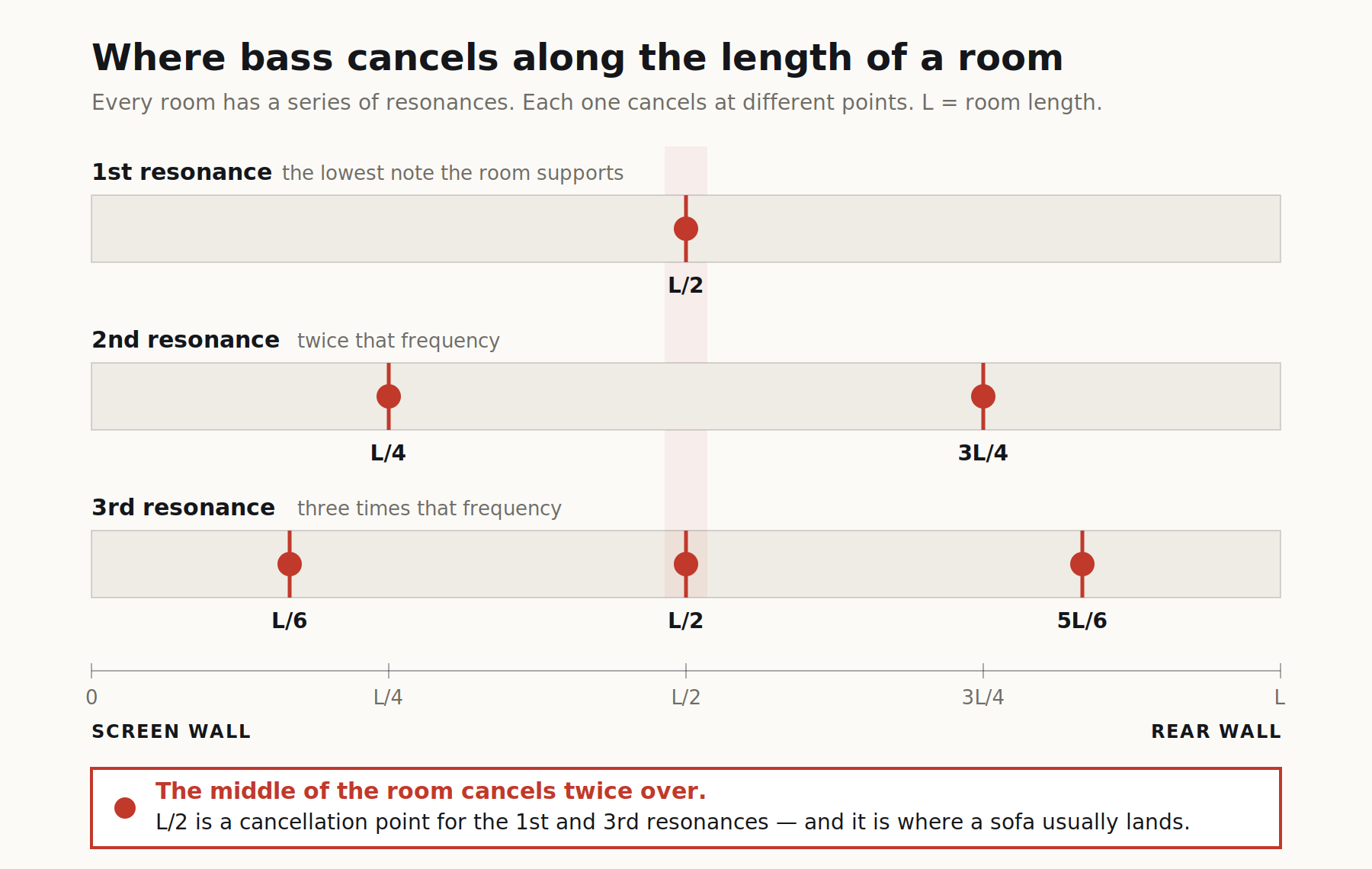
    1st
    Cancels at the midpoint. One dead point, exactly halfway down the room.
    2nd
    Cancels at the quarters. Two dead points, at a quarter and three quarters.
    3rd
    Divides into sixths. Three dead points โ€” one lands back on the midpoint.

    Put those three on the same floor plan and the problem becomes obvious.

    Home cinema seat position diagram showing where bass cancels along the length of a room for the first, second and third resonances
    The same map applies to the width and the height of the room as well, each with its own set of frequencies. A seat that is clear on one axis can still sit on a cancellation for another โ€” which is why a seating layout is calculated on all three dimensions, not just the length.

    What does a cancellation actually sound like?

    Certain low notes arrive at that seat far weaker than they should. Nothing is broken. The system is working exactly as designed, and the seat is in the wrong place.

    • Explosions lose weight and land as a thud
    • Music sounds thin, with no body underneath it
    • Kick drums lose impact and turn into a click
    • Some bass notes are missing entirely while others are perfectly fine
    • Turning the volume up does not bring them back

    The instinctive response is to blame the subwoofer and buy a larger one. That rarely helps, because the problem is not how much energy leaves the driver. It is what survives the journey to that particular chair.

    Why is sitting against the rear wall a trap?

    This is the opposite failure, and it fools people for much longer because it sounds impressive at first.

    At a boundary, every resonance reaches maximum pressure at the same moment. On paper nothing is cancelling, which looks ideal. In the room it produces bass that is heavy, slow and much the same on every note, with the longest decay anywhere in the space.

    • Bass becomes boomy rather than deep
    • Dialogue clarity drops because low frequencies mask the midrange
    • Action scenes feel noisy instead of powerful
    • Long viewing sessions become genuinely tiring

    Too much bass is not premium bass. Good bass is deep, clean, controlled โ€” and consistent from one seat to the next.

    If your architect has already drawn the seating, the geometry is worth checking against the room’s resonances before the riser is cast. At drawing stage it costs nothing to change. After construction it cannot be changed at all.

    Send us your room drawing on WhatsApp โ†’

    Is room gain the same thing as boom?

    No, and confusing the two leads to the wrong fix. They are separate effects with separate causes.

     Room gainModal peak โ€” this is boom
    Where it happens Below the room’s lowest resonance At the resonances and above
    Mechanism Wavelength longer than the room, so the air behaves as a sealed volume being compressed Reflected waves reinforcing each other at specific frequencies
    Character Smooth, broadband rise as frequency falls Narrow, uneven, different in every seat
    Worst location Even across the room At the room boundaries
    Verdict Usually a benefit โ€” design for it A problem โ€” solve by placement and treatment

    Room gain is one reason a properly sealed dedicated room reaches lower and feels more solid than the same equipment in an open living space. It is worth designing for. It is not a substitute for correct seating, and it is not what makes a room boom.

    One point specific to Indian construction: room gain depends on how well the space is sealed. Air-conditioning penetrations, false ceilings, unsealed door frames and service openings all leak low-frequency pressure, so many rooms deliver less of it than theory predicts. Getting that right belongs in the same conversation as sound isolation, and both are construction-stage decisions.

    Can a bigger subwoofer or room correction fix a bad seat?

    Partly, and not the part that matters most.

    Equalisation raises a signal that is already present at the microphone. Where the room has cancelled a frequency there is very little arriving to raise, so boosting it consumes amplifier and driver headroom, increases distortion at high output, and can make other seats worse. Room correction is a finishing tool, not a rescue tool.

    Multiple subwoofers are the genuinely effective answer, and they work by a different mechanism. One subwoofer creates one fixed map of strong and weak zones. Several placed symmetrically create overlapping maps, so where one is weak another is delivering pressure, and the seats stop disagreeing with each other. Seat-to-seat consistency is one of the criteria the CEDIA/CTA-RP22 immersive audio recommended practice uses to define objective performance levels, which is why we design to it rather than to a subwoofer count.

    What we measure, and what it proves

    Two results from our own Krix reference room in Madurai, both taken with a calibrated microphone in REW:

    3.1 dB
    Seat-to-seat variation across six seats in our reference room, against a typical industry figure of 6 to 10 dB.
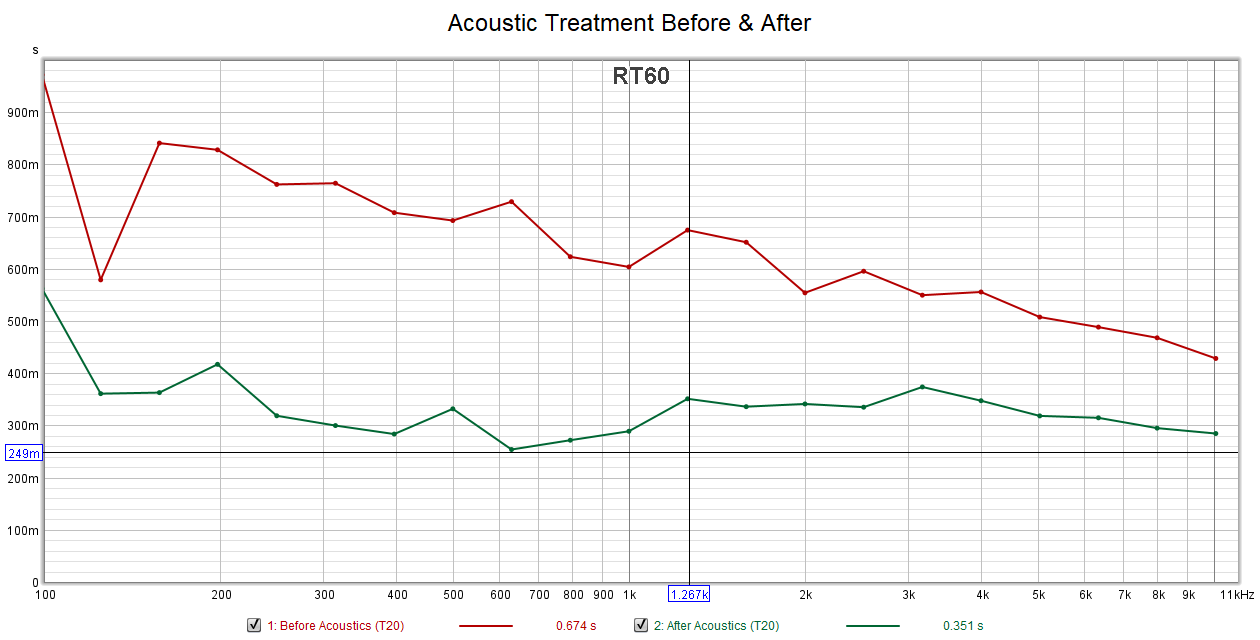
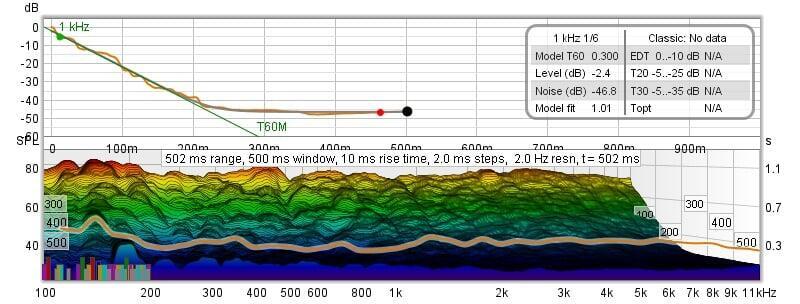
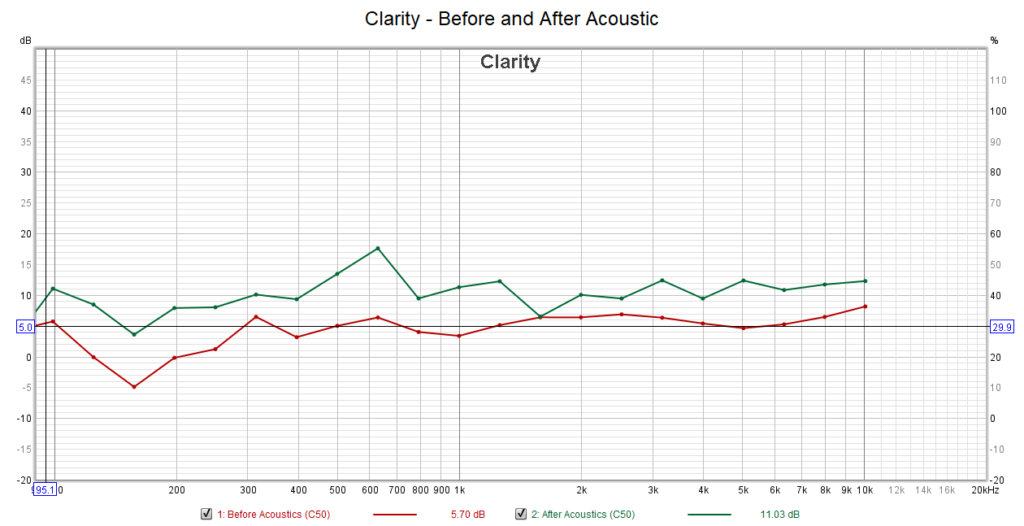
    0.64 โ†’ 0.30 s
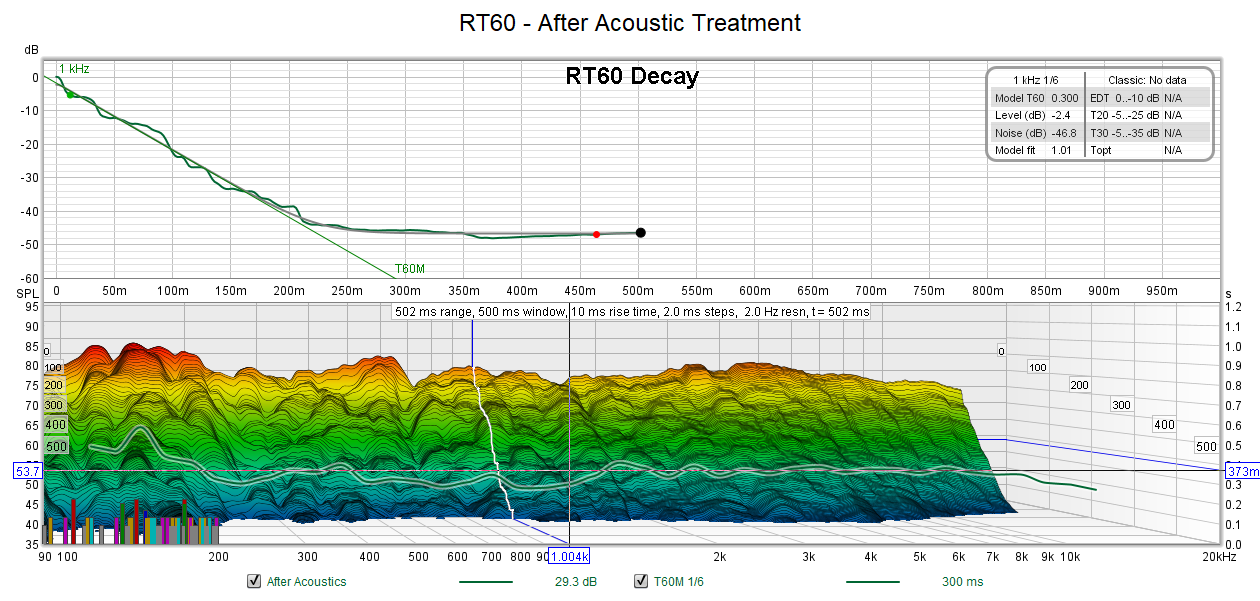
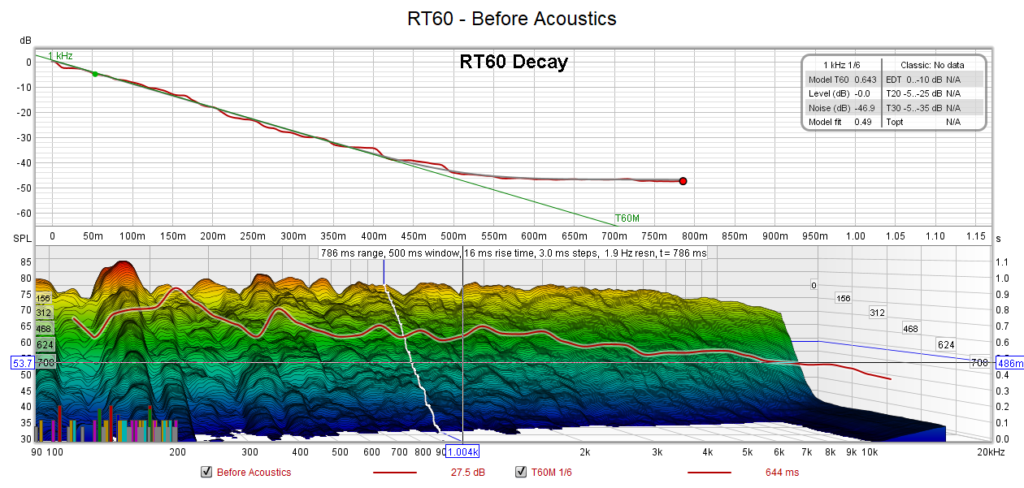
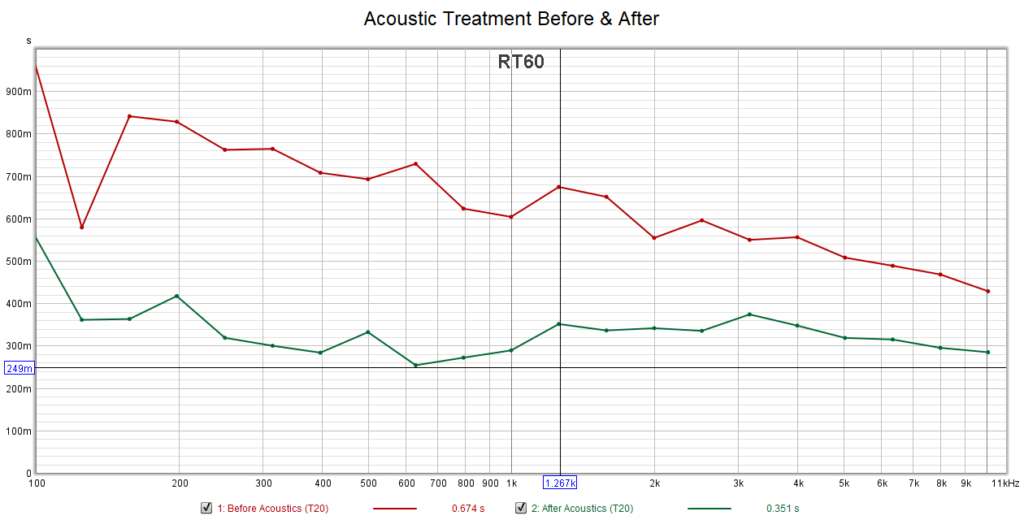
    RT60 at 1 kHz, before and after acoustic treatment. Same room, same mic position, no EQ applied.
    15โ€“20 dB
    Typical low-frequency peaks and cancellations in an untreated domestic room at the listening seat.

    That first number is the whole argument. Seat-to-seat consistency is not a happy accident of good equipment โ€” it is the outcome of a seating plan derived from the room’s dimensions, multiple subwoofers positioned by measurement, and treatment that controls what remains. Our experience center is built to CEDIA/CTA-RP22

    It is also worth being precise about what can be known when. Room dimensions let us calculate where the problems will be before a wall is built. Only a swept measurement with a calibrated microphone tells us how severe they are, because real rooms have damping, leakage and non-rigid surfaces that arithmetic cannot see.

    A room plan predicts the problem. A measurement proves the result. Anyone quoting a decibel figure for your room before measuring it is showing you a model, not your cinema.

    What is the correct order of work?

    The sequence that works

    1. Fix the room dimensions and the seating positions. Free at design stage. Permanent afterwards.
    2. Place the subwoofers by measurement. Count and position both matter. Visual symmetry alone is not enough.
    3. Treat the room. Broadband absorption at first reflection points, corner bass traps for low-frequency decay, diffusion in the rear half.
    4. Calibrate and verify. Set crossovers, delays, levels and target curve from measured data, then re-measure to confirm the result.

    Follow that order and honest mid-tier equipment performs well above its price. Reverse it and expensive equipment disappoints โ€” which is the single most common problem we are called in to diagnose, and by then the seating is usually bolted to a riser.

    If your room is already built and the bass is uneven, look at placement and treatment before another equipment upgrade. We set that out in detail in why most home theater rooms sound worse after treatment, and the full geometry โ€” speaker angles, ear height, surround placement โ€” is covered in our home cinema speaker placement guide.

    Design the seat before you specify the system

    Better bass is not only a question of more powerful equipment. It is a question of sitting in the right place inside a room that was planned for it. Sit in a cancellation and there is not enough. Sit in a pressure peak and there is too much. Both spoil the experience, and both are decided long before the equipment is delivered.

    In Madurai and the surrounding districts our projects begin from โ‚น8 lakh. Elsewhere in South India the minimum engagement is โ‚น50 lakh, which is also the level at which genuinely reference-level performance becomes achievable. The seating geometry costs the same in every one of them: nothing, if it is decided at design stage.

    Frequently Asked Questions

    Does home cinema seat position matter more than the subwoofer?

    Below roughly 150 Hz, position has a very large influence. Room resonances create fixed zones of reinforcement and cancellation that no subwoofer can move, because they are set by the room’s dimensions rather than the equipment. A larger subwoofer raises output everywhere but does not change where the cancellations fall. Above that range, speaker quality, acoustic treatment and calibration matter more.

    Why does the middle of the room sound bad for bass?

    The exact midpoint of a room is a cancellation point for the first resonance along that dimension, and for every odd-numbered resonance above it. It is one of the weakest positions in the entire room for low frequencies, and it is where a sofa naturally lands when a room is laid out by eye rather than calculated.

    Is sitting against the rear wall good for bass?

    It gives you more bass, not better bass. At a boundary every resonance reaches maximum pressure simultaneously, producing heavy one-note bass with the longest decay in the room. Leave meaningful distance from the rear wall and treat that wall properly with absorption and bass trapping.

    Can room correction or EQ fix a bad seating position?

    No. Equalisation boosts a signal that already exists at that position. Where the room has cancelled a frequency there is almost nothing to boost, so the correction only consumes amplifier and driver headroom and raises distortion at high output. Correction is a finishing step applied after placement and treatment, not a repair for a seating error.

    Do multiple subwoofers solve room mode problems?

    They reduce them substantially. Several subwoofers placed symmetrically create overlapping pressure patterns, so a weak zone from one is filled by another and the seats become far more consistent with each other. In our own reference room in Madurai this approach, combined with a calculated seating plan and acoustic treatment, produced 3.1 dB seat-to-seat variation across six seats against a typical industry figure of 6 to 10 dB.

    What is room gain in a home cinema?

    Room gain is the smooth rise in low-frequency output below the room’s lowest resonance, where the wavelength is longer than the room and the air behaves as a sealed volume being compressed. It is broadband and generally beneficial. It is not the same as a modal peak, which is narrow, uneven, worst at the boundaries, and heard as boom.

    At what stage should home cinema seating be planned?

    At design stage, alongside the room dimensions, and before any civil work on the riser. The resonance frequencies come from the length, width and height, and the workable seating positions follow from them. Seating must also satisfy screen viewing angle and surround speaker geometry at the same time, which usually leaves a small number of valid positions. After construction, those options are largely gone.

    How much does a properly designed home cinema cost in India?

    SMART Home Cinema projects in Madurai and the surrounding districts begin from โ‚น8 lakh. For projects elsewhere in South India the minimum engagement is โ‚น50 lakh, which is also the level at which reference-level performance becomes achievable. Seating geometry costs nothing in any of these tiers, provided it is decided at design stage.

    Design Consultation ยท South India

    Send us your room before the riser is built

    Share the room dimensions and the proposed seating layout. We will tell you where the resonances fall, whether the plan is workable, and what needs to change while changing it is still free.

    Discuss Your Room on WhatsApp โ†’

    Chennai ยท Madurai ยท Coimbatore ยท Bengaluru ยท Hyderabad ยท Across South India & Pan-India projects

    Paul Joseph Klattan
    HAA Level 3 Certified | ISF Certified | Trinnov Certified
    Founder, SMART Home Cinema ยท Madurai, Tamil Nadu

    Paul designs, treats and calibrates reference-level private cinemas across South India using a measurement-driven process built on REW analysis, RT60 optimisation, multi-subwoofer integration and verified seat-averaged target curves. He operates a Krix Reference Level Experience Center in Tamil Nadu at Madurai with four demonstration environments, built to CEDIA/CTA-RP22 โ€” one of the few properly calibrated immersive audio environments in South India.

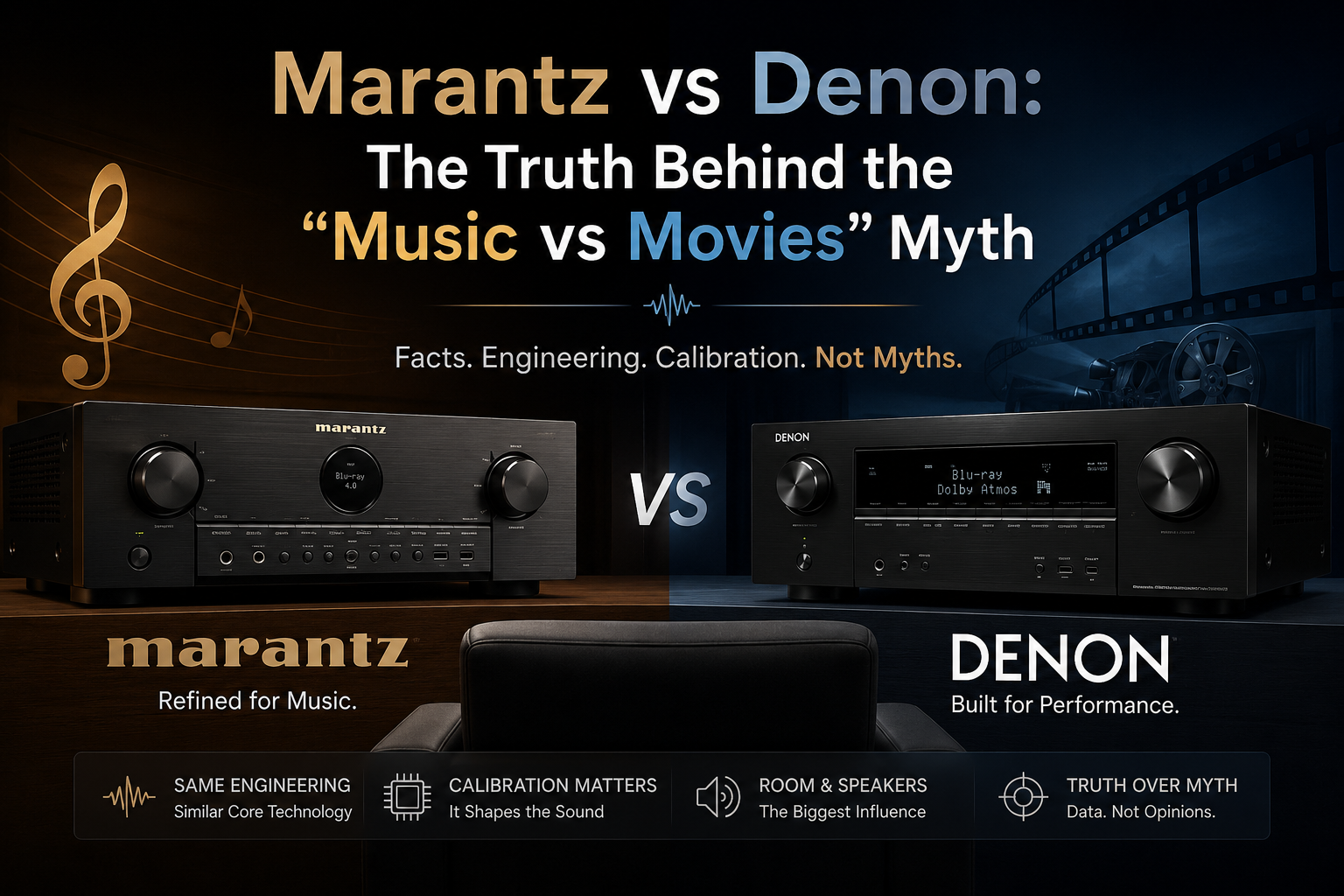
  • Marantz vs Denon: The Truth Behind the “Music vs Movies” Myth

    Marantz vs Denon: The Truth Behind the “Music vs Movies” Myth

    Marantz vs Denon: The Real Technical Difference Explained
    SMART Home Cinema ยท Engineering Series

    Marantz vs Denon: The Real Technical Difference

    The music-versus-movies myth, examined from the measurement bench rather than the showroom floor.

    HAA Level 3 ยท ISF ยท Trinnov Certified

    Marantz vs Denon is one of the first questions I hear before a home cinema project begins, and it almost always arrives in the same sentence: Marantz is for music, Denon is for movies. It is not true in the way people mean it. A difference between the two does exist, it is real, it is documented by the manufacturer, and it is measurable. But it is not a music-versus-movies difference, and it is far smaller than the three things that genuinely decide how a room sounds: the room itself, the loudspeakers, and the calibration decisions made after everything is installed.

    This article explains where the belief came from, exactly what is different inside the two boxes, and why that difference stops mattering the moment a room is treated and professionally calibrated.

    Where did the “Marantz for music, Denon for movies” idea come from?

    It came from brand history and product positioning, not from measurement.

    Marantz built its reputation over decades in two-channel hi-fi. Denon built its reputation in multichannel AV. Each brand marketed to the audience it already owned, and each product line reflected that emphasis. That emphasis showed up in three visible ways:

    1. Feature allocation at a given price. Denon models have historically offered more amplifier channels and higher claimed power output at the same price point, which appeals to a home theatre buyer counting channels.
    2. Analog stage investment. Marantz has consistently spent more of its bill of materials on the analog output stage and preamp outputs, which appeals to a stereo listener driving external amplifiers.
    3. Voicing philosophy. Marantz maintains a dedicated internal listening and tuning process and markets a recognisable house character. Denon’s development priorities have been weighted toward decoding, channel count and processing features.

    None of this makes one brand a “music” product and the other a “movie” product. It makes them two products designed for two different buyer profiles, developed under common ownership since the two companies merged in 2002. Both now sit within Sound United, which became part of HARMAN International in September 2025 and operates as a standalone business unit. The brands remain separately engineered and separately positioned, but they are not rivals from different worlds.

    What do Denon and Marantz actually share inside the box?

    More than most buyers realise. At matched tiers, the two brands commonly share platform engineering. In practice that means the same HDMI and video handling, the same core decoding and object rendering for Dolby Atmos and DTS:X, the same bass management architecture, and the same licensed room correction platform running identical mathematics.

    This is the important part. Every operation that shapes what you hear as “cinema sound” โ€” decoding, object rendering, crossover and LFE routing, time alignment, room correction โ€” happens in the digital domain, and at matched tiers that digital domain is common to both brands. Nothing in the digital signal path is tuned for movies on one and music on the other.

    One caution, because this is where lazy advice fails buyers: shared platform does not mean identical models. Correction tier, Dirac Live availability, number of independent subwoofer outputs, preamp output configuration and amplifier section all vary by model. A specific Denon and a specific Marantz must still be compared line by line. The brand name tells you almost nothing; the model specification tells you everything.

    What is the one real technical difference between them?

    There are two, and they both sit at the very end of the signal path. The first is documented by Marantz itself, and it is the single most useful fact in this entire debate.

    1. The DAC filter โ€” and why this is the heart of the myth

    Every digital-to-analog converter needs a reconstruction filter. Digital audio carries repeated ultrasonic copies of the signal as a by-product of sampling, and a filter removes them before the signal reaches the analog stage. Both brands have this. Neither one outputs an unfiltered signal. The difference is the shape of that filter.

    On current Marantz models this shape is exposed as a menu option called DAC Filter, and Marantz publishes what each setting does:

    SettingFilter typeMarantz’s own description
    Filter 1
    (factory default)
    Short-delay slow roll-off The recommended setting to enjoy the Marantz sound
    Filter 2 Sharp roll-off The recommended setting for bench test measurements

    Read that table again, because it settles the argument. The “Marantz sound” is a factory default menu setting, and the manufacturer itself recommends a different setting when you want to measure the product accurately.

    The engineering behind it is straightforward. A slow roll-off filter attenuates gently as it approaches the Nyquist limit. That gentleness has two consequences: it reduces pre-ringing in the time domain, which is the sonic character owners describe as smooth or relaxed, and it produces measurable attenuation in the top octave at standard sample rates, along with less rejection of ultrasonic image content. A sharp roll-off filter does the reverse: flatter in-band response and stronger rejection, at the cost of more ringing around the transition.

    Neither is “wrong.” They are two valid trade-offs from the same textbook. But one of them is a deliberate, mild treble softening applied at the factory โ€” and on models that do not expose the setting in a menu, that behaviour is simply fixed in firmware, which is precisely why so many listeners came to hear Marantz as the warmer brand without ever knowing why. Denon’s AV receivers do not present an equivalent filter menu.

    Marantz publishes this setting in its own support documentation. It is not a rumour, an audiophile theory, or a review-site opinion.

    2. The analog output stage

    After the filter comes the analog buffer and gain stage. Marantz uses discrete surface-mount current-feedback modules it calls HDAM (Hyper Dynamic Amplifier Module) in place of integrated op-amps, with stated design goals of wide bandwidth, high slew rate and low applied negative feedback. Denon uses conventional integrated op-amp stages engineered to the same functional specification with a different cost and performance emphasis.

    This is a genuine engineering difference, and it is also a narrow one. It shows up in bandwidth above the audible range, in distortion residue and in output impedance. It does not show up as a “music curve” or a “movie curve,” because no such thing is designed into either product.

    Most buyers choose the electronics first and think about the room afterwards. In a properly engineered cinema, that order is reversed โ€” the room, the layout and the acoustic design come first, and the processor is selected to serve them.

    Discuss your room before you choose equipment โ†’

    Does the receiver change the sound more than the room does?

    No. It is not close, and the gap is not a matter of opinion.

    Below a room’s transition frequency, an untreated room routinely produces response peaks and cancellation nulls of 15 to 20 dB at the listening position. Moving a seat by 30 centimetres can change bass response by 10 dB. Seat-to-seat variation across a single row in an untreated room commonly runs 6 to 10 dB.

    Two measurements from our own work, both taken with a calibrated microphone in REW:

    0.64 โ†’ 0.30 s
    RT60 at 1 kHz, before and after acoustic treatment. Same room, same mic position, no EQ applied.
    3.1 dB
    Seat-to-seat variation across six seats in our reference room, against a typical industry figure of 6 to 10 dB.
    15โ€“20 dB
    Typical low-frequency peaks and nulls in an untreated domestic room at the listening seat.

    Now set those numbers against a DAC filter or an analog output stage, whose in-band deviation from flat is a fraction of a decibel. The room is doing something one to two orders of magnitude larger than anything the receiver’s output section contributes.

    Two identical receivers in two different rooms will sound more different from each other than a Denon and a Marantz in the same room.

    A buyer choosing between the two brands to solve a tonal problem is adjusting the smallest available variable while the largest one goes untouched.

    Why does auto-calibration make the two brands seem to sound different?

    Because the correction engine is the same, but the settings people leave switched on afterwards are not.

    At matched tiers both brands run the same room correction platform with the same measurement microphone type and the same filter generation. Where the results diverge is in the post-calibration defaults that most owners never revisit:

    • Dynamic EQ applies loudness compensation referenced to cinema reference level, and is enabled by default after auto-calibration. Below reference level โ€” which is where nearly all music listening happens โ€” it adds substantial low and high frequency boost. Owners describe the result as big, cinematic or boomy, and then credit it to the brand.
    • Dynamic Volume compresses dynamic range. Useful for late-night viewing, wrong for music.
    • Target curve selection. The Reference target applies a gentle roll-off in the top octave, intended for cinema-mixed content in an acoustically treated room. A flat target is also available. Both options exist on both brands.
    • The Marantz DAC filter from Section 03, which stays at its softened factory default unless someone deliberately changes it.

    Two people run auto-calibration in two different rooms, leave different defaults enabled, and conclude that one brand is warmer than the other. The brand contributed almost nothing to that outcome.

    What changes when a calibrator sets the target curve by hand?

    This is the part the myth ignores entirely. Auto-calibration proposes. A calibrator decides.

    On a professionally calibrated system, the following are set from measured data rather than accepted from an automatic routine:

    1. Filter and processing defaults are normalised first. On Marantz, that means selecting the measurement-flat filter setting before any measurement is taken, so the system is characterised honestly rather than through a factory voicing.
    2. Crossover per speaker, derived from the measured in-room low-frequency limit, not from the manufacturer’s driver specification.
    3. Subwoofer phase, delay and level, aligned to the main channels through the crossover region rather than set by ear.
    4. A seat-averaged target curve, defined deliberately with a chosen low-frequency slope and top-octave behaviour, rather than a single-position result.
    5. Where to cut and where to boost, decided case by case against headroom and driver limits.
    6. Verification, by re-measuring in REW and confirming the result against the intended target rather than trusting the on-screen display.

    Once that curve is defined, measured and verified, the contribution of the DAC filter and the analog stage sits inside the measurement noise. If a client wants a warmer presentation, we build it into the target curve with a controlled high-frequency slope and correct low-frequency weight. If they want more clarity, we adjust tonal balance without pushing the system into harshness.

    The target curve is the voicing. It is an engineering decision made in your room, not a characteristic you buy at a shop.

    Where does calibration reach its limits?

    This matters as much as what calibration can do, and it is where inexperienced setup causes real damage.

    EQ is not free. Every decibel of boost consumes amplifier and driver headroom and raises distortion at high output. A system EQ’d flat on a graph at low volume can compress, distort or protect itself at reference level. And a null caused by room cancellation cannot be filled with EQ at all โ€” the energy is being destroyed by the room, so adding electrical power only heats the voice coil.

    Correct practice is a sequence, not a slider:

    1. Select speakers and processing appropriate to the room volume and target output
    2. Place speakers and subwoofers by measurement, not by furniture layout
    3. Treat the room so the decay behaviour is correct before any EQ is applied
    4. Set crossovers, distances, levels, phase and subwoofer integration
    5. Apply EQ and target curve conservatively, cutting by preference
    6. Verify by re-measurement, then confirm by listening at reference level

    Anyone who tells you a receiver’s auto-calibration will “fix the room” has skipped steps 2, 3 and 6. That is the actual difference between a good system and a great one, and it has nothing to do with the logo on the front panel.

    So how should you actually choose between Denon and Marantz?

    Choose on system requirements, in this order:

    1. Channel count and processing capability you need now, and in three years
    2. Internal amplification or external power amplification
    3. Which room correction platform you or your calibrator will actually use
    4. Number of independent subwoofer outputs
    5. Preamp output configuration, including balanced outputs for long cable runs to an amplifier rack
    6. Input, output and source requirements
    7. Service and parts support in India

    Nowhere on that list is “music or movies.” If a dealer opens with that framing, they are selling you a brand story instead of designing a system.

    At reference level, the debate ends on its own

    In a reference-level system โ€” โ‚น50 lakh and above โ€” the receiver’s internal amplifiers are not in the signal path at all, because external power amplification drives the loudspeakers. The unit becomes a processor doing four jobs: decoding, bass management, time alignment and room correction. All four are digital, and all four are shared architecture.

    What matters at that point is the preamp output section, channel count, processing capability and I/O. Output stage engineering does matter here, but as a preamp-drive question into long balanced cable runs. It is still not a music-versus-movies question.

    The receiver is one of the last decisions in a properly planned home cinema, not the first. It follows the room, the speaker layout, the acoustic design and the amplification strategy. Reverse that order and no processor will save the result.

    Frequently Asked Questions

    Is Marantz better than Denon for music?

    Not inherently. Marantz applies a slow roll-off DAC filter by default and uses discrete HDAM analog output modules, which together create a slightly softer top-end character out of the box. Both are engineering choices, not music-specific tuning. On current Marantz models the filter is a user-selectable menu setting, and once a room is treated and a target curve is set by measurement, the difference falls inside the measurement noise.

    Do Denon and Marantz use the same room correction?

    On matched-tier models they use the same licensed room correction platform running the same mathematics on the same measurement data. However, the correction tier and whether Dirac Live is supported vary by model, so each unit must still be checked individually rather than assumed from the brand name.

    What is the DAC Filter setting on a Marantz receiver?

    It is a menu option on current Marantz models that selects the digital reconstruction filter inside the converter. Filter 1 is the default short-delay slow roll-off setting that Marantz associates with its house sound. Filter 2 is a sharp roll-off setting that Marantz itself recommends for bench measurement. Filter 2 is the correct starting point before professional calibration.

    Does a Denon receiver output a raw unfiltered signal?

    No. Every digital-to-analog converter requires reconstruction filtering to remove ultrasonic image content, and both brands have it. The difference is the shape of that filter and the design of the analog buffer stage after it, not the presence or absence of filtering.

    What is HDAM in a Marantz receiver?

    HDAM stands for Hyper Dynamic Amplifier Module. It is a discrete surface-mount amplifier module Marantz uses in the analog stage after the DAC in place of an integrated op-amp. The stated design goals are wide bandwidth, high slew rate and low applied negative feedback.

    Will switching from Denon to Marantz fix my bass problem?

    Almost certainly not. Bass problems are caused by room modes, speaker and subwoofer placement, and seating position, which routinely produce response swings of 15 to 20 dB at the listening seat. No receiver analog stage can offset that, and no receiver change will.

    Can calibration boost any frequency to make the response flat?

    No. Every decibel of boost consumes amplifier and driver headroom and raises distortion at high output. A null caused by room cancellation cannot be filled with EQ at all. Correct practice is to cut where energy is excessive, correct the cause of a null by placement or treatment, and reserve boost for narrow, well-understood cases.

    Does the receiver brand matter in a โ‚น50 lakh home cinema?

    Less than most buyers expect. At that level the internal amplifiers are bypassed in favour of external power amplification, so the unit functions as a processor. Selection is driven by channel count, processing capability, preamp output configuration including balanced outputs, and input and output requirements.

    The logo matters less than the engineering behind the system

    The Marantz versus Denon debate survives because it gives buyers something simple to decide, and deciding feels like progress. But it focuses attention on a variable worth a fraction of a decibel while ignoring variables worth twenty.

    Marantz does not automatically make a system musical. Denon does not automatically make a system cinematic. If two systems in the same room sound different, the cause is almost always the target curve, the crossover points, the subwoofer integration, the speaker placement or the acoustic treatment. Change any one of those and the result changes audibly. Change the brand on the front panel and, in a properly calibrated room, it usually does not.

    Engineer the room. Define the curve. Then select the processor that serves the system.

    A home cinema is a designed system, not a shopping list. If you are planning a room in Madurai, Tamil Nadu or anywhere in South India, the conversation should start with the space โ€” not the equipment.

    Discuss Your Project on WhatsApp โ†’
    Paul Joseph Klattan
    HAA Level 3 Certified | ISF Certified | Trinnov Certified
    Founder, SMART Home Cinema ยท Madurai, Tamil Nadu

    Paul designs and calibrates reference-level home cinema systems across South India using a measurement-driven process built on REW, RT60 analysis and verified in-room target curves. He operates a Krix Reference Level Experience Center in Madurai with four demonstration environments, and works with homeowners and architects on rooms where long-term performance matters more than specifications on a box.

  • What I Learned from the Smart Home Expo 2026 – 11.8.6 Reference Cinema Experience

    What I Learned from the Smart Home Expo 2026 – 11.8.6 Reference Cinema Experience

    What I Learned from the Smart Home Expo 2026 Reference Cinema Experience

    What I Learned from the Smart Home Expo 2026 Reference Cinema Experience

    Inside the reference-grade calibration, acoustic design strategy, and filmmaker’s vision that redefined premium home theater expectations in India.

    Calibration expertise in action: Meeting with reference-grade system specialists at Smart Home Expo 2026, Mumbai. The โ‚น3 Crore reference cinema demo represents the pinnacle of precision audio engineering and immersive system design.

    The Filmmaker’s Vision & System Design Philosophy

    What does it really mean when we talk about experiencing cinema “the way the filmmaker intended”?

    The Smart Home Expo 2026 11.8.6 immersive audio demo experience in Mumbai answered that question in a way that few installations in India have demonstrated before. Standing inside that reference-grade theater at Booth #E30, Hall 1 (Jio World Convention Centre), you immediately understood: this wasn’t about having the most expensive speakers. It was about capturing something infinitely more valuableโ€”complete immersion.

    “The filmmaker is a storyteller. They wants to transport you to another world, another time, another reality for two hours, then bring you back. A truly exceptional experience is one where you’re transported from the moment the first frame appears. There’s nothing distracting you. You believe you’re on Mars. You’re in another century. You’re in another body.”

    To achieve that? You need three things working in perfect harmony:

    • A well-designed room (acoustics and optics)
    • Excellent electronics (speakers, processors, display)
    • Meticulous calibration (frequency, timing, phase alignment)

    The Smart Home Expo 2026 11.8.6 immersive audio demo proved that when these three elements align, something magical happens. Not by accident. By engineering.

    What Makes the Smart Home Expo 2026 11.8.6 Immersive Audio Demo Experience Different?

    Why did architects, integrators, and premium home theater enthusiasts across India keep returning to Booth #E30 throughout the expo?

    Because the Smart Home Expo 2026 11.8.6 immersive audio demo wasn’t a product showcase. It was a masterclass in system design.

    Most high-end installations in India focus on one element: “We have the best projector” or “We have premium speakers.” The Smart Home Expo 2026 demo did something radicalโ€”it showed that Reference-grade performance depends on system integration.

    The Setup That Redefined Expectations

    The 11.8.6 configuration featured Artcoustic Q8-5 speakers as the core audio foundation, paired with powerful Artcoustic Sub4-12 subwoofers positioned strategically to deliver chest-thumping low frequencies with surgical precision. The entire system was processed through a StormAudio Elite 32-channel AV processor, calibrated using Dirac Live ART (Active Room Treatment) technology.

    The visual complement? A SIM2 UltraNero 4 projector delivering 7000 lumens of perfectly calibrated HDR performance, projected onto a massive 206″ 2.40:1 Screen Research surface with Lumagen processor handling flawless DTM and NLS color correction.

    But here’s what separated this demo from others: Every single component was working toward one goalโ€”serving the content, not overshadowing it. This is what reference-grade actually means.

    The โ‚น3 Crore investment wasn’t in products. It was in precision.

    As shared during discussions with calibration experts at the expo, the philosophy was clear: Proper system design and calibration are non-negotiable for achieving filmmaker’s intent.

    Inside the 11.8.6 Immersive Audio Setup: What Makes It Work?

    What exactly is an 11.8.6 configuration, and why does it matter?

    The numbers tell a story:

    11.8.6 Configuration Breakdown

    • 11 = Main Channels: Front Left, Center, Right + Wide channels + Side and Back surround channels creating complete horizontal soundfield
    • .8 = 8 Subwoofers: Strategically distributed throughout the room for seamless bass integration without localization
    • .6 = 6 Atmos Height Channels: Overhead/ceiling speakers creating genuine vertical immersion and true three-dimensional spatial effects

    This isn’t overkill. This is precision.

    Why 11.8.6 Immersive Audio Matters

    In traditional 5.1 or 7.1 systems, sound comes from limited positions with bass managed by a single or dual subwoofers. In an 11.8.6 immersive audio system, you experience complete three-dimensional sound:

    • Full surround coverage from 11 main channels (front array + comprehensive surround positioning)
    • Seamless bass foundation Eight strategically distributed subwoofers can significantly improve bass consistency and reduce seat-to-seat variation, helping create a more uniform listening experience.
    • Overhead immersion from 6 Atmos height channels creating genuine vertical soundscape

    When a spaceship flies overhead in a film, you don’t just see it moving across the screen. You hear it moving through the space around you, above you, and feel the bass reverberate through your entire bodyโ€”creating true multi-sensory immersion that conventional systems simply cannot deliver.

    The Artcoustic Difference

    The Artcoustic Q8-5 speakers are engineered for this exact purpose. Their slim, aesthetically refined cabinets deliver commanding power and flawless detail without dominating the room visually. They’re reference-grade tools, not statement pieces.

    The Artcoustic Sub4-12 subwoofers deserve special mention. Positioned behind the cinema screen, these aren’t just adding bassโ€”they’re delivering the cinematic impact directors mix for in commercial theaters. That chest-thumping low frequency response isn’t just felt; it’s part of the emotional storytelling architecture.

    The Processing Layer: Where Most Installations Fail

    Here’s where most installations fail in India: they buy great speakers and hope for the best.

    The Smart Home Expo 2026 11.8.6 immersive audio demo proved why the processor is as critical as the speakers themselves.

    The StormAudio Elite 32-channel AV processor isn’t just routing audio. Rather than simply routing signals, the StormAudio processor provides advanced tools for bass management, timing alignment, channel routing and room-correction optimization. With 32 channels of processing capability, it handles the complexity of an 11.8.6 system with room to spare.

    The integration of Dirac Live ART (Active Room Treatment) was transformational during setup. Dirac Live can identify and optimize many frequency and timing-related issues, but it does not replace room design, speaker placement, subwoofer strategy, or acoustic treatment.

    Butโ€”and this is criticalโ€”automation isn’t a substitute for expertise. As demonstrated at the expo, expert calibrators use Dirac’s automatic correction as a starting point, then fine-tune using measurements and trained ears to achieve reference-grade results.

    The Calibration Experience: Why Those Final Hours Transform Everything

    What happened in those final hours before the Smart Home Expo 2026 opened?

    This is where the story gets genuinely interestingโ€”and reveals why calibration expertise is worth serious investment.

    The Challenge: Setting Up in an Impossible Environment

    Setting up a reference-grade 11.8.6 immersive audio demo in a convention center environment presents unique challenges most home theater installers never face:

    • The space wasn’t a dedicated theaterโ€”it was an open booth in a busy expo hall
    • Ambient noise from surrounding booths and foot traffic
    • Reflective surfaces (glass, metal, hard flooring)
    • Zero acoustic treatment initially
    • One night to complete setup and calibration

    The constraints demanded careful decisions and efficient workflow planning within limited setup time.

    The Calibration Philosophy

    Proper calibration elevates a system from “great” to “truly magical.” This isn’t hyperboleโ€”it’s the difference between hearing sound and believing you’re somewhere else.

    Here’s what professional calibration actually involves:

    • Frequency Response Correction โ€“ Improving tonal balance across the audible spectrum while working within room limitations
    • Time Alignment โ€“ Sound from every speaker reaches your ears at precisely the right moment (millisecond accuracy)
    • Polarity Management โ€“ Ensuring speaker phases align so bass doesn’t cancel itself out
    • Acoustic Problem-Solving โ€“ Identifying room reflections, standing waves, flutter echoes, then solving them electronically and physically

    The StormAudio Elite processor has all these tools built in. No external DSP devices. No additional wiring. No complexity creep. Just precise control through a network connection and measurement microphone.

    How the Magic Actually Happens

    The calibration experts at the Smart Home Expo 2026 11.8.6 demo used a hybrid approach that demonstrates best practices:

    1. Let Dirac Live do the heavy lifting โ€“ The automatic room correction handled the biggest acoustic problems, dramatically reducing manual labor
    2. Measure the results โ€“ Verify what the algorithm corrected using analysis tools and measurement microphones
    3. Fine-tune by ear and analyzer โ€“ Listen to familiar music, measure with precision instruments, adjust parametrically until perfection
    This process, which traditionally took 10-12 hours in a dedicated room, was compressed into a single night in a noisy convention centerโ€”without compromising results.

    Visitors who experienced the system throughout the expo were consistently blown away by the “clearly audible” difference those final calibration hours made. The Smart Home Expo 2026 demo proved something fundamental:

    That’s the difference between a system that sounds good and a system that sounds reference-grade.

    Acoustic Design Beyond Standard Treatments

    What surprised most architects visiting the Smart Home Expo 2026 booth?

    It wasn’t just the speakers. It was the acoustic design strategy that wasn’t about covering every wall in absorption panels.

    The Smart Acoustic Approach

    The demo room used a selective treatment philosophy:

    • Strategic Absorption โ€“ Placed at first-reflection points (where sound bounces toward listening positions) and behind speakers to control reflections
    • Diffusion Elements โ€“ Rather than absorbing all sound energy, diffusers scatter reflections, maintaining natural room acoustics while eliminating problematic early reflections

    This approach is vastly superior to “treat every surface” because:

    Why Selective Acoustic Treatment Wins

    • Preserves room tone โ€“ Overly absorptive rooms sound dead, unnatural, lacking liveliness
    • Visually elegant โ€“ You don’t need wall-to-wall panels that make the space look like a recording studio
    • Cost-effective โ€“ Targeted treatment outperforms blanket treatment at fraction of cost
    • Proven approach โ€“ This is how professional mastering studios and reference theaters approach acoustics worldwide

    The Artcoustic speakers’ slim cabinet design complemented this philosophy perfectly. Controlled speaker behavior can support acoustic goals, but room design and treatment strategy remain critical. This is reference-grade engineering meeting acoustic reality.

    For anyone planning a premium home theater in India, understanding acoustic treatment strategy is as important as speaker selection. This demo demonstrated how selective acoustic strategies can support both performance and aesthetics when implemented carefully.

    Why This Demo Matters for India’s Premium Home Theater Market

    Why is the Smart Home Expo 2026 11.8.6 immersive audio demo experience particularly significant for India?

    Because it solved problems that are uniquely Indian.

    The Room Size Challenge

    Premium home theaters in India typically don’t have the ideal dimensions. Most installations work with:

    • 18’x16’x10′ (common in urban penthouses)
    • 15’x14’x9′ (apartment conversions)
    • Custom dimensions in villas with unique architecture

    The Smart Home Expo demo showed that advanced immersive systems can be adapted to challenging room conditions when design and calibration are approached carefully. The key? System calibration becomes even more critical in smaller spaces where room modes (standing wave resonances) are more pronounced.

    The Investment Reality for Premium Buyers

    Premium home theater buyers in India aren’t price-shopping. They’re investing โ‚น45-50 lakhs minimum into their installation. But they’re also discerning. They want proof that the system delivers experience, not just specifications on paper.

    The Smart Home Expo 2026 demo provided that proof. When an architect saw a reference-grade 11.8.6 immersive audio system perform flawlessly in a challenging environment (a convention center), they understood: “This will work even better in my client’s dedicated room.”

    The Expertise Gap

    India has excellent integrators, but reference-grade calibration expertise is rare. The Smart Home Expo demo showcased what’s possible when calibration is treated as seriously as component selection.

    Meeting with specialists like Gaรซl Sicot from StormAudio at the expo revealed something important: the calibration process itself is a competitive advantage for Indian installers. Those who invest in proper measurement tools, training, and methodology will stand apart in the premium market.

    For us at SMART Home Cinema, the discussion reinforced something we strongly believe in: premium home cinema performance is not created by equipment alone. Measurement methodology, calibration workflow and room behavior play an equally important role. This philosophy is reflected in our own reference-level demonstration environment built around Krix cinema solutions and supported by advanced measurement practices, including HAA Level 3 certified calibration approaches.

    Is Reference-Grade 11.8.6 System Design Worth the Investment?

    Let’s address the question every serious buyer asks: “Is this for me?”

    The answer isn’t “yes” or “no.” It’s “it depends on what you value.”

    You Should Consider 11.8.6 If:

    • You view home cinema as a primary entertainment form (not occasional viewing)
    • You’re serious about experiencing content as creators intended
    • You have a dedicated room or are building one specifically for cinema
    • You value the emotional, transportive experience over technical bragging rights
    • You’re willing to invest in proper calibration, not just component selection
    • You’ll use the system regularly enough to justify the investment

    It’s Overkill If:

    • Your room serves multiple purposes (movie watching + gaming + lounging + dining)
    • Your listening position is constantly changing
    • You prioritize aesthetics over performance
    • You’re not comfortable with professional acoustic room treatment
    • Your budget is below โ‚น40 lakhs total investment

    The Real Investment Question

    Reference-grade 7.4.4 / 9.4.6 immersive audio systems (like what the Smart Home Expo 2026 demo showcased) typically cost:

    • Components: โ‚น45-50 lakhs minimum
    • Professional calibration: โ‚น3-5 lakhs
    • Room design/construction: โ‚น10-15 lakhs (depends on existing space)
    • Total investment: โ‚น60-70 lakhs for a complete, reference-grade system

    Is a โ‚น60-70 lakh investment worth it?

    Only if your use case justifies it.

    But here’s what the Smart Home Expo 2026 demo proved: a properly designed, calibrated 11.8.6 system doesn’t depreciate like consumer electronics. A properly designed room and infrastructure can remain relevant for many years while electronics may evolve.

    That’s not an expense. That’s an asset.

    The โ‚น3 Crore reference demo at the expo? That’s an investment in proof-of-concept and brand credibility. Your own 11.8.6 system will be proportional to your space and budget, but the principles remain identical.

    The Real-World Difference: What Actually Changes

    What actually changes when you watch a film in the Smart Home Expo 2026 11.8.6 immersive audio demo versus a conventional home theater?

    Before: Standard System Experience

    • You’re watching a movie
    • Sound comes from left, right, center, maybe surrounds
    • Bass is felt generically when explosions happen
    • Dialogue occasionally seems disconnected from action on screen
    • You’re aware you’re in your home theater
    • The experience feels like content playing in a room

    After: Reference-Grade 11.8.6 System

    • You’re in the movie from moment one
    • Sound comes from every direction, including above (true 3D immersion)
    • Bass integrates seamlessly with the image, adding emotional weight without distraction
    • Dialogue feels like it’s coming from the actor’s mouth, not a speaker
    • The room disappears from your consciousness
    • You emerge from the experience as if waking from a dream
    • You understand why the filmmaker made specific creative choices
    This isn’t subjective opinion. This is the difference between a system designed to play content and a system designed to transport you.

    System Design Over Product Chasing: The Real Lesson

    What makes the Smart Home Expo 2026 11.8.6 immersive audio demo experience One of the most discussed demo experiences at Smart Home Expo 2026?

    Because it refused to choose between components.

    It didnโ€™t rely on premium speakers alone.”

    It didnโ€™t assume that high-end electronics could compensate for room acoustics and system integration.”

    It didnโ€™t rely on individual components to carry the experience.”

    Instead, it proved something fundamental: reference-grade home theater is a system, not a collection of products.

    The Artcoustic speakers, Artcoustic subwoofers, StormAudio processor, SIM2 projector, Screen Research screen, and Lumagen color corrector all served one purposeโ€”to faithfully reproduce the filmmaker’s vision in a room where acoustics, optics, and electronics worked in perfect orchestration.

    That’s why integrators, architects, and serious enthusiasts kept returning to that booth. That’s why the Smart Home Expo 2026 11.8.6 immersive audio demo has become the reference point for premium home theater installation in India.

    The Takeaway

    When planning a serious home theater, stop thinking about individual products. Start thinking about system design.

    • A great processor won’t save mediocre speakers
    • Premium speakers won’t overcome a poorly designed room
    • Expensive components won’t deliver reference-grade experience without proper calibration

    But when all three elementsโ€”design, electronics, calibrationโ€”work together? That’s when magic happens.

    The Smart Home Expo 2026 wasn’t just showcasing products. It was demonstrating a philosophy: that true luxury in home cinema isn’t about the price tag. It’s about precision, expertise, and unwavering commitment to the filmmaker’s vision.

    That’s what reference-grade means. And that’s why it matters.

    Ready to Explore Reference-Grade Home Theater?

    Planning a premium home cinema for your new home? Start with the experience you wantโ€”not just a list of products. At SMART Home Cinema, we help homeowners approach home cinema as a complete system through room planning, immersive audio design and calibration-focused implementation. Visit our reference-level experience environment or connect with us to discuss your project.

    Discuss Your System Design

    Published: May 2026 | Updated: May 27, 2026 | Category: Premium Home Theater | Read Time: 12 minutes

    This article is based on direct experience at Smart Home Expo 2026, Mumbai, including conversations with calibration experts and hands-on experience with reference-grade immersive audio systems.

  • Inside Krix’s Newย MX-40iย & MX-20 Mk2: My Meeting with Ashley Krix in Mumbai

    Inside Krix’s Newย MX-40iย & MX-20 Mk2: My Meeting with Ashley Krix in Mumbai

    Inside Krix’s New MX-40i & MX-20 Mk2: My Meeting with Ashley Krix at SmartHome Expo 2026 | Paul Joseph Klattan

    SmartHome Expo 2026 ยท Mumbai ยท Field Report

    Inside Krix’s New MX-40i & MX-20 Mk2:
    My Meeting with Ashley Krix in Mumbai

    What happens when a cinema designer sits down with the man who built the speakers? Here is everything Ashley Krix shared with me about the engineering behind the two systems redefining private cinema in 2026.

    By Paul Joseph Klattan ยท Founder, SMART Home Cinema ยท HAA Level 3 Certified ยท 10 min read

    Krix MX-40i MX-20 Mk2 home cinema India โ€” Paul Joseph Klattan, Founder of SMART Home Cinema, with Ashley Krix at SmartHome Expo 2026 Mumbai
    With Ashley Krix at SmartHome Expo 2026, Mumbai โ€” a conversation that went far deeper than a product launch.

    There are conversations that confirm what you already believe โ€” and then there are conversations that change how you think. My time with Ashley Krix at SmartHome Expo 2026 in Mumbai was firmly the latter.

    We spent significant time going deep into the engineering philosophy behind Krix’s new flagship modular systems โ€” the MX-20 Mk2 and the MX-40i. Not the marketing version. The actual physics: driver geometry, sensitivity targets, infrasonic engineering, and the baffle wall philosophy that sits at the heart of everything Krix builds.

    I am writing this because what Ashley shared matters for anyone planning a high-performance home cinema in India โ€” and because I believe the Indian market deserves the same level of technical conversation that happens in Australia, Europe, and the United States. We already run Krix systems in our Madurai experience center. This trip deepened my understanding of why.

    “Real cinema at home โ€” not an approximation of it, not a consumer product dressed up in audiophile language. The actual thing.”

    โ€” Ashley Krix, SmartHome Expo 2026, Mumbai

    The ContextWhy This Generation of Krix Products Is Different

    Krix has been building cinema speakers for decades. Their modular systems โ€” where the LCR (Left, Centre, Right) speakers and subwoofer modules share identical height and depth so they integrate seamlessly into a single baffle wall behind an acoustically transparent screen โ€” have become a reference standard in dedicated home cinema rooms globally.

    But the MX-20 Mk2 and MX-40i are not incremental updates. They represent a fundamental rethink of two things: high-frequency reproduction and low-frequency extension. Ashley was direct about this. The previous generation used doped fabric dome tweeters across the MX-5, MX-10, and Megaphonix series. The new systems move entirely to compression drivers with titanium diaphragms. That is not a component upgrade โ€” it is a philosophical shift in how the brand thinks about pattern control and output at high frequencies.

    Simultaneously, the subwoofer engineering in the MX-40i reaches into territory that barely existed in residential audio five years ago: true infrasonic reproduction down to 10Hz with DSP. At those frequencies, you are no longer talking about what you hear. You are talking about what you feel โ€” air moving in the room, pressure that registers in your chest before your ears process it as sound.


    System OneThe MX-20 Mk2: Precision Redefined for Mid-Scale Rooms

    The original MX-20 has been a trusted specification for dedicated rooms between 4 and 7 metres deep โ€” a room size that covers a large percentage of serious home cinema builds in India. The Mk2 takes that proven platform and addresses the two areas where the original left performance on the table.

    From Dome to Compression

    The original MX-20 used a fabric dome tweeter โ€” a perfectly competent component at moderate output levels, but one that begins to exhibit dispersion irregularities and compression at higher SPL. The MX-20 Mk2 replaces this with a compression driver with a 35mm (1.4″) voice coil and titanium diaphragm, coupled to a patented constant-directivity horn.

    The constant-directivity horn is the critical element here. Where a dome tweeter disperses high frequencies broadly โ€” meaning energy hits side walls before reaching the listener โ€” the constant-directivity horn maintains a controlled, consistent dispersion pattern across the entire high-frequency range. The result is more energy delivered to the listening position, less to the room boundaries, and a cleaner, more precise high-frequency image. Dialogue in particular becomes dramatically more localised โ€” you hear exactly where voices are coming from, not an approximation.

    More Driver, More Effortlessness

    The original MX-20 used a 10-inch mid-bass driver. The Mk2 upgrades this to a 300mm (12″) paper cone driver with a 63.5mm voice coil, maintaining a sensitivity rating of 95dB. In practical terms, a larger driver moves more air with less excursion to achieve the same output โ€” which means lower distortion at reference levels and a sense of effortlessness that smaller drivers cannot replicate at high SPL. The room simply fills with sound rather than the speakers straining to fill it.

    The subwoofer modules in the MX-20 Mk2 pair use a 380mm (15″) driver with a 100mm (4″) edge-wound copper voice coil, covering a standard cinema response of 25Hz to 200Hz. A reversible cabinet design allows flexible room orientation โ€” a practical consideration that matters when you are fitting modules into a wall cavity with constraints on which direction the port fires.

    Paul Joseph Klattan with Ashley Krix in front of the Krix MX-20 Mk2 modular baffle wall at SmartHome Expo 2026 Mumbai โ€” showing the 12-inch mid-bass driver and constant-directivity compression horn
    The Krix MX-20 Mk2 in full โ€” the compression horn and 12″ driver dominate the baffle wall behind us.
    Paul Joseph Klattan pointing at the Krix MX-40i full baffle wall installation at SmartHome Expo 2026 Mumbai โ€” showing the 18-inch infrasonic subwoofer modules and 3-way bi-amped LCR array
    The MX-40i in full baffle wall configuration โ€” five modules, one wall cavity, and 18″ infrasonic drivers that reach down to 10Hz.

    System TwoThe MX-40i: When Bass Becomes Physical

    If the MX-20 Mk2 is an evolution, the MX-40i is a statement. It is designed for large-scale home cinema rooms up to 14 metres deep โ€” spaces that occupy an entire dedicated floor or wing of a residence. And the engineering reflects that ambition at every level.

    Three Ways Are Better Than Two โ€” at This Scale

    The LCR modules in the MX-40i are a 3-way bi-amped design โ€” a configuration that separates the workload across three dedicated drivers: a 152mm (6″) midrange, a 380mm (15″) low-frequency driver, and the same 35mm (1.4″) voice coil titanium compression driver from the MX-20 Mk2, mounted here to a proprietary 90ยฐ ร— 40ยฐ short-throw dual horn.

    Why does a dedicated midrange matter? In a 2-way system, the same driver that handles the 400Hzโ€“2kHz midrange โ€” where voice intelligibility and instrument texture live โ€” also handles bass frequencies. At reference levels in a large room, this driver is working hard across a wide bandwidth, and distortion rises. By introducing a dedicated midrange driver and crossing the 15″ woofer out at 400Hz, the MX-40i allows each driver to operate exclusively in the bandwidth it does best. The result is definition and accuracy that a 2-way system physically cannot replicate in a room of this scale.

    The sensitivity figures reflect this architecture: 98dB LF sensitivity and 101dB HF sensitivity. For context, every 3dB increase in sensitivity halves the amplifier power required to achieve the same output โ€” and doubles the available headroom. At 101dB sensitivity, the MX-40i HF system is operating at a level where almost no residential amplifier will come close to running out of headroom under any content.

    10Hz: The Infrasonic Threshold

    The “i” in MX-40i stands for infrasonic โ€” and this is where the conversation with Ashley became particularly compelling. The subwoofer modules use a 460mm (18″) treated paper cone driver with a neodymium magnet and a demodulating ring, capable of 50mm peak-to-peak displacement. With DSP, the system reaches a measured extension of 10Hz.

    Ten hertz is below the threshold of human hearing. You cannot hear 10Hz โ€” but in a properly isolated room with this system operating at reference levels, you absolutely feel it. The air in the room pressurises differently. You feel it in your chest, in your seat, in the walls. It is the physical sensation of being inside an event rather than observing one through speakers.

    Designer’s Note โ€” Paul Joseph Klattan

    High-performance audio is not about volume. It is about the effortless delivery of energy โ€” dynamics that feel real, bass that displaces air the way real events do, and high-frequency detail that resolves without ever becoming fatiguing. The MX-40i is engineered around that principle from the subwoofer cone to the compression horn.

    Paul Joseph Klattan standing in front of the complete Krix MX-40i baffle wall display at the Krix Experience Sound booth โ€” SmartHome Expo 2026 Mumbai โ€” showing the full scale of the modular home cinema speaker system
    The full Krix booth at SmartHome Expo 2026 โ€” the MX-40i baffle wall in context. The scale only becomes apparent when a person stands in front of it.

    The PhilosophyThe Baffle Wall Is King

    Throughout our conversation, Ashley kept returning to one core principle โ€” the one that distinguishes Krix from speaker brands that happen to make large systems: the baffle wall.

    All five modules in both systems โ€” three LCR speakers and two subwoofers โ€” share the same height and slim-line depth. This is not a coincidence of industrial design. It is a deliberate engineering decision that allows all five modules to be installed flush into a single wall cavity, behind an acoustically transparent screen. No standalone speaker enclosures. No visible drivers. No boundary effects from a box sitting in front of a wall.

    The acoustic-absorbent front baffles on every module swallow reflections from the back of the screen before they reach the listener. In practice, this eliminates a class of colouration โ€” that slightly nasal, “boxy” quality that haunts even excellent speakers mounted conventionally โ€” that is otherwise very difficult to treat acoustically.

    The Grimani Principle โ€” Referenced by Ashley Krix

    High sensitivity equals low distortion because the speakers never have to struggle to hit reference levels. When a driver is working at 30% of its maximum excursion to deliver 95dB at the listening position, the cone is operating in its linear range โ€” where distortion is minimal and dynamic response is fastest. This is why Krix remains committed to high-sensitivity drivers across all of their systems, including 100dB-rated subwoofers like the Cyclonix 18.


    Full PictureHow the New Systems Compare

    To understand what the MX-20 Mk2 and MX-40i represent, it helps to see where they sit relative to the existing Krix modular lineup.

    Feature Megaphonix Flat MX-20 Mk2 MX-40i
    Configuration 2-Way 2-Way 3-Way Bi-Amp
    HF Driver Fabric Dome Compression โ€” Titanium Compression โ€” Titanium
    Horn Type Standard Patented Constant-Directivity Proprietary 90ยฐร—40ยฐ Dual Horn
    LCR Driver 255mm (10″) 300mm (12″) 380mm (15″)
    Dedicated Midrange No No Yes โ€” 152mm (6″)
    Sub Driver Varies 380mm (15″) 460mm (18″) Neodymium
    LF Extension 40Hz 25Hz 10Hz (with DSP)
    LCR Sensitivity 95dB 95dB 98dB LF / 101dB HF
    Room Depth Target Not specified Up to 7m Up to 14m

    What This MeansWhy This Matters for High-End Home Cinema in India

    India’s private cinema market is at an inflection point. Five years ago, a serious home cinema in India meant importing a mid-tier system, applying generic acoustic treatment, and hoping the result came close to a commercial cinema experience. The knowledge gap, the logistics gap, and the experience gap were all significant.

    That gap has closed. The same systems specified for reference rooms in Los Angeles, Sydney, and London are available here. The engineering knowledge to deploy them correctly exists here. What remains is the willingness among serious buyers to specify for the result they actually want โ€” not a compromise driven by unfamiliarity with what is possible.

    The MX-20 Mk2 is the right system for a well-designed dedicated room in a premium Indian residence โ€” a room between 20 and 40 square metres with proper isolation and acoustic design. The MX-40i belongs in a different category entirely: large-scale dedicated cinema rooms in luxury villas, farmhouses, or commercial private screening facilities where the brief is genuinely reference-level performance with no acoustic compromise.

    We have both systems on our shortlist for upcoming projects. And having heard Ashley’s explanation of the engineering decisions behind them โ€” not just the specifications, but the reasons for those specifications โ€” I am even more confident they belong at the centre of any serious Indian cinema build at this performance tier.

    โ—ˆ

    Planning a reference-level home cinema in South India? We currently run Krix systems in our Madurai experience center. Come and hear them before you specify. Book a private demonstration โ†’

    Experience Center ยท Madurai, Tamil Nadu

    Hear Krix in a Properly Engineered Room

    Our Madurai experience center runs Krix systems in a calibrated environment โ€” not a showroom with music playing, but a properly designed cinema room where you can hear what these speakers actually do at reference levels.

    Book a Private Demonstration Visit SMART Home Cinema

    Chennai ยท Madurai ยท Coimbatore ยท Bengaluru ยท Hyderabad ยท Across South India & Pan-India projects.

    Krix MX-40i Krix MX-20 Mk2 SmartHome Expo 2026 Reference Home Cinema Infrasonic Audio Compression Driver Home Cinema India Tamil Nadu Baffle Wall

    By Paul Joseph Klattan ยท SMART Home Cinema ยท smartcinemas.in

  • Sound Isolationย for Home Cinemas:What You Actually Need to Know

    Sound Isolationย for Home Cinemas:What You Actually Need to Know

    Sound Isolation for Home Cinemas: What You Actually Need to Know | SMART Home Cinema

    SMART Home Cinema ยท Engineering Series

    Sound Isolation for Home Cinemas:
    What You Actually Need to Know

    Most home cinema builds either skip sound isolation entirely or do it wrong. Here is the honest, engineering-led guide โ€” so you know exactly what you need, what it costs, and what happens if you get it wrong.

    By SMART Home Cinema ยท 12 min read ยท NRC Research Referenced

    Of all the components that define a reference-level home cinema โ€” the projector, the processor, the speakers, the acoustic treatment โ€” sound isolation is the one most frequently underestimated, most commonly done incorrectly, and most expensive to fix after the fact.

    It is also the most misunderstood. Ask ten people what “soundproofing” means and you will get ten different answers, most of them wrong in ways that cost real money. This guide is built from engineering first principles, not marketing claims โ€” because when you are investing โ‚น50 lakh or more in a reference-level home cinema system, the structural decisions made before a single speaker is installed determine whether that investment is ever fully realised.

    “A reference-level cinema that bleeds bass into the hallway at 11pm isn’t a reference-level cinema โ€” it’s a room you can’t use at full capability.”


    Section 01Do You Actually Need to Soundproof?

    Let us answer the most important question first โ€” and answer it honestly, because the truthful answer is not always yes.

    If you are setting up a modest home theater system in a spare room, watching at moderate volumes, and neither your neighbours nor your family are being disturbed, the cost of proper sound isolation is difficult to justify. Spend that budget on better speakers, a superior projector, or acoustic treatment instead. You will get a better experience for your money.

    But if you are building a reference-level home cinema โ€” a room designed to deliver true cinematic sound pressure levels with a properly calibrated system โ€” sound isolation is not optional. It is the structural foundation. Without it, two things happen simultaneously: the experience inside the room is compromised because you are unconsciously limiting the volume, and the peace of everyone outside the room is compromised because you are not.

    85+
    dB SPL โ€” typical reference cinema listening level at the primary seat
    105+
    dB peak SPL in a properly calibrated reference cinema
    40 dB
    Isolation needed to make a reference cinema inaudible in an adjacent room
    5 dB
    Isolation gained per doubling of wall mass โ€” why mass alone is never enough

    Section 02Soundproofing vs. Acoustic Treatment: Not the Same Thing

    This distinction is the source of more wasted money in Indian home cinema builds than almost any other single misunderstanding. Both matter. Both are essential for a high-performance room. But they solve entirely different problems โ€” and confusing them means buying the wrong solution for the wrong problem.

    ๐Ÿ”‡
    Acoustic Treatment
    Controls how sound behaves inside the room. Manages echo, reverberation, flutter, and bass build-up using absorbers, diffusers, and bass traps. Does nothing to stop sound travelling through walls.
    ๐Ÿงฑ
    Sound Isolation
    Controls how much sound travels through the building structure โ€” escaping to adjacent rooms or entering from outside. This article is about isolation only. You need both, but they must be planned separately.

    A room lined with acoustic foam panels will sound better to the person sitting inside it. It will do almost nothing to stop cinema-level bass from travelling through the slab into the room below. Conversely, a heavily isolated room with no internal treatment will reflect sound catastrophically, making it uncomfortable to listen in despite being inaudible from outside.

    Plan both. Budget for both. But do not mistake one for the other.


    Section 03The Two Principles That Govern Everything

    Every sound isolation strategy โ€” regardless of room type, budget, or complexity โ€” is built on exactly two mechanisms. Understanding them at a conceptual level before specifying a single material is the difference between an effective room and an expensive disappointment.

    Mass: The First Line of Defence

    Sound is energy. It moves through a surface by causing that surface to vibrate. The heavier and denser a surface is, the more energy is required to move it, and therefore the less sound energy passes through. This is the mass law of acoustics, and it is why thick concrete walls are naturally quiet.

    In practice, every time you double the mass of a wall or ceiling assembly, you gain roughly 5 dB of additional isolation. This sounds meaningful until you consider what it actually requires: doubling the mass of a standard brick wall means significant additional material, structural load, and space loss โ€” for a gain that is barely perceptible to the human ear in isolation.

    Mass is necessary. Mass alone is never sufficient.

    Decoupling: The Non-Negotiable

    Sound does not only travel through solid material. It travels through connections. A screw fastening drywall directly to a stud is a sound transmission path. A rigid wall touching the floor slab is a transmission path. Every mechanical connection between your room’s surfaces and the surrounding building structure is a path that can bypass your mass investment entirely โ€” carrying vibration directly through the structure regardless of how heavy your walls are.

    Decoupling means physically breaking those connections. This is achieved through resilient mounts, floating floor assemblies, independent stud framing, or fully room-within-a-room construction depending on the performance level required.

    Research Finding โ€” National Research Council of Canada

    “Without resilient or independent support, sound-absorbing insulation inside a wall cavity contributes nothing to isolation. The insulation only works when the surfaces are properly decoupled first.”

    This is the finding that most surprises people โ€” and most commonly explains why well-intentioned isolation efforts fail. Filling wall cavities with insulation without first decoupling the surfaces is, acoustically speaking, largely irrelevant. Decoupling is not an enhancement to consider once the budget allows. It is the prerequisite that everything else depends on.

    The Expensive Mistake

    Specifying expensive mass-loaded vinyl or double layers of high-density board without addressing the mechanical connections between surfaces is one of the most common and costly errors in home cinema builds across India. The materials are not the problem. The installation method โ€” maintaining those rigid connections โ€” is. A cheaper assembly with proper decoupling will outperform an expensive one without it every time.


    Section 04Where Sound Escapes: The Weak Points in Any Cinema Room

    A room is only as isolated as its worst weak point. You can engineer an exceptional wall assembly and lose the entire investment through a gap under the door. Sound โ€” like water โ€” finds every available path, and at the sound pressure levels a reference cinema operates at, any gap that transmits air transmits sound.

    01
    The Door Consistently the single biggest failure point in home cinema builds. A standard interior door โ€” even a solid core one โ€” offers minimal isolation on its own. But the door leaf is rarely the main problem. It is the air gaps: under the door, around the frame, and at the threshold. Sound and air follow identical paths. If light leaks under a door, cinema-level bass leaks through that door. The solution is an acoustic door engineered specifically for isolation โ€” with an automatic drop seal that engages on closing and compression seals on all four edges. A high-quality wall assembly behind a standard poorly-sealed door is money wasted.
    Highest Risk Point
    02
    Windows For a dedicated home cinema, the correct recommendation where the layout allows is to eliminate windows entirely. Even a double-glazed window is structurally the weakest point in any wall for low-frequency sound โ€” precisely the frequencies that dominate cinema soundtracks. Any window frame that is not perfectly sealed is an air gap. If your room gives you the choice, a windowless interior space will always outperform a room with windows for the same isolation budget. If windows cannot be avoided, secondary glazing with a proper air gap and perimeter sealing is the minimum acceptable approach โ€” but it remains a compromise.
    High Risk
    03
    HVAC Penetrations & Ductwork In Indian homes, air conditioning is non-negotiable in a cinema room โ€” and it is one of the most overlooked transmission paths. A duct that connects the cinema to the rest of the home HVAC system is effectively a megaphone into adjacent rooms. Dedicated independent AC units, silenced duct runs, or properly baffled penetrations are required. This consideration must be made at the design stage, not as an afterthought once walls are built.
    High Risk ยท Often Overlooked
    04
    Walls, Floors & Ceilings The principle is consistent across all surfaces: mass combined with decoupling. The specific assembly โ€” how many layers of board, which type of resilient channel or mount, whether you build an independent ceiling or use isolation clips โ€” depends entirely on your existing structure, available height, and budget. There is no single universally correct specification. Anyone proposing a standard formula without first assessing your specific site is guessing.
    Medium Risk ยท Site Dependent
    05
    Electrical Outlets & Conduit A back-to-back electrical socket punched through a shared wall is a direct hole in your isolation assembly. All electrical penetrations must be offset โ€” never back-to-back on a shared wall โ€” and properly sealed with acoustic putty pads. Small gaps, large consequences at reference SPL levels.
    Lower Risk ยท Easy to Address at Build Stage
    โ—ˆ

    Planning a home cinema build in Tamil Nadu or South India? Sound isolation must be specified before walls are built โ€” retrofitting costs significantly more and often delivers less. Talk to SMART Home Cinema about your project โ†’


    Section 05The India Context: Specific Challenges You Need to Plan For

    Sound isolation design in Indian residential construction comes with a set of specific structural and climatic considerations that differ from the environments most Western acoustic guides are written for.

    RCC Slab Construction

    Most Indian apartments and many independent homes use reinforced concrete slab construction. Concrete is excellent for airborne sound isolation through its mass โ€” but it is an extremely efficient conductor of structure-borne vibration. Bass frequencies from a subwoofer couple directly into the slab and radiate from every surface connected to it. A floating floor system โ€” where the cinema floor assembly is mechanically decoupled from the slab โ€” is essential in any multi-storey application.

    Shared Walls in Apartments

    In apartment configurations, a shared wall with a neighbour is a legal and social liability if cinema-level SPL is transmitted through it. A proper isolation assembly here typically requires an independent stud wall built inside the room โ€” maintaining a complete air gap from the existing wall โ€” with no mechanical connections bridging the two. This costs usable room width, which must be factored into the initial room sizing.

    Year-Round Air Conditioning

    Unlike European builds where cinema rooms can sometimes rely on passive ventilation, South Indian homes require active air conditioning year-round. The AC penetration and the noise of the unit itself โ€” both airborne and structure-borne โ€” must be addressed in the design. A split unit mounted on an isolated cinema wall that vibrates at compressor frequency will undermine your entire isolation investment.

    Common Mistake in Indian Builds

    Many Indian AV integrators treat sound isolation as a simple material specification โ€” recommending a standard panel type without assessing the actual structural connections, penetrations, and flanking paths in the specific building. The result is systems that test well on paper and perform poorly in practice. The assessment must precede the specification, every time.


    Section 06How Much Isolation Do You Actually Need?

    The target isolation level for a home cinema is determined by two numbers: how loud the room will operate inside, and how quiet it needs to be outside. The gap between those two numbers is your required STC (Sound Transmission Class) rating โ€” the industry-standard measure of a building assembly’s isolation performance.

    A reference cinema calibrated to 85 dB average SPL with peaks above 100 dB, where the adjacent space should remain below 35 dB (a quiet bedroom at night), requires approximately 50โ€“65 dB of isolation across the full frequency range. Low-frequency isolation at 40โ€“80 Hz โ€” the range dominated by cinematic bass โ€” is the hardest to achieve and the most consequential. It requires the heaviest assemblies, the most careful decoupling, and the most rigorous sealing.

    For context: a standard brick wall in Indian residential construction delivers approximately 40โ€“45 dB of isolation for mid-frequency sound โ€” and far less for bass. A properly designed isolation assembly adds to that baseline through decoupling and additional mass, not by replacing the existing structure wholesale.


    Section 07Matching Isolation Level to Your Situation

    The right isolation specification is the one that resolves your specific constraints โ€” room type, neighbours, operating level, and budget. This table provides an honest starting framework. Any integrator who quotes a specific assembly without understanding your site first is working from assumption, not engineering.

    Situation Isolation Priority Minimum Recommended Action
    Basic home cinema, moderate volume, detached home Low Focus budget on acoustic treatment and equipment. Address any obvious door gaps.
    Shared apartment or semi-detached home, moderate volume Medium Acoustic door essential. Address shared walls and HVAC penetrations at minimum.
    Reference cinema, detached independent home High Full isolation design โ€” acoustic door, decoupled surfaces, floating floor. Site assessment required.
    Reference cinema, apartment or attached home Critical Room-within-a-room construction. Independent framing, floating floor, decoupled ceiling. No compromises.
    Dedicated cinema room, any configuration with family above/below High Floating floor is non-negotiable. Structure-borne bass through slabs will wake sleeping children.

    Design Consultation ยท South India

    Get Your Isolation Strategy Right Before the Walls Go Up

    Sound isolation retrofitted after construction costs significantly more and delivers less than isolation designed in from the start. SMART Home Cinema begins every project with a site assessment โ€” because the correct specification depends on your building, not a standard formula.

    Book a Site Consultation Visit SMART Home Cinema

    Chennai ยท Madurai ยท Coimbatore ยท Bengaluru ยท Hyderabad ยท Across South India & Pan-India projects.

    Frequently Asked Questions

    Do I need to soundproof my home cinema?

    Not always. If you are watching at moderate volumes and no one is being disturbed, your budget is better spent on better speakers or acoustic treatment. But if you are building a reference-level home cinema designed to run at true cinematic sound pressure levels โ€” typically 85 dB average with peaks above 100 dB โ€” sound isolation is not optional. It is the structural foundation of the entire project, and the most expensive element to fix after the fact.

    What is the difference between soundproofing and acoustic treatment?

    Acoustic treatment controls how sound behaves inside the room โ€” managing echo, reverb, and bass build-up using absorbers, diffusers, and bass traps. Sound isolation controls how much sound travels through the building structure โ€” escaping to adjacent rooms or entering from outside. They solve completely different problems and must be planned and budgeted separately. Acoustic foam panels do almost nothing for sound isolation.

    What are the two main principles of sound isolation?

    Mass and decoupling. Mass โ€” the heavier and denser a surface, the harder it is for sound energy to vibrate it, gaining roughly 5 dB per doubling of mass. Decoupling โ€” physically breaking the mechanical connections between your room’s surfaces and the surrounding structure using resilient mounts or independent framing. Research from the National Research Council of Canada confirms that insulation inside a wall cavity contributes nothing to isolation unless the surfaces are first properly decoupled. Decoupling is the prerequisite, not an upgrade.

    What is the weakest point in home cinema sound isolation?

    The door, almost universally. A standard interior door โ€” even solid core โ€” offers minimal isolation, and the real problem is air gaps: under the door, around the frame, at the threshold. Sound and air follow identical paths. A reference-level cinema requires an acoustic door with an automatic drop seal that engages when the door closes and compression seals on all four edges. Even the best wall assembly is undermined by a poorly sealed standard door.

    Should a home cinema have windows?

    Where the layout allows, eliminating windows is the correct approach for a dedicated home cinema. Even double-glazed windows are the weakest structural point in any wall for low-frequency sound โ€” precisely the frequencies that dominate cinema soundtracks. If windows cannot be avoided, secondary glazing with a proper air gap and perimeter sealing is the minimum acceptable solution, but it remains a compromise relative to a solid wall.

    How does RCC slab construction in India affect home cinema isolation?

    Concrete slab construction is excellent for airborne sound isolation through mass, but it is an efficient conductor of structure-borne vibration. Subwoofer bass couples directly into the slab and radiates from every connected surface โ€” floors below, walls adjacent, ceilings above. A floating floor system that mechanically decouples the cinema floor assembly from the slab is essential in any multi-storey Indian home cinema application.

    Where can I get professional home cinema sound isolation design in South India?

    SMART Home Cinema provides end-to-end home cinema design โ€” including sound isolation planning โ€” across Tamil Nadu and South India, with projects across India. Their process begins with a site assessment of your specific building before any assembly is specified, because the correct isolation design depends entirely on your structure, not a standard formula. Contact them for an initial consultation before any construction work begins.

    Sound Isolation Home Cinema India Soundproofing Acoustic Door Decoupling Mass Law Reference Cinema Tamil Nadu South India

    Published by SMART Home Cinema ยท Engineering Series ยท smarthomecinema.in

  • The Architecture of Immersive Audio: A Complete Guide to 3D Home Theater Sound in India

    The Architecture of Immersive Audio: A Complete Guide to 3D Home Theater Sound in India

    Immersive Audio Overview: The Complete Engineering Guide to 3D Home Theater Sound in India

    SMART Home Cinema ยท Engineering Series

    The Architecture of Immersive Audio:
    India’s Definitive Technical Guide

    From flat surround to a three-dimensional soundstage โ€” everything you need to understand object-based rendering, speaker geometry, and reference-level home cinema design.

    By SMART Home Cinema ยท Updated June 2025 ยท 14 min read ยท CEDIA/CTA-RP22 Referenced

    Close your eyes in a world-class cinema. A helicopter doesn’t just pan left-to-right โ€” it lifts from behind you, crosses overhead, and dissolves into rain falling from every direction. That spatial precision, that sense of physical presence, is what immersive audio engineers. And for the first time in history, it is reproducible inside your home.

    This guide draws from the CEDIA/CTA-RP22 engineering standards โ€” the global benchmark for reference home cinema design โ€” to explain immersive audio from first principles. Whether you are planning a dedicated screening room in Mumbai, a media lounge in Bengaluru, or a multi-purpose home theater in Chennai, these are the technical foundations that separate a satisfying system from a transcendent one.

    “The goal of immersive audio is not to impress โ€” it is to disappear. The moment you notice the speakers, the illusion has failed.”


    Section 01What Is Immersive Audio โ€” and Why Does It Matter?

    Conventional surround sound โ€” the 5.1 and 7.1 configurations that defined home theater for two decades โ€” operates on a single horizontal plane. Speakers circle the listener at ear level, creating a convincing panorama in the X and Y axes. But the real world is not flat. Rain falls downward. Helicopters ascend. Thunder rolls through the atmosphere above you.

    Immersive audio introduces the Z-axis: height. By adding speakers elevated on walls and mounted overhead on the ceiling, modern systems construct a true spherical soundstage. The listener is no longer surrounded โ€” they are enveloped.

    Formally defined by CEDIA standards, immersive audio is engineered to faithfully deliver the artistic intent of content creators, placing the listener physically inside an artificial environment. The two principal commercial formats โ€” Dolby Atmos and DTS:X โ€” have been adopted by virtually every major streaming platform, Blu-ray release, and Hollywood studio. Today, if you are watching premium content without a capable system, you are hearing a fraction of what the filmmaker intended.

    2D
    Traditional surround sound โ€” horizontal plane only
    3D
    Immersive audio โ€” full spherical soundstage with height
    118
    Maximum simultaneous audio objects in Dolby Atmos
    34
    Maximum discrete speakers in a reference-level RP22 system

    Section 02Decoding the Nomenclature: What Does 7.4.4 Actually Mean?

    Walk into any high-end AV showroom in India and you will encounter configurations like 9.4.4, 7.1.6, or 13.4.8. This three-digit notation is not marketing shorthand โ€” it is a precise engineering specification defined by CEDIA/CTA-RP22.

    X
    Listener-Level Speakers Discretely rendered speakers at or just above seated ear height โ€” your front L/R/C, surrounds, and wide channels. e.g., “7” = front L/C/R + side surround L/R + rear surround L/R.
    Y
    LFE / Subwoofer Channel(s) The Low Frequency Effects feed. In object-based processors there is only one discrete LFE channel (.1), even if physically distributed across 2โ€“4 subwoofers for room optimization. e.g., “.4” = four subwoofer units, one LFE signal.
    Z
    Upper-Layer Speakers Discretely rendered height and ceiling speakers. These are the defining element of immersive audio. e.g., “.4” = four overhead or height channels delivering the third dimension.

    Key Insight

    A 7.4.4 system has seven listener-level speakers, four subwoofers, and four upper-layer speakers โ€” 15 physical drivers total. The subwoofer count exceeding “.1” reflects multiple units driven from a single LFE channel for room acoustic optimization, not separate channels. This distinction matters enormously when specifying a processor.


    Section 03Channel-Based vs. Object-Based Audio: The Paradigm Shift

    Understanding the difference between these two rendering philosophies is the single most important technical concept for any serious home cinema enthusiast. It determines why reference-grade processors cost what they do โ€” and why the gap in performance is not merely incremental but architectural.

    Dimension Channel-Based Audio Object-Based Audio
    Core concept Sounds locked to fixed speaker positions Sounds defined as 3D coordinates in metadata
    Scalability Degrades if your layout doesn’t match Scales 6โ€“34 speakers
    Spatial precision Fixed to predefined zones Continuous โ€” any location in 3D space
    Missing speakers Information lost or poorly imaged Renderer redistributes to adjacent speakers
    Artistic intent Approximated Faithfully reproduced
    Examples PCM 5.1, DTS-HD MA 7.1 Dolby Atmos, DTS:X, Auro-3D

    With a channel-based mix, the engineer makes a decision: “this sound goes to the left surround speaker.” If your room has no left surround speaker, or if it is in a different position than the reference, the image suffers. With object-based audio, the engineer says: “this sound exists at coordinate (โ€“0.6, 0.3, 0.8) in 3D space.” The processor then calculates mathematically โ€” in real time โ€” how your specific arrangement of speakers should reproduce that position.

    This is why a high-end Trinnov Altitude or StormAudio ISP processor โ€” which performs this computation with acoustic calibration data of your actual room and speaker positions โ€” produces a fundamentally superior spatial image compared to a mass-market AV receiver attempting the same algorithm without that precision data.

    โ—ˆ

    Want to hear the difference firsthand? SMART Home Cinema’s Krix Experience Center in Tamil Nadu is one of the few rooms in India where you can audition object-based rendering against channel-based on properly engineered hardware. Book a private demonstration โ†’


    Section 04Beds & Active Objects: Anatomy of a Modern Soundtrack

    Every Dolby Atmos or DTS:X soundtrack is a hybrid composition of two distinct audio element types. Understanding this architecture explains why some speakers in your system may remain silent during certain content โ€” and why that is perfectly intentional.

    Bed Objects
    The ambient foundation โ€” static background music, room tone, environmental ambience. Typically assigned to a fixed 5.1 or 7.1 base channel structure. Always active.
    Active Objects
    Dynamic, moving sound elements โ€” footsteps crossing overhead, a drone flying behind you, rain descending from above. Each carries 3D coordinate metadata that the processor renders in real time across your specific speaker layout.

    Why Do Some Speakers Go Silent?

    This is among the most common questions from enthusiasts who invest in elaborate speaker configurations and then notice certain channels remaining dormant. The answer is straightforward once you understand rendering:

    Native content vs. upmixing: A music recording mastered in 7.1.4 channel-based audio will leave your “Wide” or “Top Middle” speakers silent because no data was authored for those positions. Those speakers will activate only if you engage an upmixer (like Dolby Surround or DTS Neural:X) to synthesize content for them โ€” or if the source material is object-based and the mix actually places elements in those zones.

    This is also why more speakers improve the system even when they’re not always active. When objects are authored at positions between your physical speakers, a 13-channel system resolves them with greater precision than a 9-channel system โ€” smoother panning, more accurate phantom imaging, higher spatial resolution.


    Section 05The CEDIA RP22 Performance Levels: Where Does Your System Stand?

    CEDIA’s RP22 standard defines four performance levels for immersive audio rooms. These are not marketing tiers โ€” they are engineering benchmarks that define minimum speaker counts, SPL targets, acoustic treatment requirements, and rendering specifications. In India’s rapidly growing luxury AV market, understanding these levels separates an informed buyer from one who pays reference prices for a mid-tier outcome.

    Level 1
    Entry Immersive โ€” e.g., 5.1.2 Minimum viable 3D audio with two height channels. Suitable for apartments and small media rooms where architectural constraints limit speaker placement. Object rendering remains basic.
    Level 2
    Enhanced โ€” e.g., 7.1.4 Full Dolby Atmos/DTS:X bed plus four independent height channels. Achieves convincing immersive imaging for a 15โ€“30 mยฒ dedicated room. The practical minimum for a serious enthusiast.
    Level 3
    Performance โ€” e.g., 9.4.4 to 11.4.6 High spatial resolution with expanded listener-level and height arrays. Multiple subwoofers for flat bass response. Object Audio Renderer required for optimal scaling.
    Level 4
    Reference โ€” e.g., 13.4.6 and beyond Studio-reference spatial accuracy. Trinnov/StormAudio OAR processing. Timbre-matched speaker arrays from brands like Krix, JBL Synthesis, or Perlisten. Full acoustic treatment. This represents the ceiling of what residential home cinema can achieve โ€” a project category we design toward and help clients plan for.

    Section 06Engineering a Reference System: The Hardware Imperative

    Object-based audio’s promise โ€” that the same soundtrack reproduces faithfully across any speaker configuration โ€” is only as good as the hardware executing the math. Three component categories determine whether your system merely plays immersive audio or renders it at reference quality.

    The Object Audio Renderer (OAR)

    The processor is the brain of an immersive system. Consumer AV receivers use simplified rendering engines, often approximating object positions with pre-programmed panning tables. Reference-grade processors like the Trinnov Altitude series and StormAudio ISP Elite perform continuous, room-aware spatial computation โ€” factoring in your exact speaker positions measured by a calibration microphone to render objects to within centimetres of their authored coordinates.

    Acoustic Output: SPL, Bandwidth, and Timbre Matching

    A spatially perfect rendering collapses if the speakers themselves color the sound differently across channels. Reference immersive systems require every speaker โ€” from the front left to the top centre overhead โ€” to be timbre-matched: identical tonal character so that a sound moving from one to another is perceived as continuous motion, not a series of discrete relays.

    Brands achieving this at the performance level required for RP22 Level 3โ€“4 rooms include:

    Krix Systems JBL Synthesis Perlisten Audio Trinnov Audio StormAudio Sony 4K Laser JVC D-ILA

    Visual-Acoustic Alignment

    A consideration often overlooked in India’s home cinema market: screen size directly governs the placement of your front speaker array. The Left, Centre, and Right channels must be positioned so dialogue and on-screen effects emanate precisely from their visual source. Projection systems โ€” particularly Sony and JVC laser projectors at 4K resolution โ€” enable screen sizes large enough to match the angular relationships that professional mixing engineers design to. A 65-inch flat panel with a 9.4.4 speaker layout is, acoustically speaking, a mismatch.

    India Market Note

    India’s premium home cinema segment is expanding rapidly in Tier 1 cities and select Tier 2 markets. Increasingly, discerning buyers in Hyderabad, Pune, and Chennai are specifying Performance Level 3โ€“4 systems rather than traditional “surround sound upgrades.” The investment in a reference-level room is not incremental over a high-end consumer setup โ€” it is a categorically different product, requiring design from acoustic first principles.


    Section 07Key Questions Before You Specify Your System

    For buyers considering a serious investment in immersive audio, the specification process should begin well before any hardware is selected. These are the decisions that cascade into every downstream component choice:

    Room dimensions and architecture. The ratio of room length, width, and height governs your practical speaker count and placement geometry. A room under 25 mยฒ cannot physically accommodate the speaker spacing required for Performance Level 4 without acoustic compromises. This is not a limitation of budget โ€” it is physics.

    Primary content type. Cinematic content (Blu-ray, 4K UHD, streaming) is authored with object-based mixes optimized for large speaker arrays. Music content โ€” even on Atmos Music platforms like Apple Music Spatial Audio โ€” uses a more conservative height object deployment. A system optimized purely for cinema may deliver a different musical experience than one tuned for a hybrid cinema-music room.

    Acoustic treatment vs. acoustic design. Treatment (panels, diffusers, bass traps) addresses a room that already exists. Acoustic design shapes the room during construction or renovation to eliminate problems before they exist. Reference-level rooms require the latter. If you are at the planning stage, this is where the highest-ROI decisions are made.

    Integration with the rest of the home. In India’s residential market, custom home cinemas increasingly coexist with smart home ecosystems โ€” Crestron, Control4, and Lutron integrations that govern lighting scenes, HVAC quiet modes, and motorized seating. Specifying these at the AV design stage eliminates costly retrofits.

    Experience Center ยท Tamil Nadu

    Hear What a Properly Engineered Immersive Room Actually Sounds Like

    Theory only goes so far. At the SMART Home Cinema Experience Center in Tamil Nadu, Levels 1 and 2 of the RP22 standard are fully realised โ€” giving you a calibrated, honest benchmark to hear immersive audio done right before specifying your own system.

    Book a Private Demonstration Download Our Design Guide

    No sales pressure. Serious enthusiasts and architects welcome. ยท Chennai ยท Madurai ยท Coimbatore ยท Bengaluru ยท Hyderabad ยท Across South India & Pan-India projects.

    Frequently Asked Questions

    What is immersive audio in a home theater?

    Immersive audio is a 3D sound technology that places speakers not only around you at ear level but also elevated on walls and overhead on the ceiling, creating a true spherical soundstage. Unlike traditional surround sound, it uses object-based rendering (Dolby Atmos or DTS:X) to position individual sounds anywhere in three-dimensional space โ€” making you feel physically present inside the scene rather than seated in front of it.

    What is the difference between 7.1 and 7.1.4 surround sound?

    A 7.1 system uses seven listener-level speakers plus one subwoofer on a flat horizontal plane. A 7.1.4 system adds four independent overhead or height speakers, delivering a true three-dimensional sound field. The third number in any speaker configuration always refers to upper-layer (height or ceiling) channels. This addition is what moves a system from surround sound into immersive audio territory.

    What is object-based audio and why is it better than channel-based?

    Channel-based audio locks each sound to a fixed speaker position; if your layout doesn’t exactly match the mix, the image degrades. Object-based audio (Dolby Atmos, DTS:X) assigns 3D spatial coordinates to each sound element as metadata. A high-performance processor like a Trinnov Altitude then mathematically calculates how your specific speaker arrangement should reproduce that position โ€” in real time โ€” preserving the sound designer’s exact artistic intent regardless of how many speakers you have.

    How many speakers do I need for immersive audio?

    A minimum of 9 speakers (7.1.2) is recommended to begin experiencing immersive audio meaningfully. For reference-level performance matching CEDIA RP22 Performance Level 3 or 4 standards, systems typically range from 9.4.4 to 13.4.6 or beyond, with multiple subwoofers for flat bass response and independent overhead speakers for maximum spatial resolution. The right count for your room is determined by room geometry, not budget alone.

    Is Dolby Atmos worth it for a home theater in India?

    Yes โ€” the vast majority of premium Blu-ray, 4K UHD, and OTT content on Netflix, Amazon Prime Video, and Apple TV+ is now mastered in Dolby Atmos. In India, where streaming consumption of premium content is among the fastest growing globally, investing in a properly engineered Atmos system ensures you are experiencing content as the filmmaker intended. A well-designed Atmos room is not a luxury โ€” it is the technically correct playback environment for modern content.

    What do Trinnov and StormAudio do that a normal AV receiver cannot?

    Consumer AV receivers use simplified, fixed rendering algorithms to approximate object positions. Processors like the Trinnov Altitude and StormAudio ISP Elite perform continuous, room-aware spatial computation using acoustic measurements of your actual room โ€” speaker positions, distances, and room impulse responses โ€” to render 3D objects with centimetre-level precision. They also handle significantly more simultaneous object tracks and apply time-domain correction that consumer receivers cannot execute at sufficient resolution. The difference is audible and measurable.

    Where can I experience a reference-level immersive audio system in India?

    SMART Home Cinema operates a dedicated immersive audio experience center in Tamil Nadu, engineered to CEDIA RP22 Level 1 and Level 2 standards โ€” giving visitors a properly calibrated environment to hear immersive audio as it is designed to be heard. It is one of the few facilities in India where you can experience object-based rendering on correctly specified hardware before committing to your own installation. Private demonstrations are available by appointment at no cost.

    Dolby Atmos DTS:X Object-Based Audio CEDIA RP22 Home Theater India Trinnov Audio Reference Cinema Krix Speakers Tamil Nadu

    Published by SMART Home Cinema ยท Engineering Series ยท smarthomecinema.in

  • Home Cinema Speaker Placement Guide – 9 Critical Steps

    Home Cinema Speaker Placement Guide – 9 Critical Steps

    Home Cinema Speaker Placement Guide

    Introduction

    Designing a high-performance home cinema is not about adding more speakersโ€”it is about placing them correctly. Even premium speakers will underperform if placement, angles, and alignment are not executed with precision.

    Designing a high-performance home theater that does justice to immersive audio formats like Dolby Atmosยฎ, DTS:Xยฎ Pro, and Auro-3Dยฎ requires more than just buying high-quality gear; it requires a strategic approach to speaker placement. While these technologies all have different requirements for locating speakers beyond a standard 7.1 setup, following a logical set of rules can help reconcile these differences for an optimal experience

    This guide focuses specifically on small theaters with a single row of listeners, which represents the most critical and performance-sensitive segment in private home cinema design. The goal is to achieve reference-level imaging, tonal balance, and spatial accuracy using scientifically grounded placement principles.

    1.Defining the Reference Seating Position (RSP) or Main Listening Position (MLP)

    Before placing any speaker, establish the RSPโ€”typically the center seat in the single row.

    All speaker placement, angles, delays, and calibration decisions must be referenced to this point.

    Key Principle:

    • If the RSP is wrong, the entire system alignment will be compromised.

    Top view of home theater speaker placement showing 7.2.4 layout with correct angles from the listening reference point in a single-row setup

    2. Front Stage Speaker Placement (LCR)

    The front stage is responsible for dialogue clarity, imaging, and screen anchoring.

    2.1 Left and Right Speakers

    • Horizontal angle from LRP: ยฑ22ยฐ to ยฑ30ยฐ
    • Height: Tweeter aligned with ear height at RSP
    • Orientation: Directly aimed at the listener (toe-in required)

    Why this matters: Proper angular separation ensures accurate stereo imaging and seamless panning across the screen

    2.2 Center Channel

    • Position: Exactly at 0ยฐ (center of screen)
    • Height: Ideally same acoustic height as L/R tweeters
    • If placed below screen: apply upward tilt toward ear level

    Critical Note: The center channel must not be treated as secondaryโ€”it carries the majority of dialogue and must match tonal characteristics of L/R.

    2.3 Acoustically Transparent (AT) Screen Advantage

    For best results:

    • Place LCR speakers behind an acoustically transparent screen
    • Maintain identical height and alignment across all three speakers

    This creates a true cinematic experience where sound originates from the screen itself

    3. Subwoofer Placement (Low Frequency System)

    Low frequencies are highly affected by room modes, making placement critical.

    • Minimum: 2 subwoofers
    • Ideal placement for small rooms:
      • Front wall (symmetrical)
      • Midpoints of opposing walls (if feasible)

    3.2 Key Objective

    • Achieve uniform bass response at RSP
    • Minimize peaks and nulls caused by room interaction

    Important: Subwoofer placement must be validated through measurement (REW or equivalent)โ€”visual symmetry alone is not sufficient.

    4. Surround Speaker Placement (Side Surrounds)

    Surround speakers create envelopment and spatial immersion.

    4.1 Placement Guidelines

    • Angle from RSP: 90ยฐ to 110ยฐ
    • Height: Ear level to +20 cm (slightly above ear height)
    • Orientation: Direct or slightly diffused depending on speaker design

    4.2 Distance Consideration

    • Maintain equal distance from RSP where possible
    • Avoid placing too close to listeners to prevent localization

    Key Insight: In a single-row theater, side surrounds must balance localization vs envelopmentโ€”too direct feels distracting, too diffuse reduces immersion.

    5. Overhead / Height Speaker Placement (Atmos Layer)

    Height speakers add the third dimension (vertical immersion).

    • Minimum: 2 (Top Middle)
    • Preferred: 4 (Top Front + Top Rear)

    5.2 Placement Angles

    • Top Front: 30ยฐ to 55ยฐ in front of RSP
    • Top Rear: 30ยฐ to 55ยฐ behind RSP

    5.3 Alignment

    • Maintain symmetry across left and right channels
    • Ensure equal distance from RSP for time alignment accuracy

    Important: Height speakers must not be placed randomly on the ceilingโ€”incorrect placement destroys spatial accuracy.

    Elevation view of speaker placement showing height channels and listening ear level alignment in home theater

    6. Speaker Distance, Delay & Time Alignment

    Physical placement alone is not enough. All speakers must be:

    • Distance matched to RSP
    • Delay aligned using processor/DSP
    • Phase coherent with subwoofers

    Outcome:

    • Accurate arrival time
    • Precise imaging
    • Cohesive sound field

    7. Acoustic Considerations (Non-Negotiable)

    Speaker placement works only when supported by proper acoustics.

    7.1 First Reflection Points

    • Treat side walls and ceiling reflection points
    • Prevent comb filtering and imaging blur

    7.2 Bass Control

    • Use bass traps to manage low-frequency decay
    • Target controlled RT60 values

    7.3 Front Wall Treatment

    • Absorptive or baffle wall design improves:
      • Clarity
      • Low-frequency integration7.3 Front Wall Treatment

    7.4 Why Most Indian Home Theater Rooms Struggle with Acoustics

    Acoustic treatment is often misunderstood and incorrectly implemented in many home theaters. In fact, improper treatment can degrade performance by over-absorbing critical frequencies or ignoring low-frequency behavior. If you want a deeper technical understanding of why this happens, read our detailed analysis on why most treated rooms fail to deliver accurate sound reproduction:
    https://smartcinemas.in/blog/why-most-home-theater-rooms-sound-worse-after-treatment/

    8. Common Mistakes to Avoid

    • Placing speakers based on room convenience instead of angles
    • Ignoring ear height alignment
    • Using a single subwoofer in a critical listening room
    • Incorrect surround height (too high or too low)
    • Random Atmos placement without angular reference
    • Skipping measurement and calibration

    9. Final Calibration (Critical Step)

    After placement:

    • Perform acoustic measurements (REW, etc.)
    • Adjust crossover, delay, and EQ
    • Validate frequency response and time alignment

    Result: A system that is not just installedโ€”but engineered and verified.

    Conclusion

    In a small home theater with a single row, precision matters more than scale. Proper speaker placement ensures that every seatโ€”especially the reference seatโ€”delivers a balanced, immersive, and accurate cinematic experience.

    This is the difference between:

    • A room with speakers
    • And a reference-level home cinema

    FAQ

    What is the most important reference point for speaker placement in a home theater?

    The Reference Seating Position (RSP)โ€”typically the center seat in a single-row theaterโ€”is the most critical factor. All speaker angles, distances, delays, and calibration must be aligned to this point to achieve accurate imaging and tonal balance.

    Why are speaker angles more important than room symmetry?

    Room symmetry alone does not guarantee correct sound reproduction. Angular placement relative to the LRP (e.g., ยฑ22ยฐโ€“30ยฐ for L/R, 90ยฐโ€“110ยฐ for surrounds) ensures proper sound staging, imaging, and panning accuracy, which are essential for a reference-level experience.

    Can I achieve good bass performance with a single subwoofer?

    In most rooms, a single subwoofer leads to uneven bass response with peaks and nulls. Using at least two subwoofers, properly placed and calibrated, helps achieve consistent low-frequency performance at the listening position

    How high should surround speakers be in a single-row home theater?

    Surround speakers should be placed at ear level or slightly above (up to ~20 cm). Placing them too high reduces envelopment and creates a disconnected sound field, especially in a single-row setup

    What is the biggest mistake in Dolby Atmos speaker placement?

    The most common mistake is random ceiling placement without angular reference. Height speakers must follow defined angles (typically 30ยฐโ€“55ยฐ from the listener) to create accurate vertical imaging and proper 3D sound movement.

    Is speaker placement enough, or is calibration also required?

    Speaker placement is only the first step. A true home cinema requires measurement-driven calibration, including:
    Distance and delay alignment
    Crossover optimization
    Frequency response correction
    Without calibration, even correctly placed speakers will not perform at their full potential.

    What happens if surround speakers are placed too close to the listener?

    If placed too close, surround speakers become localized, breaking immersion. Proper distance and level calibration are required to maintain an enveloping sound field

    How important is toe-in for front speakers?

    Toe-in is critical for achieving accurate imaging and high-frequency clarity. Speakers should typically be aimed directly at the Listening Reference Point for optimal performance.

    Should front speakers be placed behind an acoustically transparent screen?

    Yes, placing LCR speakers behind an acoustically transparent screen ensures proper alignment with on-screen visuals, creating a more realistic and immersive cinematic experience.


  • The Science of Cinema: Why Our Madurai Krix Experience Center Defies Tradition

    The Science of Cinema: Why Our Madurai Krix Experience Center Defies Tradition

    The Science of Cinema: Why Our Madurai Krix Experience Center Defies Tradition

    In India, “Luxury Home Cinema” is often misunderstood. Most people think it means expensive leather recliners, colorful LED strips, and a famous brand name on the speaker grille. At our Madurai center, we have a different philosophy: Audio First. We believe a true cinema isnโ€™t something you just watch; itโ€™s a sound bubble you live inside.

    1. Engineering the “Impossible”: Reference Levels for 30% Less

    In a room of 21′ x 17′, standard physics usually dictates the use of the Krix MX-10 series to hit THX Reference levels (105dB peaks for LCR and 115dB for subwoofers). However, we chose a more challenging and rewarding path.

    By utilizing the Megaphonix Flatโ€”which features a high sensitivity of 95dB and a 255mm (10โ€) bass driverโ€”we achieved those same reference targets through precision acoustic design. Because the Megaphonix has excellent off-axis response and a proprietary waveguide for a 90ยฐ x 40ยฐ dispersion, we were able to optimize the room’s acoustics to gain extra SPL.

    Actual REW measurement of On axis vs Off Axis showing how Krix speakers maintain clear sound quality for every seat in a Madurai Ref level Experience Center.

    Actual REW measurements comparing on-axis and off-axis response, demonstrating how Krix speakers deliver consistent sound clarity across every seat in our Madurai Reference Level Experience Center.

    The Result: You save 20% to 30% on equipment costs without losing a single decibel of impact. We deliver the sameโ€”or betterโ€”performance than systems costing twice as much.

    2. The 7.4.4 Immersive Sound Bubble

    We don’t just provide “loudness”; we provide localization.

    • The Foundation: We deployed four Cyclonix 12 subwoofers. With their 305mm (12โ€) long-throw drivers and 92dB sensitivity, these four units move massive amounts of air to hit that physical 115dB LFE target.
    • The Surround: We use four IW-50 (Symmetrix) speakers for surrounds. Their fully enclosed backbox ensures that the peaks stay clear and punchy.
    • The Atmos: Four IC-52 ceiling speakers complete the 7.4.4 “sound bubble”

    3. The Baffle Wall Secret

    Krix often recommends their own modular baffle system, but we took it a step further. We integrated our Megaphonix Flat (only 162mm deep) into a custom THX-spec baffle wall. This solved the dreaded SBIR (Speaker Boundary Interference Response) issue, ensuring the bass is tight, fast, and free of cancellations.

    Room Eq Wizard (REW) experiment measurement shows Speaker Boundary Interference Response (SBIR) bass frequency dips due to front wall reflections and its solved i krix experience center India (Madurai, Tamil Nadu)

    Room EQ Wizard (REW) measurements demonstrating Speaker Boundary Interference Response (SBIR), showing bass frequency dips caused by front wall reflections โ€” and how it was corrected in our Krix Reference Level Experience Center in Madurai, Tamil Nadu, India.

    4. Optics: The IMAX Feel at Home

    While 99% of showrooms install flat screens because they are easy, we installed a 180″ Curved Screen paired with a JVC 4K Laser Projector. A curved screen requires expert calibration to prevent “pincushion” distortion, but the reward is a wrap-around visual field that creates a true IMAX-level immersion you won’t find anywhere else.

    Krix Reference Level Home Cinema Experience Center

    5. Modern Acoustics vs. “Soundproofing” Myths

    Many claim to “soundproof” a room by covering walls in foam. This is scientifically impossible for bass; low frequencies travel through 9″ brick walls like they aren’t even there.

    We avoid the “old concept” of full-wall absorption. Instead, we use a strategic mix of GreatSound Acoustics advanced absorption, bass traps, and diffusers hidden behind acoustically transparent fabric. The speakers are invisible. We believe the equipment should be heard, not seen. When the lights go down, the room disappears, and you are simply inside the movie.

    6. Calibration: The 1% Club

    The best gear in the world sounds mediocre if it isn’t calibrated. We use the 4-Mic Measurement method with REW (Room EQ Wizard). This is a complex, high-level kit used by the worldโ€™s top calibrators, and very few integrators in India have the expertise to handle it.

    Final Word

    Not all home cinemas are created equal. Before making your decision, visit our Krix Experience Center to experience a 7.4.4 system built on engineering, measurement, and precision calibrationโ€”where performance is proven, not assumed. Even with the same brand and model, the final result depends on the expertise behind the design. Visit our Krix Experience Center. Come hear what a professional 7.4.4 system sounds like when it is designed by engineers, not just salesmen.

  • Home Cinema Acoustics Part 1: โ€“ Why Most Home Theater Rooms Sound Worse After Treatment

    Home Cinema Acoustics Part 1: โ€“ Why Most Home Theater Rooms Sound Worse After Treatment

    Why Most Home Theater Rooms Sound Worse After Treatment

    If youโ€™ve invested lakhs into high-end speakers and electronicsโ€”but your system still sounds muffled, harsh, or lifelessโ€”the problem is not your equipment.

    Itโ€™s your room.

    Absorption panels are one of the most misunderstood elements in home cinema design. When used incorrectly, they donโ€™t improve soundโ€”they destroy it, creating what professionals call a โ€œdead room.โ€

    The Common Problem: The โ€œDead Roomโ€ Myth

    Many enthusiastsโ€”and even some architectsโ€”believe:

    โ€œMore absorption = better soundโ€

    So they cover entire walls with PET panels, foam, or rockwool.

    This is a critical mistake.

    Your brain relies on controlled reflections to understand space, depth, and immersion. When you remove too many reflections:

    • The sound loses spaciousness
    • The room feels unnaturally silent
    • Listening becomes fatiguing over time

    A great home cinema is not silentโ€”itโ€™s balanced.

    Think of it like this:
    ๐Ÿ‘‰ You want a controlled sound field, not an acoustically โ€œemptyโ€ room.

    What Makes Absorption Panels Truly Effective?

    Absorption is not about covering wallsโ€”itโ€™s about engineering the roomโ€™s decay and reflection behavior.

    1. Coverage Is About RT60, Not Percentage

    What actually matters is:

    • Room size (volume)
    • Surface materials
    • Target reverberation time (RT60 ~0.25โ€“0.5sec for cinemas)

    ๐Ÿ‘‰ Good acoustics is calculatedโ€”not guessed.

    2.Thickness Determines Performance

    Not all panels are equal.

    • 25mm (1-inch panels):
      • Effective mainly above ~500โ€“800 Hz
      • Minimal impact on lower midrange
    • 100mm (4-inch panels):
      • Effective around ~250โ€“400 Hz
      • Much better for cinema applications

    However, true low-frequency control requires:

    • Air gaps behind panels
    • Or specialized bass traps / pressure absorbers

    3. Dialogue Clarity Is Not Just Low Frequencies

    Many assume dialogue sits in 250โ€“500 Hz.

    In reality:

    • Clarity & intelligibility: 1kHz โ€“ 4kHz
    • Warmth/body: 200โ€“500 Hz

    Poor treatment in mid-high frequencies is what makes dialogue sound unclearโ€”not just low-frequency issues.

    4. Material & Design Matter More Than Looks

    Cheap solutions like:

    • Egg-crate foam
    • Thin PET panels

    โ€ฆmainly absorb high frequencies, leaving the room unbalanced.

    This leads to:

    • Dull sound
    • No clarity improvement
    • Poor cinematic experience

    High-performance panels are designed to:

    • Control mid frequencies
    • Preserve high-frequency energy
    • Maintain natural room โ€œairโ€

    Expert Perspective: Placement Matters More Than Panels

    Absorption panels donโ€™t work randomlyโ€”they must be placed strategically.

    First Reflection Points

    • Side walls and ceiling reflections must be controlled
    • This improves clarity and imaging

    Ceiling: The Most Ignored Surface

    Untreated ceilings:

    • Collapse soundstage height
    • Reduce immersion

    Symmetry Is Critical

    For accurate imaging:

    • Left and right sides must behave similarly
    • Especially near the front stage (LCR speakers)

    The Science: Why Over-Absorption Fails

    Your brain uses early reflections (within ~5โ€“30ms) to:

    • Determine direction
    • Perceive space

    This is related to the Haas (precedence) effect.

    If you remove all reflections:

    • Sound becomes unnatural
    • Localization weakens
    • Fatigue increases

    ๐Ÿ‘‰ The goal is controlled reflectionsโ€”not elimination


    Engineered Acoustic Solutions by GreatSound Acoustics

    GreatSound Acoustics offers a scientifically engineered range of sound-absorbing panels designed specifically for high-performance home cinemasโ€”not just aesthetic wall treatments. Unlike generic foam or thin PET solutions, their products such as the BigWave 80, Curve 75, BigCube 80, BigBeat 80, BigDot 80 are built to deliver controlled mid-frequency absorption while preserving natural high-frequency energy. With options that combine acoustic performance + architectural design, GreatSound panels integrate seamlessly into luxury interiors while addressing real acoustic challenges like reflections, dialogue clarity, and room decay. Whether you’re designing a dedicated theater or upgrading an existing space, these solutions are tailored for Indian conditionsโ€”offering durability, consistency, and measurable acoustic improvement.

    Is It Worth It?

    If your goal is High End cinema performance, acoustics is not optional.

    Even the best speakers will fail in a poor room.

    Because in reality:

    You are not hearing your speakersโ€”you are hearing your room.


    Conclusion: System Design Over Products

    A high-performance home cinema is not built by buying expensive gear.

    It is built by controlling:

    • Sound energy
    • Reflections
    • Decay

    Absorption panels are not decorationโ€”they are acoustic tools.

    To understand how absorption actually impacts real-world performance, read our detailed case study on why RT60 matters in home theater acoustic treatment.

    When designed correctly, they ensure:

    • Clear dialogue
    • Wide soundstage
    • Consistent performance across seats

    If you’re planning a serious home theater, focus on system designโ€”not just speakers. Visit GreatSound Acoustics to see how our engineered panels transform spaces.

    External Authority Links:

  • The Sound of Silence: Why NCB Curves Are the Foundation of Your High-End Home Cinema

    The Sound of Silence: Why NCB Curves Are the Foundation of Your High-End Home Cinema

    Why NCB Curves Are the Foundation of Your High-End Home Cinema? In the world of premium home theater, we spend thousands of hours obsessing over speaker dispersion, 4K HDR tone mapping, and bass management. But there is a silent predator that can destroy even the most expensive system before the first frame of a movie ever plays: Background Noise.

    If your room isnโ€™t quiet, you arenโ€™t just hearing the hum of the air conditioningโ€”you are losing the soul of the film. Here is why we use Noise Criterion, Balanced (NCB) Curves to define the gold standard of silence.

    To combat this, we use the NCB method (ANSI S12.2-2008) to evaluate room noise. Unlike a simple decibel reading, NCB curves account for the non-linear way humans hear, testing specifically for audible “rumble” (low-frequency noise) and “hiss” (high-frequency noise).

    Why NCB Curves Are the Foundation and Matters for Dynamic Range

    The lower the noise floor in your entertainment space, the larger the acoustic dynamic range you can achieve.

    • The Softest Details: A quiet whisper or the rustling of leaves in a movie might measure only 30 dB or less.
    • The Masking Problem: If your room has a typical household noise floor of 50 dB, those 30 dB details are completely masked.

    By following the NCB standards, we ensure that every subtle cue intended by the sound mixer is audible, creating a more realistic and engaging experience.

    The Four Levels of Silence

    The sources define four specific performance tiers for background noise. These are measured with all AV equipment and mechanical systems (like HVAC) running at nominal temperatures

    NCB curves home cinema performance levels noise floor measurement chart
    Performance LevelNCB RangeWhat It Means
    Level 1NCB 26โ€“35Minimum to convey basic artistic intent
    Level 2NCB 22โ€“26Serious enthusiast tier; significantly reduces masking
    Level 3NCB 18โ€“22Meets or exceeds reference commercial cinema standards
    Level 4NCB 15โ€“18Pinnacle of achievable performance; perceived silence

    Level 1 is where most residential installations land โ€” often unintentionally.

    Level 2 A higher tier for serious enthusiasts that significantly reduces masking

    Level 3 is where a committed enthusiast should aim.

    Level 4 is the engineering summit. At this level, the room approaches perceived silence. The noise floor disappears. And for the first time, you hear a film the way the sound mixer intended โ€” with every subtle texture, every micro-detail, every deliberate breath of silence preserved.

    Designing for Level 4 Performance

    Achieving a Level 4 NCB rating is an engineering feat. It requires:

    1. Mechanical Silencing: HVAC ducts must be oversized to allow for low-velocity air, and silencers (mufflers) must be used to remove fan-motor tonality.
    2. Structural Decoupling: Isolating the room-within-a-room so that vibration from appliances elsewhere in the house doesn’t turn your walls into “speakers” for noise.
    3. Low-Noise Lighting: Specifying LED dimmers that don’t produce a high-frequency buzz or hum.

    Elevate Your Experience

    A truly immersive cinema doesn’t start with the speakers; it starts with the silence between the notes. If you are ready to design a space that achieves Performance Level silence, contact our team of specialists today. Letโ€™s build your sanctuary.

    Ready to Experience Reference-Level Cinema?

    Building a world-class home theater isn’t about guessworkโ€”itโ€™s about precision engineering. At SMART Home Cinema, Tamil Nadu (Madurai) we specialize in designing and implementing immersive audio environments that strictly adhere to the industryโ€™s most rigorous standards. Whether you are looking for a high-performance media room or the ultimate private screening sanctuary, we offer tailored solutions across all four Performance Levels:

    • Performance Level 1: We ensure your system meets the essential requirements to faithfully convey the basic artistic intent of every film and musical score.
    • Performance Level 2: For the serious enthusiast, we elevate accuracy, delivering a more refined and engaging experience that surpasses standard consumer expectations.
    • Performance Level 3: We bring the professional experience home, meeting or exceeding the exhibition standards of the worldโ€™s finest commercial cinemas.
    • Performance Level 4: The pinnacle of audio engineering. We design systems that achieve the maximum level of performance possible, optimizing every parameter from spatial resolution to seat-to-seat consistency.

    Why Choose SMART Home Cinema? Our design methodology is built on the three pillars of high-performance audio: Spatial Resolution for pinpoint localization, Dynamic Range for breathtaking impact, and Timbre for absolute tonal accuracy. We don’t just sell equipment; we value-engineer your space using objective metrics to guarantee a predictable, reference-grade result.

    Your Journey to Reference Level Starts Here. Stop settling for “surround sound” and start experiencing true immersion. Contact SMART Home Cinema today for a consultation and let us transform your vision into an engineered reality.

    The Hardware of Excellence: Engineering Your Reference Level Home Cinema

    At SMART Home Cinema, we donโ€™t just select brands based on reputation; we choose them based on objective data like Spinorama (ANSI/CTA-2034-A) and SPL capacity. To achieve the “Sound of Silence” and the reference-level impact required for Performance Level, we utilize a curated portfolio of industry-leading technology.

    Unrivaled Processing & Amplification

    To manage the 15 to 34+ discrete speaker feeds required for high-resolution spatial imaging, we utilize the worldโ€™s most advanced immersive audio processors:

    • Trinnov Audio & StormAudio: The gold standard for object-based rendering and remapping, ensuring every sound object is localized with surgical precision.
    • Arcam: Delivering high-current, low-distortion power to preserve the absolute timbre and tonal balance of your soundtrack.

    Reference-Grade Speaker Systems

    To hit 105dBโ€“108dB peaks at the listening position without clipping or distortion, we deploy high-output, low-compression speaker systems:

    • JBL Synthesis & Krix: Engineered for the massive dynamic range and “Bass Impact” that brings the commercial cinema experience home.
    • Perlisten & Wisdom Audio: Utilizing advanced transducers to achieve the high Directivity Index and audience coverage required for multi-row consistency.
    • Procella Audio & Sonus Faber: Whether you require the high-SPL “slam” of a baffle-wall cinema or the refined musicality of an Italian masterpiece, these brands provide the frequency response and phase coherence essential for Level 4 performance.

    State-of-the-Art Visuals

    While the sound is immersive, the picture must be transcendent. We integrate Sim2, Sony and JVC reference projectors to ensure your visual angle perfectly aligns with your front speaker layout for total sound-to-picture coherence

    From Blueprint to Reality: Experience Reference Level Performance

    Feeling the impact of a calibrated Performance Reference Level system is quite another. Achieving the gold standard of Spatial Resolution and Bass Impact requires more than just high-end gearโ€”it requires a space designed from the ground up to eliminate sound masking and maximize dynamic range

    At SMART Home Cinema, we donโ€™t just design these systems on paper; we have built the definitive proof of concept. Our Krix Home Cinema Experience Center in Tamil Nadu was engineered to showcase exactly how these objective metrics translate into a transcendent cinematic experience

    Visit our Krix Home Cinema Experience Center and read more about “https://smartcinemas.in/blog/krix-home-cinema-experience-center-tamil-nadu-7-truths/

    Why Seeing is Believing:

    1. Objective Verification: See how we apply the Unified Speaker Layout Methodology, placing screen speakers and surrounds in precise zonal locations to ensure every seat is a “money seat”.
    2. The Krix Advantage: Experience first-hand how high-sensitivity Krix speakers meet the rigorous SPL capacity requirements (105dB, 115dB) needed to deliver the visceral “slam” of a modern blockbuster without a hint of distortion.

    Take the Next Step in Your Cinematic Journey

    Whether you are aiming for Performance Level 1 or the absolute pinnacle of Level 4, your project deserves a foundation built on industry-leading science. We invite you to visit our experience center, talk with our expert engineers, and see how SMART Home Cinema utilizes world-class brands like Trinnov, StormAudio, and Krix to render reality.

  • How to Choose the Perfect Speakers for Your Home Theater: 7 Ultimate Truths Every Buyer Must Know

    How to Choose the Perfect Speakers for Your Home Theater: 7 Ultimate Truths Every Buyer Must Know

    Introduction

    How to Choose the Perfect Speakers for Your Home Theater is often misunderstoodโ€”even by serious buyers.

    Most people assume premium brands alone guarantee a cinematic experience. But the truth is, even a โ‚น20L+ system can underperform if the speaker selection and layout are not engineered correctly.

    In high-end home cinema, speakers are not just productsโ€”they are part of a precision-designed acoustic system.

    The Common Problem (What People Get Wrong)

    When clients ask How to Choose the Perfect Speakers for Your Home Theater, they usually focus on:

    • Brand reputation
    • Wattage and specs
    • Number of speakers

    But this approach leads to three major issues:

    • โŒ Mismatch between room and speaker capability
    • โŒ Poor seat-to-seat consistency
    • โŒ Collapsed surround immersion

    A Sonus Faber or Martin Logan system in a poorly designed room will never deliver its true potential.

    The biggest mistake? Treating speakers as standalone products instead of a coordinated system.

    What Makes How to Choose the Perfect Speakers for Your Home Theater Different

    Itโ€™s Not About Brandโ€”Itโ€™s About System Design

    When done correctly, speaker selection follows a structured methodology:

    1. Start with Screen Channel Alignment

    • Left, Center, Right must align with the screen image
    • Dialogue should come exactly from the actorโ€™s position

    2. Define Surround Zones

    • Side and rear speakers must create directional accuracy
    • Every seatโ€”not just the centerโ€”should experience correct imaging

    3. Bridge the Gap with Wide Speakers

    • Premium systems use front wides
    • This eliminates the โ€œaudio gapโ€ between front and surround

    4. Build the 3D Sound Dome

    • Height and ceiling speakers create vertical immersion
    • Placement depends on ceiling height and seating layout

    ๐Ÿ‘‰ “Experience the Science of Sound.” Visit Indiaโ€™s premier Reference Level Experience Center in Tamil Nadu. [Krix Home Cinema Experience Center]


    Speaker Selection Goes Beyond Specs

    High-end speaker selection is based on measurable performance:

    • Directivity (Off-axis response) โ†’ How sound spreads in the room
    • SPL Capability โ†’ Can it hit cinema-level peaks without distortion
    • Phase Consistency โ†’ Ensures precise sound imaging

    You can explore how immersive sound is standardized here:


    Real-World Insight (India Context)

    In India, especially in cities like Chennai, Madurai, or Coimbatore, we see recurring challenges:

    Typical Room Constraints

    • Room sizes: 120โ€“300 sq.ft
    • Low ceiling heights
    • Multi-purpose usage (living room + cinema)

    Common Buyer Mistakes

    • Choosing bookshelf speakers for large rooms
    • Ignoring acoustic treatment
    • Mixing brands in LCR or Subwoofers

    Reality Check

    A โ‚น15L system with proper design will outperform a โ‚น25L system without it.

    Brand Positioning Insight

    The key is not which brandโ€”but where and how it is used.


    Expert Perspective (Critical Section)

    This is where most integrators fall short.

    1. Performance Levels Define Everything

    A serious home theater must target defined performance levels:

    • Level 1 โ†’ Basic surround
    • Level 2 โ†’ Enthusiast level
    • Level 3 โ†’ Cinema-grade experience
    • Level 4 โ†’ Reference-level perfection

    At the highest level:

    • Minimum 15+ speaker channels
    • Tight frequency consistency across all seats
    How to Choose the Perfect Speakers for Your Home Theater layout design

    2. SPL (Sound Pressure Level) Matters

    For true cinema impact:

    • Front speakers must handle 105โ€“108 dB peaks
    • Without distortion or compression

    If not:
    ๐Ÿ‘‰ Explosions feel weak
    ๐Ÿ‘‰ Dialog clarity drops
    ๐Ÿ‘‰ Immersion breaks


    3. Phase & Tonal Matching

    Mixing mismatched speakers causes:

    • Blurred soundstage
    • Poor localization
    • Inconsistent tone

    Thatโ€™s why premium systems use:
    โœ” Same brand ecosystem
    โœ” Matched driver technology
    โœ” Consistent crossover design


    4. Calibration is the Hidden Weapon

    Even the best speakers fail without proper tuning.

    Professional calibration includes:

    This is what separates:
    ๐Ÿ‘‰ A โ€œgood systemโ€ from a reference-level experience


    Is It Worth It?

    If you’re asking How to Choose the Perfect Speakers for Your Home Theater, you’re likely investing seriously.

    Hereโ€™s the truth:

    • โœ” Yes, itโ€™s worth itโ€”if done correctly
    • โŒ No, if treated as a product purchase

    A well-designed system delivers:

    • Effortless clarity at any volume
    • Seamless 360ยฐ sound movement
    • True cinematic emotional impact

    Conclusion

    How to Choose the Perfect Speakers for Your Home Theater is not about picking the most expensive brand.

    Itโ€™s about:

    • Engineering
    • Placement
    • Calibration
    • System synergy

    The difference between an average room and a breathtaking cinema lies in design intelligenceโ€”not product price.


    If you’re planning a serious home theater, focus on system designโ€”not just speakers.

  • Most People Sit in the Wrong Spot in a Home Theater โ€” Hidden Truths That Destroy Your Sound

    Most People Sit in the Wrong Spot in a Home Theater โ€” Hidden Truths That Destroy Your Sound

    The Seat Everyone Gets Wrong {#the-seat-everyone-gets-wrong}

    Most people sit in the wrong spot in a home theater โ€” and the worst part is, they never find out.

    They spend lakhs on speakers. They pick premium brands. They trust the salesperson.

    And then they sit down, press play โ€” and wonder why it doesn’t quite feel like that demo they heard at the showroom.

    The room is fine. The speakers are fine. The seating position is the problem.

    This is one of the most overlooked variables in home theater design โ€” not just in India, but globally. Yet it is arguably the single factor that determines whether a โ‚น30 lakh system sounds extraordinary or merely adequate.

    “You can have the world’s finest speakers, but if you’re sitting in the wrong spot, you’re experiencing a fraction of what the system can do.”

    What the “Money Seat” Actually Means {#what-the-money-seat-actually-means}

    The Reference Seating Position โ€” Where Everything Is Designed To Converge

    Professional home theater design is built around a specific concept: the Reference Seating Position (RSP).

    This is the single nominated seat โ€” at seated ear level โ€” where the entire audiovisual experience is engineered to converge perfectly.

    Think of it as the apex of a triangle the designer has drawn between your ears and the speaker array.

    For this to work correctly, the RSP must sit on the perpendicular axis of the front center speaker. When it does, dialogue locks to the screen, effects feel grounded in physical space, and music becomes three-dimensional.

    When it doesn’t โ€” even by half a meter โ€” the experience begins to fragment.

    This isn’t opinion. It’s geometry.


    The Listening Area โ€” Consistency Across Every Seat

    Beyond the RSP, every other seat in the room forms what designers call the Listening Area โ€” a defined perimeter running through the middle of the outermost listeners’ heads.

    The design challenge: recreating the RSP experience as closely as possible across every seat.

    This is where speaker count, placement angles, and row height interact in ways most buyers never anticipate when they’re just picking a sofa configuration from a catalogue.


    The Wall Trap: Why Your Back Row Is Ruining Everything {#the-wall-trap}

    Proximity to Walls and the Surround Dominance Problem

    Here is a mistake that appears in nearly every self-designed home theater in India:

    The rear seating row is pushed against the back wall.

    It feels natural. It maximises floor space. It looks clean on a floor plan.

    It destroys Bass & surround sound.

    When listeners sit too close to a rear or side wall, the surround speakers โ€” which are designed to create an enveloping, ambient field โ€” suddenly become dominant point sources. Instead of sound washing around you, a surround speaker feels like it’s right next to your ear.

    The cinematic illusion collapses instantly.

    Minimum Distances That Actually Matter

    Performance-level standards used by certified design professionals specify minimum distances from walls based on system ambition:

    Performance LevelMinimum Distance from Side & Back Walls
    Entry-Level> 0.5 metres
    Mid-Level> 0.8 metres
    High-Performance> 1.2 metres
    Reference-Grade> 1.5 metres

    Most Indian home theaters โ€” even expensive ones โ€” violate the minimum distance for their stated performance level.

    If your integrator has never discussed wall proximity with you in this context, that is a significant gap in the design conversation.


    Room Modes โ€” The Invisible Enemy Beneath Your Feet {#room-modes}

    Why Certain Seats Feel Bass-Heavy and Others Feel Thin

    Every rectangular room โ€” and most Indian home theaters are rectangular โ€” has acoustic resonance patterns called room modes or standing waves.

    These are frequencies at which sound bounces between parallel walls and reinforces or cancels itself at specific points in the room.

    Sit at a reinforcement node: bass sounds bloated, powerful, almost overwhelming.

    Sit at a null point: bass disappears. The same subwoofer, the same room, a different chair position โ€” and the experience is unrecognizable.

    This is why two people sitting in the same home theater, just one row apart, can have completely different bass experiences. Neither the speaker nor the amplifier changed. The listening position did.

    Designing around room modes requires acoustic analysis โ€” not guesswork โ€” and is one of the most technically demanding aspects of high-performance theater design.

    External Reference: Dolby’s room acoustics guidance covers how standing waves impact cinema calibration at a professional level.


    The India Problem: Rooms Built for Living, Not Listening {#the-india-problem}

    How Indian Architecture Challenges Home Theater Design

    Premium home theater buyers in India face a distinct challenge: most residential spaces โ€” even in luxury apartments and villas โ€” are not acoustically conceived.

    Rooms are either too wide or too narrow relative to their length. Floor plans are optimised for aesthetics, ventilation, and vastu โ€” not for speaker geometry.

    These constraints are not insurmountable. But they demand a higher level of design intelligence, not just premium product selection.

    A Krix or Sonus Faber loudspeaker placed incorrectly in an unconsidered room will underperform relative to a mid-range speaker installed with precision in a properly designed space.

    The hardware is only as good as the environment it operates within.

    Multi-Row Seating and the Occlusion Problem

    In larger dedicated theaters โ€” a growing trend in South Indian luxury homes โ€” multi-row seating introduces a specific acoustic risk: occlusion.

    When seat backs are too high, they physically block the direct sound path of surround and height speakers to listeners in rows behind them.

    The solution professional designers use: tiered seating on risers, with precise calculation of seat back height relative to speaker mounting angles.

    In some configurations, surround speakers may need to be slightly elevated or repositioned to maintain a clear line-of-sight from every seat to every speaker โ€” without losing the directional intent of the mix.

    Multi-row tiered home theater seating showing correct speaker line-of-sight โ€” most people sit in the wrong spot in a home theater

    Expert Perspective: Design First, Speakers Second {#expert-perspective}

    Why Most People Sit in the Wrong Spot in a Home Theater โ€” And Who’s Responsible

    The honest answer? The conversation was never had.

    Most home theater projects in India begin with a product discussion:

    • Which brand?
    • How many speakers?
    • What’s the amplifier power?

    Almost none begin with:

    • Where will the RSP be relative to the front wall?
    • How does the room’s modal behavior affect bass seat selection?
    • What speaker count is required to maintain imaging consistency across all rows?

    These are not exotic questions. They are foundational ones.

    Brands like XTZ Speakers provide measurement-grade tools specifically to analyze room acoustic behavior before installation begins. Krix loudspeakers are engineered to perform within acoustically controlled environments โ€” their dispersion patterns and driver configurations assume a degree of room consideration.

    A speaker designed for precision will reveal an imprecise room far more mercilessly than a forgiving consumer product.

    Calibration Is Not a Substitute for Correct Seating

    Many integrators lean on automatic room correction software โ€” Dirac, Audyssey, YPAO โ€” as a fix-all.

    Calibration is a tool. It cannot move your chair.

    Room correction can compensate for certain frequency irregularities. It cannot fix a seat placed at a room mode null. It cannot resolve surround speaker dominance caused by a chair pressed against a back wall. It cannot reconstruct a blocked line-of-sight from a high-backed seat to a height speaker.

    The technology is powerful. Its limits are real.

    External Reference: THX’s certification standards detail the acoustic performance benchmarks that define professional-grade home theater environments.


    Is Getting This Right Worth the Effort? {#is-it-worth-it}

    For casual entertainment rooms: probably not. A well-placed soundbar and a good screen will serve perfectly well.

    For a dedicated home theater designed to deliver a genuine reference-grade experience: absolutely, without question.

    The buyers who invest โ‚น20โ€“60 lakh in a home theater system and then experience consistent disappointment are almost always dealing with a seating and room design problem โ€” not a speaker or electronics problem.

    The buyers who find themselves genuinely moved by their home theater โ€” who feel the impact of a film, the space of a concert, the weight of an explosion โ€” are almost always in rooms where this work was done correctly.

    The difference in cost between a poorly designed system and a correctly designed one of equivalent specification is often negligible.

    The difference in outcome is everything.

    External Reference: Acoustic Sciences Corporation (ASC) publishes extensive research on how listening position affects perceived audio quality in room environments.

    Conclusion {#conclusion}

    Most people sit in the wrong spot in a home theater. Not because they made a careless choice โ€” but because nobody told them this question existed.

    The home theater industry, particularly at the premium end, has long focused the conversation on hardware: drivers, amplifiers, decoding formats, screen resolution. These matter. But they are the final layer of a design stack that begins with the room and the position of the listener within it.

    A reference-grade system is not defined by its most expensive component. It is defined by how precisely every variable โ€” room geometry, speaker placement, seating position, acoustic treatment โ€” has been considered and resolved in relation to every other.

    That is the discipline. That is the standard. That is what separates a home theater that impresses on a spec sheet from one that moves you every time you sit down.


    One Final Thought

    If you’re planning a serious home theater, focus on system design โ€” not just speakers.

    The right seat, in the right room, with the right speaker geometry, will outperform any combination of premium hardware placed without intent.

    Talk to someone who starts the conversation with your room โ€” not with a product catalogue.


    Interested in how we approach home theater design for Indian homes? [Home Theater Acoustic Design: Why โ€œPrettyโ€ Home Cinemas Often Fail] โ€” a detailed look at how room acoustics, seating geometry, and speaker layout come together in a certified installation.

  • Why Reference Level 105dB Home Cinema Is Harder to Reach Than You Think – 7 Hidden Truths Reveal

    Why Reference Level 105dB Home Cinema Is Harder to Reach Than You Think – 7 Hidden Truths Reveal

    Why Reference Level 105dB Home Cinema is Harder to Reach is a question that barely gets asked โ€” yet it is the most important question any serious home theater buyer should be asking right now.

    Most people walk into this journey believing they need the right screen, the right projector, and the right speakers. They spend months researching brands, comparing wattage figures, and building wishlists. Then they finish the room, hit play on their favourite film โ€” and feel vaguely disappointed without quite knowing why.

    The room sounds loud. It sounds expensive. But it does not sound like a cinema.

    This post explains exactly why that happens, and what separating a genuine reference-level home cinema from a very costly audio system actually requires.

    What Reference Level Actually Means {#what-reference-level-actually-means}

    Before anything else, let us establish a clear baseline.

    Reference level, as defined by Dolby Laboratories and upheld by THX Ltd., is a specific two-tier acoustic standard โ€” and most buyers only know half of it.

    The complete reference level specification is:

    • Main speakers (all channels): 105dB SPL peak at the primary listening position
    • Subwoofer / LFE channel: 115dB SPL peak at the primary listening position

    That 10dB difference between the two figures is not a rounding error. It is a deliberate design standard that reflects how film sound mixers treat low-frequency effects โ€” explosions, impacts, rumbles, seismic events โ€” as a physically separate and dramatically more powerful element of the soundtrack.

    Dialogue sits around 85dB in this standard. Full dynamic range is preserved exactly as the mixing engineer intended at those targets.

    This is not a volume preference. It is not “loud.” It is an engineering target that governs how films are actually mixed โ€” and unless your room hits and sustains both targets cleanly, you are not hearing what the director approved.

    The figures 105dB and 115dB both sound achievable on paper. Many receivers quote 110W per channel. Many speakers claim 93dB sensitivity. Many subwoofers claim 500W of amplification. The math looks comfortable.

    It is not. Especially for the subwoofer.

    The Common Misconception โ€” and Why It Costs You {#the-common-misconception}

    “I have a 7.1.4 Atmos system with good speakers. That should be enough.”

    This is the single most expensive misunderstanding in premium home theater.

    Reference level is not about having enough speakers or enough watts. It is about a system โ€” room, acoustics, electronics, speakers, and calibration โ€” working together with zero compromise at any point in the chain.

    Here is what gets overlooked:

    • Peak vs. continuous power: A film’s dynamic range can demand 20dB peaks above its average. That 110W receiver is working at roughly 1,000W equivalent during peak transients โ€” and most consumer electronics cannot sustain that cleanly.
    • The subwoofer standard is 115dB โ€” not 105dB: The LFE channel carries a +10dB advantage in the reference spec precisely because bass requires vastly more acoustic energy to reproduce physically. Most residential subwoofers are not engineered to reach and sustain 115dB cleanly in a real room. This is where the system most commonly falls apart.
    • Room gain vs. room loss: In a poorly treated room, low-frequency energy accumulates unpredictably. Some seats get too much bass. Some get almost none. Neither is reference level.
    • SPL at the seat, not at the speaker: Sensitivity ratings are measured in free-field lab conditions at 1 metre. Your listening seat is 3โ€“5 metres away. Every doubling of distance costs roughly 6dB. The math changes dramatically.

    The result: buyers spend โ‚น25โ€“60 lakhs on components, move into a room that has never been acoustically designed, and wonder why the experience feels unresolved.

    What Makes Reference Level 105dB Harder to Reach Than People Think {#what-makes-it-harder}

    Why Reference Level 105dB Home Cinema is Harder to Reach comes down to six compounding factors โ€” each one capable of erasing your investment independently.

    1. Room Volume and Dimensions

    THX certified cinema rooms operate within specific volume envelopes. A room that is too small creates standing wave problems. A room that is too large demands more acoustic power than residential electronics can cleanly deliver.

    Indian luxury homes often allocate 300โ€“450 sq ft for a home theater. This is workable โ€” but only if the room is designed for cinema from the slab up, not retrofitted into a spare bedroom.

    2. Speaker Sensitivity and True Headroom

    Here is where brands like Krix Speakers โ€” purpose-built for cinema environments โ€” earn their position. Krix systems are designed and manufactured to THX standards with sensitivity ratings suited to achieving true reference output without strain.

    A speaker that clips or compresses at 95dB cannot be driven to 105dB peaks without audible distortion, regardless of amplifier power. Headroom โ€” the space between a speaker’s comfortable operating range and its absolute maximum โ€” is where real cinema performance lives.

    3. Amplifier Quality Under Load

    Professional-grade multichannel amplifiers behave very differently from AV receivers when asked to deliver sustained high-output passages. Current delivery, power supply reserves, and thermal management all affect whether your system sounds controlled and dynamic โ€” or compressed and fatiguing โ€” at reference levels.

    4. The 115dB Subwoofer Requirement โ€” the Hardest Target in the Entire Spec

    If the 105dB speaker target is difficult, the 115dB subwoofer reference target is where most home cinema builds โ€” regardless of budget โ€” quietly fail.

    Here is why this number is so demanding:

    Low frequencies require exponentially more acoustic energy to reproduce at high levels than mid or high frequencies. A subwoofer delivering clean 115dB peaks at 20โ€“80Hz, sustained across the dynamic range of a modern film mix, needs exceptional driver excursion capability, a very high-headroom amplifier, and an enclosure that does not give up at the worst moment.

    Most consumer and even enthusiast-grade subwoofers are rated at a single frequency (typically 80Hz or higher) under ideal conditions. Real cinema bass extends down to 20Hz and below. At those frequencies, achieving 115dB in a residential room without port noise, driver bottoming, or amplifier clipping requires engineering that very few residential products actually deliver.

    What actually reaches the 115dB subwoofer standard:

    • High-excursion, large-diameter drivers (typically 15″ or 18″ for cinema use) capable of moving significant air at low frequencies
    • Amplifiers with genuine peak power reserves โ€” not marketing wattage โ€” often 1,000W or above for a single unit
    • Proper subwoofer placement that leverages room gain without creating uneven distribution
    • In many cases, multiple subwoofers positioned strategically to smooth out room mode issues and distribute bass energy more evenly across all seats

    Krix cinema subwoofers are engineered for exactly this specificationโ€”built on the same professional cinema DNA as their main channel speakers, designed to deliver clean 115dB peaks without strain or distortion.
    For those who want to experience how true reference-level performance feels in a real environment, you can visit our Krix Home Cinema Experience Center

    Reference level 105dB home cinema design with Krix speakers and acoustic treatment

    Getting clean, extended bass to 20Hz at reference level in a residential room is arguably the hardest single engineering challenge in home cinema design. Placement, room modes, crossover alignment, phase alignment, and subwoofer quantity all interact in ways that almost always require measurement tools and professional calibration to resolve correctly.

    5. Acoustic Treatment and Room Response

    An untreated room can easily show ยฑ15โ€“20dB of frequency variation from seat to seat. Reference calibration assumes a relatively flat, controlled acoustic environment as its starting point. Without treatment โ€” absorption panels, bass trapping, diffusion โ€” no amount of DSP correction can fully compensate.

    6. Professional Calibration with Measurement Tools

    A calibration performed by ear or by a generic auto-EQ system is not reference calibration. True reference level calibration uses precision measurement microphones, full-band RTA analysis, time-domain measurement, and methodical adjustment. It typically takes a full day by itself.


    The India Context โ€” Room Reality vs. Showroom Promise {#india-context}

    India’s premium home theater market has grown substantially over the past five years. While metros like Mumbai, Bengaluru, Hyderabad, and Chennai lead the trend, cities such as Madurai, Coimbatore, Salem, and Tiruppur are rapidly adopting dedicated home theater spaces in premium residences.

    The challenge is that most of these rooms are designed architecturally โ€” not acoustically.

    Common mistakes seen in Indian premium home theater builds:

    • Parallel walls with no acoustic break, creating flutter echo and comb filtering
    • Marble or tiled floors that reflect high-frequency energy directly back to the listener
    • HVAC systems with insufficient acoustic isolation, creating noise floor issues that prevent clean dialogue reproduction
    • Electrical supply without proper conditioning, introducing ground hum into sensitive electronics

    The showroom experience that sold the buyer on a system was almost certainly in a purpose-built demonstration room โ€” treated, calibrated, and tuned over years. Replicating that experience requires bringing those conditions to your home.

    Home Theater Design Guide โ€” SMART-Home-Cinema-Reference-Guide.pdf

    Expert Perspective: Calibration Is the Real Product {#expert-perspective}

    Here is a perspective that rarely appears in product reviews or brand marketing: the most important purchase decision in a reference home cinema is not which speaker you buy โ€” it is who designs and calibrates your system.

    Consider two scenarios:

    Scenario A: A buyer sources world-class speakers, a high-end AV processor, and premium amplifiers. The room is a converted guest bedroom. No acoustic design is done. The system is calibrated using the receiver’s auto-EQ function. Total spend: โ‚น40 lakhs.

    Scenario B: A buyer invests in purpose-built cinema speakers matched to their room volume, sources appropriately specified electronics, and engages a certified installation specialist to design the room acoustics and perform full reference calibration. Total spend: โ‚น30 lakhs.

    Scenario B will sound measurably and perceptibly better โ€” every time.

    This is because system design multiplies the performance of every component inside it. A Krix speaker in a properly designed, acoustically treated, and calibrated room will outperform a more expensive speaker in an untreated room. Physics is not negotiable.

    According to the THX certification program, certified installers are trained specifically to bridge the gap between equipment specification and real-world performance. That training is not incidental โ€” it is the product.

    The Calibration Process Matters

    A proper calibration for a reference-level system covers:

    • SPL calibration at the primary and secondary seats โ€” verifying 105dB peaks across all main channels
    • Subwoofer SPL verification โ€” confirming the LFE channel reaches and sustains 115dB peaks cleanly without distortion or compression
    • Frequency response measurement and correction using professional tools like REW (Room EQ Wizard) across the full 20Hzโ€“20kHz range
    • Subwoofer integration and phase alignment โ€” ensuring bass transitions seamlessly from subwoofer to mains at the crossover point
    • Delay and time alignment across all channels
    • Bass management optimisation including subwoofer placement verification and room mode correction
    • Dynamic range verification โ€” confirming the complete system can reach and hold both reference targets simultaneously under real program material

    This process cannot be shortcut. And it cannot be done without a certified professional who has done it dozens of times.


    Is Pursuing Reference Level Worth It? {#is-it-worth-it}

    Honestly โ€” for the right buyer, yes. Unequivocally.

    A genuine reference-level home cinema is not simply a loud or impressive room. It is an acoustically accurate one. Films reveal detail โ€” spatial depth, micro-dynamic nuance, low-frequency texture โ€” that simply does not exist in less capable systems. The experience is qualitatively different, not just quantitatively louder.

    But the question should be reframed: “Is it worth pursuing reference level without committing to the full system design process?”

    The answer to that is no.

    Half measures in home cinema are expensive disappointments. A reference-level speaker system in an undesigned room is not a reference-level system โ€” it is a misallocated budget.

    If you are planning a serious home theater investment, the decision tree should look like this:

    1. Start with room design โ€” dimensions, acoustic treatment, isolation
    2. Specify electronics to the room โ€” sensitivity-matched speakers, appropriately rated amplification
    3. Engage certified expertise โ€” design, installation, and calibration by specialists
    4. Invest in components last โ€” the right products for a designed system, not products hoping the system works around them

    Conclusion {#conclusion}

    Why Reference Level 105dB Home Cinema is Harder to Reach than most buyers expect comes down to a single truth: it is a system achievement, not a product achievement.

    And the full reference standard โ€” 105dB for main speakers, 115dB for the subwoofer โ€” is a two-part target that demands every element of your system, your room, and your calibration to be right simultaneously.

    The gap between an expensive home theater and a genuinely reference-calibrated one is almost never the brand of speaker on the wall. It is almost always the quality of the design and calibration work that surrounds them โ€” particularly when it comes to achieving clean, sustained 115dB bass that you feel as much as you hear.

    The cinema experience that moves you in a THX-certified commercial theater โ€” the physical weight of a film’s soundtrack, the effortless clarity at volume, the sense of space โ€” exists because trained engineers designed and calibrated that room to an exact standard.

    Your home deserves the same thinking.


    Ready to Plan Yours?

    If you are planning a serious home theater, the most valuable conversation you can have is not about which speakers to choose โ€” it is about how to design the room around them.

    Talk to a certified installation specialist before you finalise any product decisions. The right sequence matters more than the right brand.

    Schedule your exclusive demo experience on WhatsApp:

  • Why RT60 Matters: Real Home Theater Acoustic Treatment Case Study (300โ€“500ms)

    Why RT60 Matters: Real Home Theater Acoustic Treatment Case Study (300โ€“500ms)

    Why RT60 Matters: Real Home Theater Acoustic Treatment Case Study (300โ€“500ms) is something most home theater buyers completely overlook.

    In India, the focus is usually on speakers, amplifiers, and brands. But the real difference between an average system and a reference-level experience comes down to one critical factorโ€”RT60 (decay time).

    In this real project, we didnโ€™t rely on guesswork. We measured, treated, and optimized the room to achieve full-band RT60 between 300ms and 500ms, which aligns with global best practices.

    The Common Problem in Indian Home Theaters

    Most home theaters in India suffer from the same issue:

    ๐Ÿ‘‰ No proper acoustic design

    Typical outcomes:

    • Echo-heavy rooms or Dead Room
    • Boomy, uncontrolled bass
    • Poor dialogue clarity
    • Listener fatigue

    Even expensive systems fail to deliver because the room is not designed for sound.

    Why RT60 Matters: Real Home Theater Case Study (300โ€“500ms)

    RT60 refers to the time it takes for sound to decay by 60 dB in a room.

    In simple terms:

    • High RT60 โ†’ sound lingers โ†’ muddy audio
    • Low RT60 โ†’ controlled decay โ†’ clarity & precision

    For home theaters, the ideal range is:
    ๐Ÿ‘‰ 300ms to 500ms across frequencies

    This is exactly what we targetedโ€”and achievedโ€”in this project.

    Before vs After: Measured Performance (Real Data)

    Before Acoustic Treatment:

    • Average RT60: ~644ms
    • Significant ringing in low frequencies
    • Uneven decay across spectrum
    Why RT60 Matters: Real Home Theater Acoustic Treatment Case Study

    RT60 – Before Acoustic Treatement Measurement using REW (Room Eq Wizard)

    After Acoustic Treatment:

    • RT60 reduced to: ~300โ€“350ms
    • Achieved full-band control within 300โ€“500ms
    • Much smoother decay curve
    RT60 - After Acoustic Treatment Measurement using REW (Room Eq Wizard)

    RT60 – After Acoustic Treatment Measurement using REW (Room Eq Wizard)

    What changed in real listening?

    • Dialogue became clear and focused
    • Bass became tight and controlled
    • Surround effects felt precise and immersive
    • Listening fatigue reduced significantly
    RT60 Before vs After Acoustic Treatment Graph Comparison

    RT60 Before vs After Acoustic Treatment Graph Comparison

    What We Did Differently

    In many Indian home theaters, a common approach is using multi-layer acoustic treatments (3-layer, 6-layer panels). While this may reduce reflections, it often leads to an over-damped or โ€œdeadโ€ room, where the sound loses its natural energy and spatial depth. Checkout here Home Theater Acoustic Design: Why โ€œPrettyโ€ Home Cinemas Often Fail for More details

    Instead of over-treating the room, we followed a balanced acoustic strategy.

    Absorbers

    • Controlled early reflections
    • Improved mid and high frequency clarity

    ๐Ÿ”น Bass Traps

    • Reduced low-frequency buildup
    • Controlled room modes

    ๐Ÿ”น 3D Diffusers (GreatSound Panels)

    • Maintained natural ambience
    • Prevented โ€œdead roomโ€ effect

    ๐Ÿ‘‰ The goal was not to kill soundโ€”but to shape it intelligently.

    Clarity Improvement

    Clarity is where the difference becomes obvious.

    Measured Results:

    • Before: ~5.7 dB
    • After: ~11 dB
    Clarity - Before vs After Acoustic Treatment Graph Comparison

    Clarity – Before vs After Acoustic Treatment Graph Comparison

    What this means:

    • Dialogue intelligibility improved drastically
    • Fine details became audible
    • Better separation between sound elements

    This is the difference between hearing sound and understanding it clearly.

    Expert Perspective

    Professionally designed theaters focus on measurable parameters:

    Key benchmarks:

    • RT60: 250โ€“500ms
    • Balanced frequency decay
    • Controlled reflections
    • Consistent performance across seats

    Is This Level of Performance Necessary?

    โœ” Yes, if:

    • You want a true cinematic experience
    • You value clarity and immersion
    • You are investing in a premium system

    โŒ No, if:

    • You are fine with basic sound
    • You prioritize aesthetics over performance

    Conclusion

    Why RT60 Matters: Real Home Theater Case Study (300โ€“500ms) clearly shows one thing:

    ๐Ÿ‘‰ Great sound is not about equipmentโ€”itโ€™s about engineering the room.

    This project proves that with the right acoustic strategy:

    • Performance improves dramatically
    • Systems reach their true potential
    • The experience becomes cinematic, not just loud

    Frequently Asked Questions (FAQ)

    What is RT60 and why is it important in a home theater?

    RT60 is the time it takes for sound to decay by 60 dB in a room. It directly impacts clarity, dialogue intelligibility, and overall listening comfort. A well-controlled RT60 ensures the sound is precise rather than echoey or muddy.

    What is the ideal RT60 for a home theater?

    For most home theaters, the ideal RT60 range is between 250ms and 500ms across frequencies. This range provides a balance between clarity and natural ambience, similar to professional cinema environments.

    How did RT60 improve in this real home theater case study (300โ€“500ms)?

    In this project, RT60 was reduced from approximately 644ms to around 300โ€“350ms using a combination of absorbers, bass traps, and diffusers from GreatSound Acoustic. This resulted in tighter bass, clearer dialogue, and a more immersive experience

    Why do many home theaters in India sound โ€œdeadโ€ after acoustic treatment?

    Many setups use heavy multi-layer acoustic panels (3-layer or 6-layer designs), which over-absorb sound. This removes natural reflections, making the room feel dull and lifeless instead of balanced and immersive

    What is the difference between absorption and diffusion in acoustics?

    Absorption reduces unwanted reflections and controls echo, while diffusion scatters sound evenly to maintain a natural sense of space. A proper home theater uses both to achieve balanced acoustics without over-damping the room.

    How does acoustic treatment affect dialogue clarity (C50)?

    Acoustic treatment improves clarity by reducing reflections and controlling decay. In this case study, clarity (C50) improved from ~5.7 dB to ~11 dB, making speech more intelligible and enhancing overall detail in the audio.

    GreatSound Through Science

  • Krix Home Cinema Experience Center Tamil Nadu: 7  Truths

    Krix Home Cinema Experience Center Tamil Nadu: 7 Truths

    Introduction

    Krix Home Cinema Experience Center Tamil Nadu is often misunderstood as just a demo space for speakers.

    But the reality is very different.

    Most premium buyers assume that investing in high-end speakers alone guarantees a cinematic experience. Unfortunately, thatโ€™s where things go wrong. The difference between a โ€œgood setupโ€ and a reference-level home theater lies not in productsโ€”but in system design, acoustics, and calibration.

    The Common Problem

    In India, especially in premium home cinema projects, thereโ€™s a recurring pattern:

    People invest heavily in equipmentโ€”but overlook performance fundamentals.

    Typical mistakes:

    • Choosing speakers based on brand, not room compatibility
    • Ignoring room acoustics and sound reflections
    • No clarity on seating layout or viewing angles
    • Treating calibration as optional

    This leads to a system that looks expensiveโ€”but sounds average.

    A true cinema experience is engineered, not assembled.

    What Makes Krix Experience Center Tamil Nadu Different

    Krix Experience Center Tamil Nadu is not just about showcasing speakersโ€”itโ€™s about demonstrating what correctly designed audio should feel like.

    Krix, as a brand, has a deep heritage in cinema-grade audio systems. Their speakers are used in commercial theaters globally, which brings a very different engineering philosophy into home environments.

    ๐Ÿ‘‰ Learn more about cinema sound standards from Dolby:

    What sets the experience apart:

    • Cinema-grade speaker design (not lifestyle audio)
    • Controlled acoustic environment to eliminate variables
    • Reference-level calibration aligned with industry standards
    • Demonstration of dynamics, not just loudness

    This is crucialโ€”because many demo rooms exaggerate bass or brightness to impress.

    A properly tuned system focuses on accuracy, balance, and immersion.

    Real-World Insight


    In Tamil Nadu, most dedicated home theater rooms fall within:

    • 200โ€“350 sq.ft rooms (12×16, 16×22 common sizes)
    • Mixed-use spaces (living + theater)
    • Concrete-heavy construction (high reflection issues)

    Common challenges:

    • Excessive echo due to untreated walls
    • Overpowered subwoofers in small rooms
    • Poor speaker placement due to interior constraints

    ๐Ÿ‘‰ THX explains Home Theater Room Size Guide:

    ๐Ÿ‘‰ Blog Refer to see what it really takes to achieve reference-level home cinema performanceโ€”itโ€™s not as simple as it look

    The Krix Experience Center Tamil Nadu helps bridge this gap by showing how the same equipment behaves differently when:

    • The room is treated correctly
    • Speakers are positioned scientifically
    • Calibration is done with measurement tools

    This is where most installations failโ€”not because of budget, but because of lack of system thinking.

    Expert Perspective

    This is where things get serious.

    A true home theater is defined by measurable performanceโ€”not subjective opinion.

    Key parameters professionals focus on:

    1. Frequency Response

    Ensures balanced sound across all frequencies
    (No exaggerated bass or harsh highs)

    2. RT60 (Decay Time)

    Controls how long sound lingers in the room
    Critical for dialogue clarity.

    For deeper technical insight, refer to “Home Theater Acoustic Design : Why โ€œPrettyโ€ Home Cinemas Often Fail

    3. Seat-to-Seat Consistency

    Every seat should sound equally good
    Not just the โ€œcenter sweet spotโ€

    4. Speaker Integration

    Seamless blending between speakers and subwoofers

    5. Calibration

    Done using measurement toolsโ€”not by ear


    The Truth Most People Miss:

    Even the best speakersโ€”including Krixโ€”can underperform in a poorly designed room.

    But when implemented correctly, they deliver:

    • Effortless dynamics
    • Accurate dialogue
    • True cinematic immersion

    Thatโ€™s the difference between hearing sound and experiencing cinema.

    Is It Worth It?

    For a casual viewer? Maybe not.

    But for someone building a serious home theaterโ€”the answer is clear.

    It is worth it if:

    • You value performance over brand perception
    • You want a long-term, future-proof system
    • You care about how it sounds, not just how it looks

    Itโ€™s NOT worth it if:

    • Youโ€™re comparing based on price alone
    • You expect plug-and-play results
    • Youโ€™re prioritizing aesthetics over acoustics

    The Krix Experience Center Tamil Nadu helps you make this distinction before investing.

    Conclusion

    Krix Experience Center Tamil Nadu is not about selling speakersโ€”itโ€™s about redefining expectations.

    It challenges a common myth:
    ๐Ÿ‘‰ Great audio comes from great products.

    The truth is:
    ๐Ÿ‘‰ Great audio comes from great system design. If you shift your focus from equipment to engineering, the entire experience changes

    What is the Krix Experience Center Tamil Nadu?

    The Krix Experience Center Tamil Nadu is a dedicated demo space designed to showcase how a properly engineered home theater should sound. It focuses on real-world performance, including acoustics, speaker placement, and calibrationโ€”not just products.

    How is the Krix Experience Center different from a regular showroom?

    Unlike typical showrooms, the Krix Experience Center Tamil Nadu demonstrates a fully optimized environment. It highlights the importance of room acoustics, system design, and professional calibration to achieve true cinematic performance.

    Why is calibration important in a home theater setup?

    Calibration ensures that your system performs accurately based on your room. Without it, even high-end systems can sound unbalanced. The Krix Experience Center Tamil Nadu demonstrates how calibration transforms the listening experience.

    Is visiting the Krix Experience Center Tamil Nadu worth it before building a home theater?

    Yes. Experiencing a correctly designed system helps you understand what to expect from your investment. It provides clarity on performance, helping you make informed decisions rather than relying only on specifications.

  • Home Theater Acoustic Design: Why “Pretty” Home Cinemas Often Fail

    Home Theater Acoustic Design: Why “Pretty” Home Cinemas Often Fail

    Many high-end home theaters look like they belong on the cover of an interior design magazine. They have the plush seating, the hidden speakers, and the perfect lighting.

    But there is a silent problem. When the movie startsโ€”especially during a high-octane action sequenceโ€”the experience becomes fatiguing, irritating, and even headache-inducing.

    The reason? Home Theater Acoustic Design Chaos.

    The Subjectivity Trap

    Audio preference is often subjective. For many homeowners in India experiencing a dedicated cinema for the first time, it is hard to judge if the sound is “accurate”โ€”even when a salesperson promises “the best audio in the world”.

    But at SMART Home Cinema, we believe in a different standard: Measurements donโ€™t have opinions. They donโ€™t exaggerate, and they certainly don’t lie.

    The Human Element:

    When a room lacks proper Home Theater Acoustic Design, sound waves bounce off hard surfaces and hit your ears at different times. This is called “Reflections.” Your brain has to work overtime to separate the dialogue from the background noise. This mental effort is what causes “listener fatigue.” In a SMART Home Cinema designed room, the sound is “tight” and meaning the sound stops exactly when the movie file tells it to, leaving silence where there should be silence.

    The Science of Comfort: Analyzing the RT60 Home Theater Acoustic Design

    In our latest project, we didn’t just “tune by ear.” We performed a deep-dive analysis of the RT60 response across the entire frequency spectrum.

    Look at the measurement data below from one of our recently completed Home Cinema Project in Tamil Nadu:

    RT60 acoustic measurement graph showing controlled sound decay in a professional home cinema

    RT60 Measurement using REW (Room Eq Wizard)

    As the graph shows, the decay time is controlled and consistent. This isn’t just a single-band success; every frequency bandโ€”from the deep bass to the high-frequency transientsโ€”falls within the strictly recommended professional limits.

    Knowledge Over Brands

    This level of consistency is never an accident. It is the direct outcome of:

    • Acoustic Expertise: Understanding how sound interacts with specific room volumes.
    • Reference-Level Design: Using tools like REW (Room EQ Wizard) to verify every design choice.
    • Precise Execution: Ensuring that the placement of every acoustic panel and speaker is mathematically correct.

    You can achieve exceptional, fatigue-free results even with ordinary equipment if the engineering is right. In the world of high-end cinema, scientific knowledge matters more than expensive brand logos.


    Frequently Asked Questions about RT60 & Acoustic Design

    What exactly is RT60, and why does it matter in a Home Cinema?

    RT60 stands for “Reverberation Time.” It is the time it takes for a sound to decay by 60 decibels after the source has stopped. In a luxury home theater, if the RT60 is too high, the sound becomes “muddy” and echoes, making dialogue hard to understand. If it is too low, the room feels “dead” and unnatural. Achieving the perfect balance is the core of professional Home Theater Acoustic Design.

    Can I fix my room acoustics just by buying expensive speakers?

    No. This is the most common mistake in high-ticket projects. Even the best speakers in the world will perform poorly in a room with uncontrolled reflections. Think of it like driving a Ferrari on a muddy, unpaved road. The “road” is your roomโ€™s acoustics. You must treat the room first to hear the true potential of brands like Krix or Perlisten.

    How do you measure RT60 accurately?

    We use professional-grade calibration microphones and REW (Room EQ Wizard) software to capture the “Impulse Response” of the room. By analyzing the decay time across all frequenciesโ€”from deep 20Hz bass to 20kHz highsโ€”we can identify exactly which acoustic treatments are needed to reach Reference Level standards.