Many high-end home theaters look like they belong on the cover of an interior design magazine. They have the plush seating, the hidden speakers, and the perfect lighting.
But there is a silent problem. When the movie starts—especially during a high-octane action sequence—the experience becomes fatiguing, irritating, and even headache-inducing.
The reason? Home Theater Acoustic Design Chaos.
Table of Contents
The Subjectivity Trap
Audio preference is often subjective. For many homeowners in India experiencing a dedicated cinema for the first time, it is hard to judge if the sound is “accurate”—even when a salesperson promises “the best audio in the world”.
But at SMART Home Cinema, we believe in a different standard: Measurements don’t have opinions. They don’t exaggerate, and they certainly don’t lie.
The Human Element:
When a room lacks proper Home Theater Acoustic Design, sound waves bounce off hard surfaces and hit your ears at different times. This is called “Reflections.” Your brain has to work overtime to separate the dialogue from the background noise. This mental effort is what causes “listener fatigue.” In a SMART Home Cinema designed room, the sound is “tight” and meaning the sound stops exactly when the movie file tells it to, leaving silence where there should be silence.
The Science of Comfort: Analyzing the RT60 Home Theater Acoustic Design
In our latest project, we didn’t just “tune by ear.” We performed a deep-dive analysis of the RT60 response across the entire frequency spectrum.
Look at the measurement data below from one of our recently completed Home Cinema Project in Tamil Nadu:
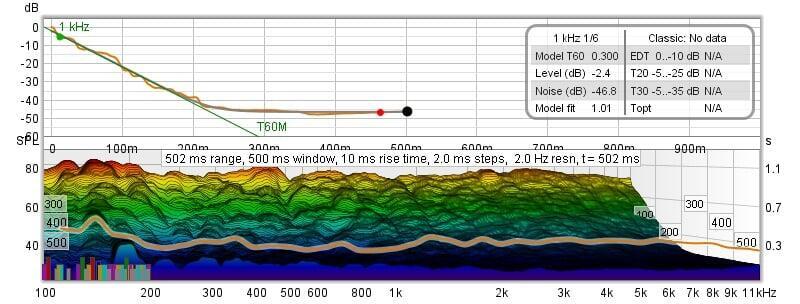
RT60 Measurement using REW (Room Eq Wizard)
As the graph shows, the decay time is controlled and consistent. This isn’t just a single-band success; every frequency band—from the deep bass to the high-frequency transients—falls within the strictly recommended professional limits.
Knowledge Over Brands
This level of consistency is never an accident. It is the direct outcome of:
- Acoustic Expertise: Understanding how sound interacts with specific room volumes.
- Reference-Level Design: Using tools like REW (Room EQ Wizard) to verify every design choice.
- Precise Execution: Ensuring that the placement of every acoustic panel and speaker is mathematically correct.
You can achieve exceptional, fatigue-free results even with ordinary equipment if the engineering is right. In the world of high-end cinema, scientific knowledge matters more than expensive brand logos.
Frequently Asked Questions about RT60 & Acoustic Design
What exactly is RT60, and why does it matter in a Home Cinema?
RT60 stands for “Reverberation Time.” It is the time it takes for a sound to decay by 60 decibels after the source has stopped. In a luxury home theater, if the RT60 is too high, the sound becomes “muddy” and echoes, making dialogue hard to understand. If it is too low, the room feels “dead” and unnatural. Achieving the perfect balance is the core of professional Home Theater Acoustic Design.
Can I fix my room acoustics just by buying expensive speakers?
No. This is the most common mistake in high-ticket projects. Even the best speakers in the world will perform poorly in a room with uncontrolled reflections. Think of it like driving a Ferrari on a muddy, unpaved road. The “road” is your room’s acoustics. You must treat the room first to hear the true potential of brands like Krix or Perlisten.
How do you measure RT60 accurately?
We use professional-grade calibration microphones and REW (Room EQ Wizard) software to capture the “Impulse Response” of the room. By analyzing the decay time across all frequencies—from deep 20Hz bass to 20kHz highs—we can identify exactly which acoustic treatments are needed to reach Reference Level standards.
Leave a Reply