One loudspeaker. Two published numbers. Three decibels apart. Only one of them belongs in a design calculation — and choosing wrong costs you eight times the amplifier.
Every speaker sensitivity SPL calculation starts with one number copied from a specification sheet. If that number is the wrong kind of number, everything downstream is wrong — the amplifier size, the headroom, and the moment the system runs out of both.
Most specification sheets print a single sensitivity figure and never say what kind it is. A small number of manufacturers print two figures for the same loudspeaker, three decibels apart. Only one of the two belongs in a calculation.
Three decibels sounds like a rounding error. In amplifier terms it is exactly double.
What does speaker sensitivity actually mean?
Speaker sensitivity is how much sound pressure a loudspeaker produces at one metre when a defined electrical input is applied. It is written as a decibel value with two conditions attached — the input and the distance. For example: 90 dB (2.83 V / 1 m).
The international measurement standard, IEC 60268-5, defines it more strictly than the market does. Three of its requirements almost never survive into a consumer specification sheet:
- Sensitivity is defined within a stated frequency band. The band must be declared. A figure averaged across a broad band is not the same figure as a single reading at one frequency.
- It is measured in free-field or half-space free-field conditions. Free field means an anechoic environment, where sound pressure falls with distance according to the inverse square law. Half space means the loudspeaker is flush with a large reflecting surface — a baffle wall, for example.
- Measurement uncertainty must be declared. The standard requires the frequency range over which total measurement error stays within ±2 dB to be stated alongside the result.
The standard also requires the mounting condition to be described with the results. Free-standing, on a standard baffle, or flush in a reflecting plane — each produces a different number from the same loudspeaker.
A sensitivity figure quoted without its measurement conditions is not a specification. It is a number.
Why does one loudspeaker have two different sensitivity numbers?
Because a room adds output the loudspeaker did not produce, and a handful of manufacturers are transparent enough to report both figures.
Paradigm is one of them. Their Founder 120H is published at 95 dB in-room and 92 dB anechoic. The same 3 dB gap appears across their range and across product generations — 91/88, 92/89, 89/86. Both figures printed, both labelled, nothing hidden.
That consistency is itself informative. An identical 3 dB gap across separate product families is not a series of individual room measurements. It is a house assumption applied to the anechoic result — reasonable engineering shorthand, and unusable as a design input for your room.
Manufacturers are candid about how large the gap can get. Dynaudio’s published engineering explainer states that in-room sensitivity ratings can be up to six decibels above an anechoic measurement, and that measurements must be carried out uniformly to be comparable at all.
So a buyer comparing a 95 dB loudspeaker against a 92 dB loudspeaker may be comparing the same loudspeaker.
Which sensitivity number should an SPL calculation use?
The anechoic figure. Always. This is not a preference — it is what the design standards specify.
CEDIA/CTA-RP22, the immersive audio design recommended practice, is the only objective performance framework the industry has. Where it defines how to predict sound pressure level at a seat, its wording is explicit: the maximum predicted SPL difference is calculated using anechoic propagation loss.
RP22 in turn depends normatively on ANSI/CTA-2034, the standard method of measurement for in-home loudspeakers. That standard contains a section titled Estimating In-Room Response from Anechoic Data, and an appendix for calculating maximum usable SPL in a non-anechoic environment.
Read those two facts together and the logic is settled. The standards treat anechoic as the measured input and in-room as the derived output. A manufacturer publishing only an in-room number has published somebody’s answer and withheld the question.
What about room gain — isn’t it real?
It is entirely real. It is also a property of the room, not of the loudspeaker — frequency-dependent, position-dependent, and strongest below the room’s transition frequency, which RP22 places between roughly 150 Hz and 500 Hz in small rooms. Below that point the room dominates through boundary loading and modes. Above it, what reaches the seat is governed mainly by the loudspeaker’s own on-axis and off-axis behaviour.
Reflected energy still adds level across the whole band. It simply adds a different amount in every room, at every seat, at every frequency. That is exactly why the two belong in separate columns. Anechoic sensitivity is a property you can carry from one project to the next. Room gain has to be measured in the room it belongs to.
One objection worth answering
In a real room the measured loss with distance is less than 6 dB per doubling, because reflected energy fills in behind the direct sound. That is true, and it is precisely why RP22 specifies anechoic propagation loss. Designing to the free-field figure produces a prediction that is conservative, repeatable, and comparable between two different rooms and two different designers.
Whatever the room gives back is margin. It is not budget.
Most systems that disappoint were not built with the wrong equipment. They were built from the right equipment and the wrong number — and the shortfall only appears when the soundtrack demands everything at once.
Have your specification checked before you commit →How much amplifier power does each 3 dB actually cost?
Exactly double. Every time. This is the part of the arithmetic that surprises people, so it is worth seeing laid out.
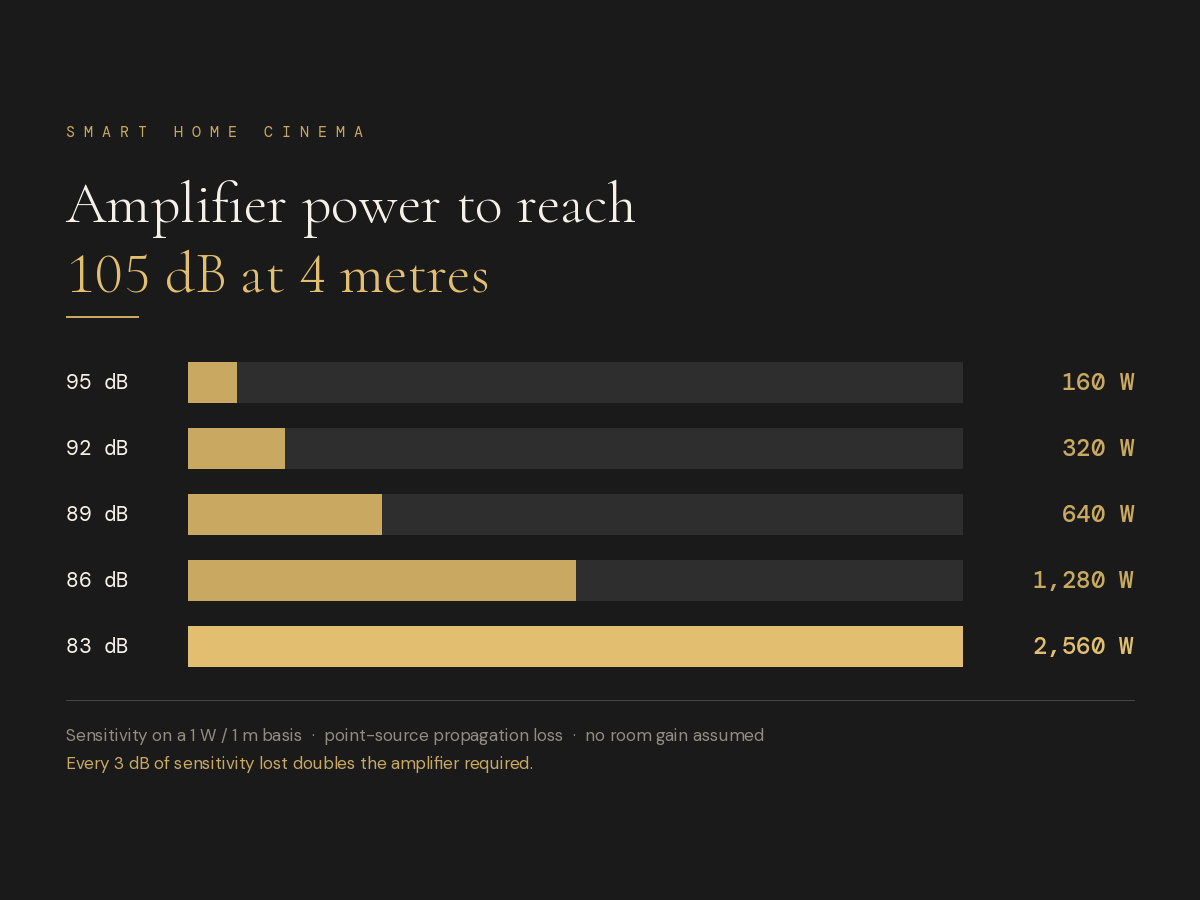
Take a realistic dedicated room. Target 105 dB peak at the reference seating position — Dolby’s reference alignment for a main channel. Seating distance from the screen wall: 4 metres, typical of a dedicated room in a South Indian villa.
A point-source loudspeaker loses 6 dB for every doubling of distance. From 1 metre to 4 metres that is 12 dB. So the loudspeaker must produce 105 + 12 = 117 dB at one metre.
Here is what that requires, across the sensitivity range you will actually encounter on spec sheets:
| Sensitivity (1 W / 1 m) | Required at 1 m | Amplifier power | Relative to 95 dB |
|---|---|---|---|
| 95 dB | 117 dB | 160 W | — |
| 92 dB | 117 dB | 320 W | 2× |
| 89 dB | 117 dB | 640 W | 4× |
| 86 dB | 117 dB | 1,280 W | 8× |
| 83 dB | 117 dB | 2,560 W | 16× |
Nine decibels — the distance between a well-engineered loudspeaker and an ordinary one — is eight times the amplifier. This is why sensitivity is not a specification to skim past. It is the single number that sets the cost of everything downstream of it.
How does a 5 dB error happen in practice?
Not through carelessness. Through two small, reasonable-looking assumptions stacked on top of each other.
Consider a loudspeaker whose specification sheet leads with 91 dB. That figure is the in-room number, and the loudspeaker is a 4-ohm design. Here is what happens to it on the way to an honest calculation:
What the undersized amplifier actually delivers
Follow it through. 400 watts into 4 ohms is 40 volts. Measured against the 2.83 V reference, that is 23 dB of gain. Added to the true anechoic sensitivity of 89 dB, output at one metre is 112 dB. Subtract the 12 dB of distance loss and the seat receives 100 dB.
The target was 105 dB. The system lands 5 dB short of reference — before any allowance for power compression, and before anyone checks whether the amplifier holds its rating into the loudspeaker’s impedance minimum.
Five decibels is not a rounding error. RP22 notes that deviations in tonal balance of as little as one or two decibels can profoundly affect the audibility of sound effects and the character of music. A 5 dB shortfall in headroom is not a slightly quieter system. It is a different system.
Why does 2.83 volts matter more than one watt?
Because a loudspeaker is a voltage-driven device, and quoting power conceals the impedance.
2.83 volts delivers exactly one watt into 8 ohms. The two units are interchangeable at 8 ohms and nowhere else. Below 8 ohms the same voltage delivers more power — so the sensitivity figure improves without the loudspeaker being any more efficient.
| Nominal impedance | 2.83 V delivers | To compare on a 1 W basis |
|---|---|---|
| 16 ohms | 0.50 W | add 3 dB |
| 8 ohms | 1.00 W | no change |
| 6 ohms | 1.34 W | subtract 1.25 dB |
| 4 ohms | 2.00 W | subtract 3 dB |
Nominal impedance deserves its own scrutiny
Under the IEC method, a loudspeaker labelled 8 ohms should not fall below 6.4 ohms; one labelled 4 ohms should not fall below 3.2 ohms. Independent measurement regularly finds loudspeakers marketed as “compatible with 8 ohms” whose real minimum sits closer to 3 ohms, with an effective load lower still across much of the audio band.
The sensitivity figure in those cases is usually honest. The impedance label is generous. Read the minimum, not the nominal — that is the number your amplifier has to survive.
What a good specification sheet looks like
The loudspeakers in our own reference room are Krix. Their sheet publishes the Megaphonix at 95 dB (2.83 V / 1 m) with 8-ohm nominal impedance. Because it is 8 ohms, that figure is the same on either basis — no conversion needed. Voltage stated, impedance stated, nothing for the designer to guess.
One thing the sheet does not state is the measurement environment. We have asked. Until we have that answer in writing we design our own rooms from the conservative reading — treating the published figure as though the room contributed nothing. If it turns out to be anechoic, every system we have specified simply has more headroom than we allowed for.
That is the discipline this article is arguing for, applied to our own brand: convert what you can, ask what you cannot, and let the unknown work in the client’s favour rather than against it.
What does speaker sensitivity not tell you?
Four things, and each one needs its own data.
It does not tell you maximum SPL
Sensitivity is a small-signal measurement. Maximum output is separately standardised: AES75-2022 measures maximum linear sound levels using M-Noise, a signal derived from analysis of hundreds of music recordings, raising level in 3 dB steps until the loudspeaker stops responding linearly. Power handling is not maximum SPL either — ANSI/CTA-2034 states plainly that it determines audio performance, not a loudspeaker’s ability to survive a given input signal.
It does not hold at high output
As a voice coil heats, its resistance rises, the amplifier delivers less power into it, and sensitivity falls. Copper’s resistance climbs roughly 0.4% per degree Celsius; a coil rising from 20 °C to 200 °C loses close to 5 dB. In home cinema this is a sustained-output concern for a hard-driven centre channel rather than a headline effect — but in a passive multi-way loudspeaker the shifting coil resistance also moves the crossover point, which changes tonal balance and not merely level.
It does not tell you anything about quality
Sensitivity says nothing about tonal accuracy, off-axis behaviour, distortion or coloration. Off-axis behaviour is what actually fills a multi-seat room, which is the entire reason ANSI/CTA-2034 measures directivity at all — because on-axis response and a single sensitivity figure do not predict how a loudspeaker sounds in a room.
It does not tell you what your room will do
Two identical loudspeakers in two Madurai rooms with different construction will measure differently at the seat. That part is measured, never predicted. Acoustic treatment is what makes the room’s contribution consistent enough to design around.
How should an integrator read a sensitivity specification?
Six checks, in order. They take under a minute per loudspeaker.
- Is it anechoic or in-room? If the sheet does not say, assume in-room and ask the manufacturer.
- Is it voltage or power? 2.83 V / 1 m is the useful form.
- What is the nominal impedance? Convert to a one-watt basis before comparing across brands.
- What is the minimum impedance? Not the nominal. This is what the amplifier actually sees.
- Which frequency band? A band-limited average and a single-frequency reading are different numbers.
- Is there separate maximum SPL data? Sensitivity plus power handling is not an output figure.
If any of the first four is missing, the specification cannot be used for design. It can only be used for marketing.
For how these figures map onto defined performance targets, see our guide to immersive audio system architecture and CEDIA RP22 performance levels.
What it looks like when the arithmetic is respected
Our Krix Reference Level Experience Center in Anna Nagar, Madurai exists partly to close the gap between what a calculation predicts and what a room delivers.
The reference system there was measured with a miniDSP UMIK-1 and REW across all six seats. Peak level reached 124.7 dB LZpeak. C-weighted maximum short-term level varied by 3.1 dB across the six seats.
The experience centre is CEDIA RP22 Level 1–2 compliant, and is one of the few properly calibrated immersive audio environments in South India. Reference-level home cinema design across South India starts at ₹50 lakhs, because the engineering that closes a 5 dB gap is design work rather than a product choice.
Frequently Asked Questions
Is higher speaker sensitivity always better?
No. Sensitivity tells you how much amplifier power a loudspeaker needs, not how well it performs. A highly sensitive loudspeaker can still have uneven frequency response, poor off-axis behaviour or high distortion. Use sensitivity for amplifier matching and system headroom, never as a measure of quality.
What is the difference between anechoic and in-room speaker sensitivity?
Anechoic sensitivity is measured in a reflection-free environment and describes the loudspeaker alone. In-room sensitivity includes the reinforcement a room contributes, typically 2 to 6 dB. Design calculations must use the anechoic figure, with room gain added separately as its own declared term.
Should I use 1W/1m or 2.83V/1m for speaker sensitivity calculations?
Use 2.83 V / 1 m where available, because it removes impedance from the comparison. The two units are identical at 8 ohms only. For a 4-ohm loudspeaker, subtract 3 dB from the 2.83 V figure to obtain the one-watt equivalent. For 6 ohms, subtract 1.25 dB.
How much amplifier power do I need to reach reference level?
It depends on sensitivity, impedance and seating distance, not room size alone. At 4 metres, reaching 105 dB peaks needs about 160 watts from a 95 dB (1W/1m) loudspeaker, about 640 watts from an 89 dB loudspeaker, and about 2,560 watts from an 83 dB loudspeaker. Every 3 dB of sensitivity lost doubles the amplifier required.
Why does SPL drop 6 dB when listening distance doubles?
Because a conventional loudspeaker radiates as a point source, spreading energy over a spherical wavefront. CEDIA/CTA-RP22 defines this as a quartering of sound pressure, or minus 6 dB, for every doubling of distance. Line-source loudspeakers behave differently, losing 3 dB per doubling in free field.
Does acoustic treatment reduce my speaker’s effective sensitivity?
A well-treated room measures closer to the anechoic figure than an untreated one, because there is less reflected energy adding to the direct sound. This is a reason to design from the anechoic number rather than an argument against treatment. A treated room delivers cleaner and far more predictable output at the same level.
Can a loudspeaker specification sheet be wrong?
Rarely wrong, frequently incomplete. Independent laboratory measurements of loudspeakers from manufacturers who publish anechoic figures have returned results around 2 dB below the published claim, using a stated measurement weighting different from the manufacturer’s. The more useful question is not whether the number is wrong, but whether the sheet tells you enough to convert it.
The number decides the room
A speaker sensitivity SPL calculation is only as good as the kind of number it begins with. The design standards compute from anechoic data. Most specification sheets publish in-room data. The gap between them, compounded by an unconverted impedance, is routinely 5 dB — the difference between a system that reaches reference level and one that runs out of headroom exactly when the soundtrack needs it most.
Getting this right costs nothing at the design stage. Getting it wrong costs an amplifier, and occasionally a loudspeaker.
A room designed around the correct numbers behaves the way the prediction said it would. That is not luck. It is arithmetic, done before anything is bought.
Discuss Your Project on WhatsApp →