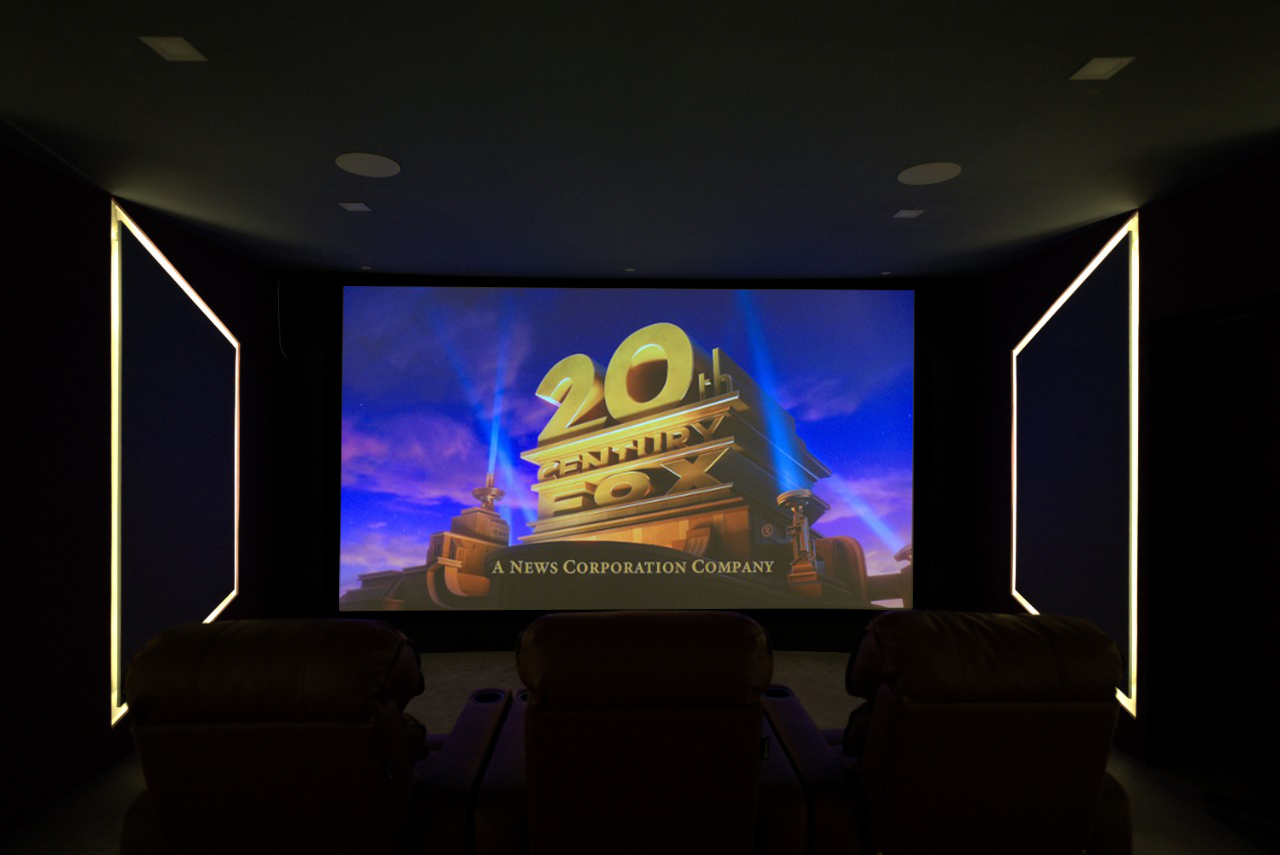
All home cinema designs require a careful mix of Science & Art.
Many rooms look like a theater, but if you can't comfortably sit down and immerse yourself in a film for hours — if you can't pick up on the subtle emotional qualities in the actors voices while at the same time fully appreciating that big action scene, you're not really getting the experience you're looking for.
" Treat Your Room Right, and it shall treat you the same "
Acoustic treatment is essential to achieving the best audio performance in home cinema. The acoustic distortion introduced by the room can be so influential that it dominates the overall sonic impression. The tone and timbre of the speakers can also vary significantly depending on the speaker / listener positions and the room acoustics. Even top-of-the-range speakers will fail to sound at their best if installed in an inadequate audio environment.
We measure and model your room with cutting-edge acoustic tools to understand the acoustic issues in your room. Then we develop solutions and review with you. Our Acoustic Solutions creates Immersive audio mimics a true-to-life experience by allowing the viewer to hear in all directions.
Measured Results
What Our Measurements Show — RT60 Before and After
RT60 is the time sound takes to decay by 60 dB after the source stops.
It is the core measurement of how a room holds sound. A room that is too live smears dialogue;
a room that is too dead loses energy and envelopment.
In the room shown above, measured with REW on the centre channel — same room, same microphone
position, no EQ — the 1 kHz decay fit shown in the graphs fell from 0.64 s to 0.30 s. More
importantly, the result held across the band. The table below uses the same method for every
band, so before and after compare like for like.
RT60 (Topt) and speech clarity (C50) before and after acoustic treatment, measured with REW
Measurement
250 Hz
500 Hz
1 kHz
2 kHz
4 kHz
8 kHz
RT60 before (s)
0.76
0.68
0.69
0.56
0.56
0.47
RT60 after (s)
0.32
0.31
0.32
0.34
0.35
0.29
C50 before (dB)
2.8
4.9
3.4
6.3
5.4
6.4
C50 after (dB)
8.7
14.1
11.4
10.3
9.6
11.7
RT60 values are REW's Topt: the decay slope over the range that gives the
best straight-line fit. Every RT60 value shown has a fit correlation of 0.99 or better, the
threshold REW uses for a reliable figure. C50 = speech clarity, the ratio of sound energy arriving
in the first 50 ms to the energy arriving later; higher is clearer. Values are 1/3-octave bands at
the listed frequencies, measured with REW and a UMIK-1 microphone. The graphs above show REW's
1/6-octave decay fit at 1 kHz, so their 1 kHz figures differ slightly from the table.
After treatment, RT60 stayed between 0.29 s and 0.35 s at every band from 250 Hz to
8 kHz, where before it ranged from 0.47 s to 0.76 s. Speech clarity (C50) rose at every
band shown, by about 4 to 9 dB. This is a room result, not a panel specification.
Why one number is not enough
Hitting a target at 1 kHz is not difficult. The common failure is what happens at the
frequency extremes. Thin absorbers work mostly on mid and high frequencies. In rooms treated with
thin absorption only, we often measure a reasonable figure at 1 kHz, under 0.2 s in the treble,
and over 0.8 s near 100 Hz. The treble is dead and the bass still rings. That is why we measure
and report the whole band, not one frequency.
How we design before we install
Measure the untreated room with REW.
Predict RT60 by frequency band for the proposed treatment layout using our RT60 predictor — before any panel is ordered.
Install absorption, bass trapping and diffusion to that plan.
Verify with the same measurement position and no EQ.
The Truth About Acoustic Treatment
Your Room Is Fighting Your Equipment.
Most People Never Realise It.
You invest heavily in speakers, amplifiers, and a projector. But if your room acoustics
are wrong, that investment is working against itself. The room introduces reflections,
bass buildup, and echo that even an excellent speaker cannot overcome on its own.
Acoustic treatment is not a luxury add-on. It is the foundation everything else sits on.
The difference between a room with proper acoustic treatment and one without is not subtle.
It is the difference between hearing a movie and being inside it.
❌ Common Misconception
"Acoustic Treatment Is Not About Layer Count"
Unfortunately, many home cinemas today use generic 3-layer or 6-layer panel systems without actual acoustic engineering. Real cinema acoustics must be designed scientifically for the specific room, not built from a standard template. When installed inside a cinema room, they aggressively
absorb mid and high frequencies while doing little to control low-frequency bass buildup. The result
is an acoustically dead room — dialogue sounds muffled,
bass is boomy and uncontrolled, and an expensive audio system performs well below its capability.
True acoustic treatment is not defined by how many foam layers are installed. Acoustic performance comes from proper control of reflections, bass behavior, decay time, speaker interaction, and room geometry — not from stacking multiple materials on walls. True acoustic treatment uses the right material, in the right thickness, at the right
position — calculated for your specific room dimensions, speaker layout, and listening
positions. It controls what needs controlling, preserves what needs preserving, and allows
your equipment to perform as its designers intended.
This is how we design every room.
The Three Pillars of Acoustic Treatment
🟫
Acoustic Absorption Panels
Placed at precise first-reflection points on walls and ceiling. Controls flutter echo
and mid-to-high frequency reflections that blur imaging and reduce clarity. Broadband
absorbers specified for the room — not decorative foam.
📐
Bass Traps
Installed in room corners where low-frequency energy builds up most severely. Reduces
bass peaks and the effect of room modes — the invisible distortions that make bass sound boomy
in one seat and thin in another. No calibration can fully fix what bass traps must solve.
🔷
Diffusers
Mounted on rear walls to scatter sound energy rather than absorb or reflect it directly.
Creates the spacious, enveloping soundfield that makes you feel surrounded by the movie —
the defining quality of true immersive audio.
Acoustic Panels Partner
The absorption panels, bass traps, and diffusers we design and install are supplied through
GreatSound Acoustics — our specialist acoustic brand dedicated exclusively
to precision acoustic solutions for home cinema and professional spaces.
Beautiful Interiors Need Engineered Acoustics Behind Them.
The home cinema market is full of beautiful-looking rooms that sound terrible. Star ceilings,
LED accent lighting, custom wall panels, motorised recliners — all of it looks impressive in
a photograph. But if the acoustics are wrong, the room is likely to fall out of use within months.
The novelty fades. The bad sound stays.
A home cinema is defined by what you hear, not what you see.
We have seen clients spend ₹15–20 lakhs on interiors and below ₹10 lakhs on audio — and hate the room.
We have also seen clients do the opposite — and never want to leave it. Acoustic science is what
separates one from the other.
❌ What People Think Makes a Cinema
Star ceiling and LED lighting effects
Fancy decorative wall panels
Motorised leather recliners
Colorful Lights
Most expensive speakers money can buy
“Smart controls” being treated as the main cinema experience
✓ What Actually Makes a Cinema
Scientifically treated room acoustics
Properly placed absorption panels and bass traps
HAA certified speaker placement and calibration
Controlled bass response at every seat
Right equipment matched to room size
Diffusion for true immersive soundfield
Frequently Asked Questions
Acoustic Treatment — What You Need to Know
What is the difference between soundproofing and acoustic treatment for home cinema?
Soundproofing blocks sound from entering or leaving a room — it requires mass, structural decoupling, and air gaps. Acoustic treatment manages how sound behaves inside the room — controlling reflections, bass buildup, and decay time. For a home cinema, acoustic treatment is what makes your system sound accurate and immersive. They solve different problems, and confusing the two is a common and costly mistake.
Do I need acoustic treatment if I already have good speakers?
Yes. High-quality speakers reveal room problems more clearly, not less. An untreated room adds reflections, bass buildup, and standing waves that degrade even an excellent speaker system. Acoustic treatment reduces those problems so the speakers can perform as designed.
Why can too much absorption make a room sound dead?
Thin absorbers work mostly on mid and high frequencies. When large areas are covered with them, the treble decays too quickly while the bass still rings. In rooms treated with thin absorption only, we often measure a reasonable figure at 1 kHz, under 0.2 s in the treble, and over 0.8 s near 100 Hz. The room sounds dull and boomy at the same time.
What acoustic treatment does a home cinema room need?
Three elements working together: absorption panels at first reflection points on the walls and ceiling to control reflections and flutter echo; bass traps in the corners to reduce low-frequency buildup and the effect of room modes; and diffusers on the rear wall to scatter sound and create an enveloping soundfield. Placement and material are calculated for the specific room, not estimated.
What is RT60 and why does it matter?
RT60 is the time sound takes to decay by 60 dB after the source stops. It shows how long a room holds sound. Too long, and dialogue smears; too short in the treble, and the room sounds dead. It should be read across the frequency range, not at one frequency.
What result can acoustic treatment achieve in a real room?
In a room we measured with REW on the centre channel — same microphone position, no EQ — RT60 at 1 kHz fell from 0.64 s to 0.30 s. Across the octave bands from 250 Hz to 8 kHz, RT60 after treatment stayed between 0.29 s and 0.35 s. Speech clarity (C50) at 1 kHz rose from 3.4 dB to 11.4 dB. This is a room result, not a panel specification.
How do you design acoustic treatment before installing it?
We measure the untreated room with REW, predict RT60 by frequency band for the proposed treatment layout using our RT60 predictor, install the absorption, bass trapping and diffusion to that plan, and then verify with the same measurement position and no EQ.
How much does acoustic treatment cost for a home cinema in India?
It depends on room size and the number of absorbers, bass traps, and diffusers the room needs. We design acoustic treatment as part of a complete home cinema. Complete projects start from ₹8 lakhs in Madurai and surrounding districts, ₹20 lakhs in Trichy, Coimbatore, Salem and Tiruppur, and ₹50 lakhs in Chennai and the rest of South India. Panels are supplied through GreatSound Acoustics. Consultations are by appointment at our Experience Center in Madurai.
A properly treated room is easier to hear than to describe. We promise to take you inside
the movie, not just watching it. Visit our Krix Reference Level Experience Center in Madurai.
One hour. No obligation.
Acoustic treatment is designed as part of a complete home cinema.
Complete projects start from ₹8 lakhs in Madurai and surrounding districts, ₹20 lakhs in Trichy,
Coimbatore, Salem and Tiruppur, and ₹50 lakhs in Chennai and the rest of South India.