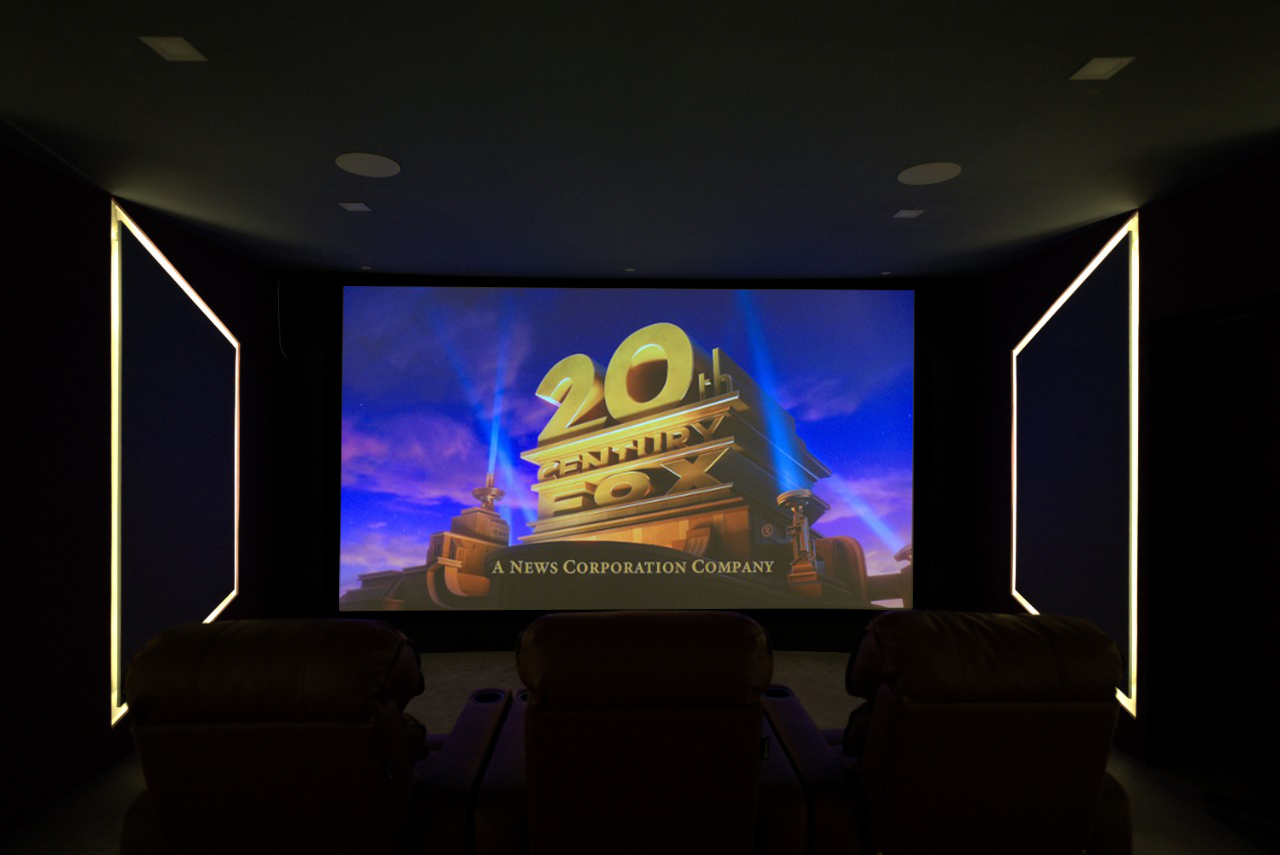
Home Cinema Audio Calibration in South India
Measured Calibration, Verified at Every Seat
Home cinema audio calibration is the measured adjustment of every channel's level, timing, crossover and equalisation, so the system performs as designed across the seating area, not just at one seat.
At SMART Home Cinema, calibration is part of every project we design and install across Tamil Nadu and South India, from our base in Madurai. Each project is calibrated by our founder, Paul Joseph Klattan, HAA Level 3 certified and a Trinnov Certified Professional. Results are measured with Room EQ Wizard (REW) and a calibrated microphone before and after calibration.
What does audio calibration actually adjust?
Calibration covers six areas. Each change affects the others, so they are revisited until the measurements agree:
- Channel levels. Each speaker is set to the same sound level at the main listening position, using a test tone and a calibrated microphone. Where that position sits matters; see why most people sit in the wrong spot.
- Distance and delay. Arrival times are aligned so every channel reaches the listener in the intended time relationship.
- Bass management. A crossover is chosen for each speaker, deciding which frequencies it plays and which go to the subwoofers.
- Subwoofer integration. Level, delay and polarity are set for each subwoofer, so the subwoofers work together across the seats and add to the main speakers at the crossover instead of cancelling.
- Equalisation. Targeted cuts are applied to the response peaks the room creates.
- Verification. Everything is re-measured to confirm each change did what it was meant to.
Is the auto-calibration in an AV receiver enough?
Capabilities vary by processor. Basic auto-setup usually gets levels and distances close, and more advanced room-correction software can also align several subwoofers automatically and improve consistency between seats. What professional calibration adds is judgement and proof:
- Placement decisions. Software can change each subwoofer's timing and level, but not where it sits, and position decides which room resonances it excites.
- Target selection. A trained person chooses the target response and decides which bands to correct.
- Knowing what not to correct. A dip caused by cancellation does not respond to boost, and boosting it spends amplifier and driver headroom for little gain.
- Independent verification. The result is re-measured at every seat with a separate calibrated microphone.
What can EQ fix, and what can't it?
Equalisation (EQ) is effective at reducing bass peaks the room creates. It generally cannot fill cancellation nulls, a single shared EQ cannot fix bass differences between seats, and no EQ fixes reflections or reverberation.
- Room peaks: yes. EQ can reduce bass peaks the room creates.
- Cancellation nulls: generally no. A null caused by cancellation does not respond to boost.
- Differences between seats, with one shared EQ: no. A single EQ on the combined subwoofer signal moves every seat by the same amount. In our own reference room, an earlier shared EQ flattened the average bass but left the seat-to-seat difference almost unchanged: 8.4 dB before, 8.3 dB after (mean difference, 30–80 Hz, 1/6-octave smoothing). Separate settings for each subwoofer are a different tool, covered below.
- Reflections and reverberation: no. These are acoustic treatment problems, starting with the first reflection points. Our RT60 case study shows what treatment changes in a measured room.
In a bass-managed system, bass is progressively redirected to the subwoofers, with the speakers and subwoofers overlapping around the crossover. That is why bass problems are usually solved through subwoofer placement and integration, not by adjusting the main speakers.
How do multiple subwoofers even out bass across seats?
A single subwoofer excites the room's resonances in one pattern, so seats that sit in a dip hear less bass. Several subwoofers, each with its own delay, level and polarity, can drive those resonances in ways that reduce the difference between seats. The improvement depends on the room and on placement; adding subwoofers does not guarantee it. For the listener's side of the same problem, read why your seat matters more than your subwoofer.
Our reference room uses four Krix Cyclonix 12 subwoofers, each set individually for delay, level and polarity.
How consistent is the bass across seats after calibration?
After per-subwoofer alignment, the largest bass difference between any two of the six seats in our reference room fell from 14.6 dB to 6.9 dB (20–100 Hz). Between 20 and 30 Hz it fell from 14.6 dB to 3.2 dB.
We measured all six seats with REW and one calibrated microphone at the same positions, subwoofers only. Seats are labelled FL, FC, FR for the front row (left, centre, right) and RL, RC, RR for the rear row. "Before" is the room's previous subwoofer settings; "after" is per-subwoofer time alignment and new EQ.
| Measured at six seats (subwoofers only) | Before | After |
|---|---|---|
| Largest difference between seats, 20–100 Hz | 14.6 dB | 6.9 dB |
| Largest difference between seats, 20–30 Hz | 14.6 dB | 3.2 dB |
| Seat-to-seat standard deviation, 20–100 Hz | 2.7 dB | 1.3 dB |
Largest difference = loudest seat minus quietest seat at any single frequency in the band. Standard deviation = spread of the six seat levels at each frequency, averaged across the band. At finer 1/6-octave resolution the improvement holds: largest difference 20–100 Hz 21.9 → 12.4 dB, 20–30 Hz 21.9 → 3.1 dB. Because one shared EQ moves every seat by the same amount, the reduction in seat-to-seat difference comes from the per-subwoofer alignment. Room result at our experience center, not a product specification.
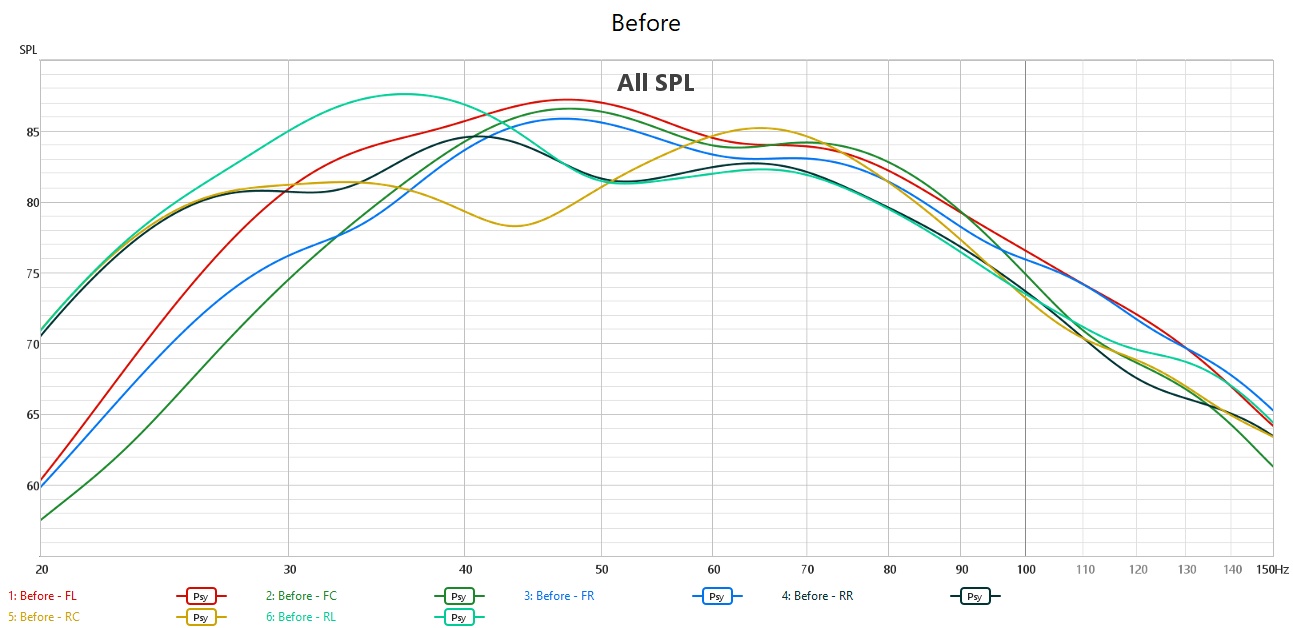
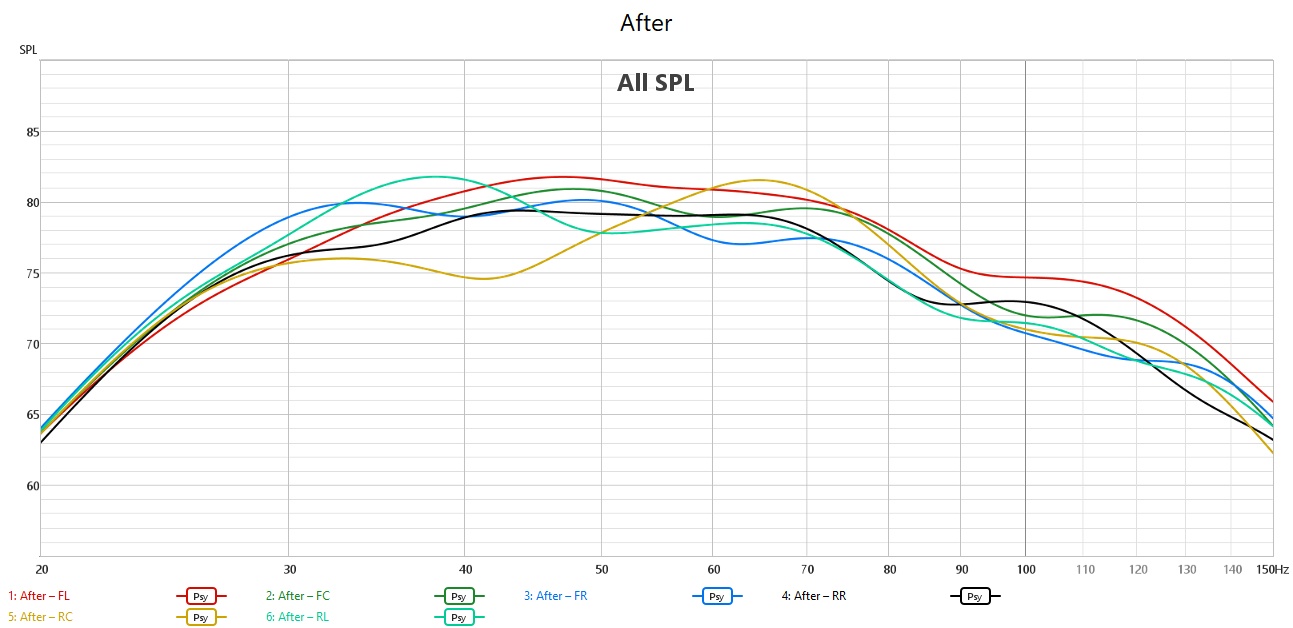
The six-seat average tells a different story. Before calibration, the averaged response was already smooth, staying within 4 dB from 30 to 80 Hz, yet in the same band individual seats differed by up to 10.5 dB. An average hides what each seat actually hears, which is why we judge the result seat by seat.
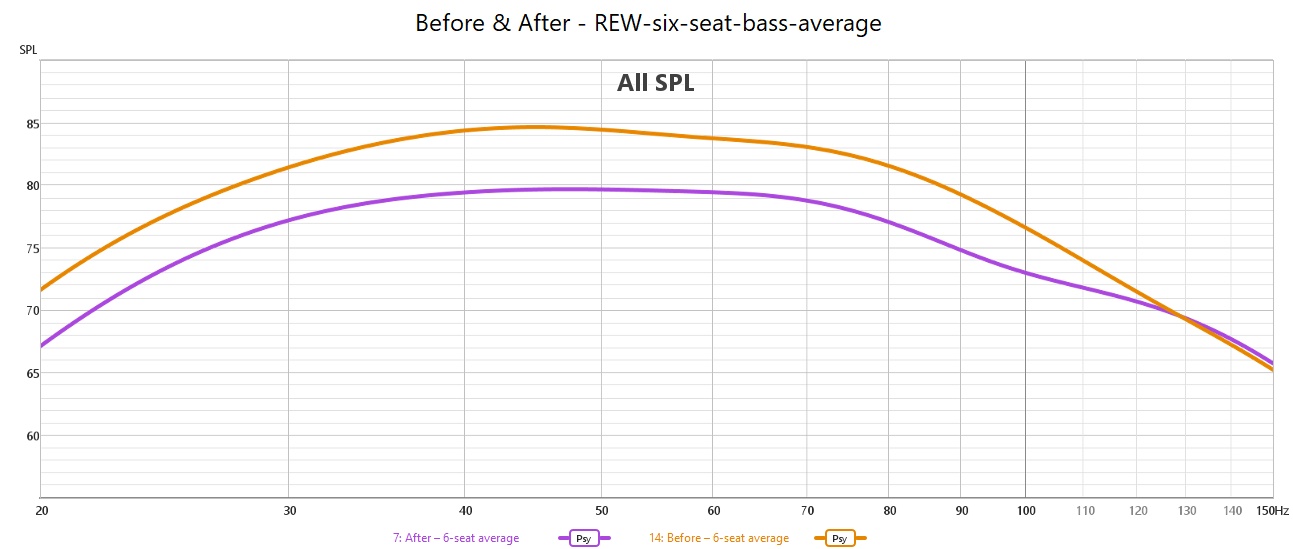
In plain terms, the largest bass difference between any two seats was roughly halved, and between 20 and 30 Hz the six seats now sit within about 3 dB of each other. Not every seat becomes identical; the room still decides part of the result.
Before changing any setting, we predicted the combined result from measurements of each subwoofer alone. At each of the six seats, the measured result matched the prediction within 0.4 to 1.1 dB (RMS difference, 20–100 Hz).
How is the subwoofer handover to the main speakers checked?
Where the centre speaker and the subwoofers overlap, their outputs can partly cancel. Aligning the subwoofer timing at the main seat reduced the worst cancellation from 7.6 dB to 4.8 dB (measured against the level the two would reach if they added without cancelling), and the peak-to-peak variation from 40 to 150 Hz from 19.5 dB to 14.4 dB (1/6-octave smoothing). The AV receiver in this room uses one subwoofer distance for all channels, so the left and right speakers were checked at the same setting.
Why does calibration come after design and treatment?
The order is room design, then acoustic treatment, then speaker placement, then calibration. Calibration refines a well-designed system; it cannot rescue a speaker in the wrong position or a room that rings. Our speaker placement guide covers the step before calibration. See our approach to home cinema design.
What does HAA Level 3 certification mean?
The Home Acoustics Alliance is a professional certification body for home cinema acoustics and calibration, and Level 3 is its highest tier. It is Paul's personal certification. He is also a Trinnov Certified Professional. For picture accuracy, see our video calibration page.
Can I hear a calibrated system before I commit?
Yes. Our Krix Reference Level Experience Center in Anna Nagar, Madurai, Tamil Nadu pairs Krix Megaphonix LCR speakers with four Krix Cyclonix 12 subwoofers and four Krix Phonix Flat surrounds. The system is calibrated so that master volume 0 dB equals cinema reference level at the main listening position, verified by measurement. Demonstration volume is then set to suit each source and film. Visits are by appointment. For what reference volume actually demands of a system, read why reference level is harder to reach than you think. Explore our home cinema packages.
Frequently asked questions
1. What is home cinema audio calibration?
The measured adjustment of each channel's level, timing, crossover and equalisation, so the system performs as designed across the seating area.
2. Is AV receiver auto-calibration enough?
Capabilities vary by processor, and some can align several subwoofers automatically. Professional calibration adds placement decisions, target selection and independent verification at every seat.
3. Can EQ fix bass differences between seats?
Not with one shared EQ, which moves every seat by the same amount. In our reference room, an earlier shared EQ left the mean seat-to-seat difference almost unchanged, at 8.4 dB before and 8.3 dB after. Separate settings for each subwoofer are a different tool.
4. Why use more than one subwoofer?
Several subwoofers, each with its own delay, level and polarity, tend to even out bass between seats. The result depends on the room and on placement.
5. How consistent is the bass across seats after calibration?
In our reference room, the largest difference between six seats fell from 14.6 dB to 6.9 dB (20–100 Hz), and from 14.6 dB to 3.2 dB between 20 and 30 Hz. Measured with Room EQ Wizard (REW), psychoacoustic smoothing.
6. Should calibration come before or after acoustic treatment?
After. Calibration refines the design, treatment and placement; it cannot replace them.
7. What is HAA Level 3?
The highest tier of the Home Acoustics Alliance, a professional certification body for home cinema acoustics and calibration.
8. Can I hear a calibrated system in Madurai?
Yes. The Krix Reference Level Experience Center in Anna Nagar, Madurai, Tamil Nadu is open by appointment.
Discuss your room with us
Send us your room dimensions and seating plan on WhatsApp, or book a visit to hear a calibrated system in person.
 WhatsApp Us


