The front row sees the widest picture. Get that seat right and the rows behind follow.
A large screen makes a strong first impression. In a showroom, or for the first ten minutes of a film, bigger feels better.
In a small home theatre, the first ten minutes are not the test. A two-hour film is. If the projector screen size is wrong for the room, the front row spends that film turning heads, looking up and missing what happens at the edges of the picture.
The fix is simple to say: size the screen for the front row, not the wall and not the back row. This guide explains why, in plain terms, and what it changes for the speakers behind the screen.
What goes wrong when the screen is too big?
The picture becomes wider than the eyes can comfortably take in at once. Viewers in the front row turn their heads to follow action, miss subtitles and details at the edges, and tilt their heads up if the screen is also tall. It feels exciting at first and tiring by the end of a film.
Drawn to scale. From a seat 2.0 m away, a 135″ 16:9 screen spans 74°. The shaded fan is the 61° recommended maximum for 4K video. The dark ends of the screen fall outside it, so the viewer turns the head to follow action at the edges.
- Head turning. When the image is wider than your comfortable field of view, your eyes can no longer take in the whole frame comfortably. You start moving your head left and right to follow the action, like sitting in the first row of a commercial cinema.
- Missed edges. Films are framed so the whole picture is seen at once. When the edges fall outside comfortable vision, subtitles, faces and on-screen text at the sides are missed or need a deliberate glance.
- Neck strain. A big screen is also a tall screen. If the top edge sits high above eye level, the front row watches with the head tilted back for the whole film.
- Fast motion is harder to follow. On a very wide image, quick pans and action scenes cover more of your vision, and many people find them uncomfortable.
None of this shows up in a short demonstration. It shows up at the end of the second film of the evening.
Why does the front row decide the screen size?
Because the front row sits closest, so it sees the screen at the widest angle. You cannot make the front row see less of the screen. If the screen is comfortable for the front row, the rows behind see it at a narrower angle, so in a typical two-row room they are comfortable too.
A common approach sizes the screen for the main seat in the back row, where the owner sits. The back row looks right. The front row, much closer to the same screen, gets an image that is too wide.
Reverse it. Choose the screen so the front row stays within a comfortable limit. The back row then sees a slightly narrower picture than it could have taken — a small loss that nobody feels as discomfort. A picture that is too wide is felt by everyone in the front row, every film.
One check remains for the back row: in a long room, or with a third row, the back seats can end up with a picture that looks too small. That is why every seat is checked, not only the front row.
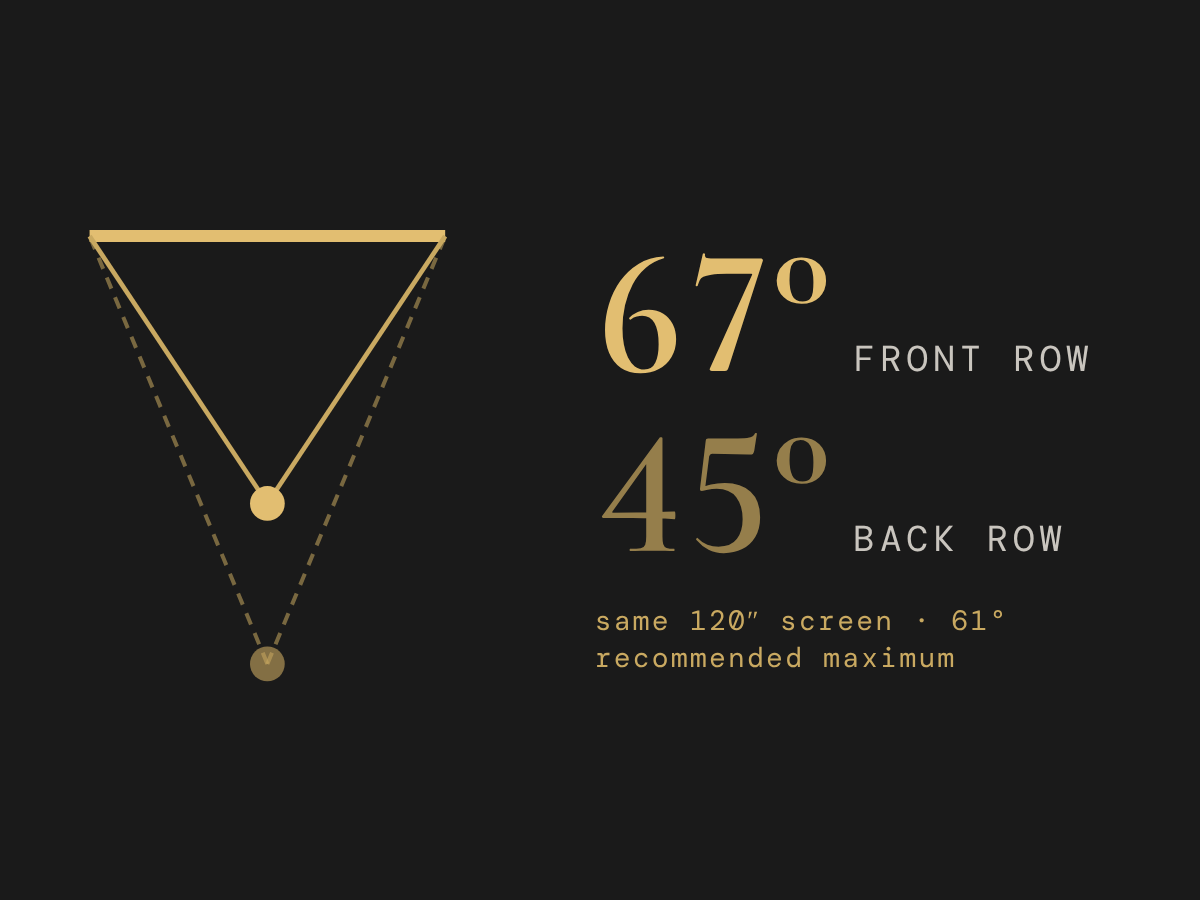
Drawn to scale. The same 120″ screen looks cinema-like from the back row (45°) and too wide from the front row (67°), which is past the 61° maximum.
How big is too big for a small room?
The published upper limit for 4K video is 61° — the width of the picture as seen from the seat. It is a maximum, not a target, and the front row reaches it first. In a two-row room, a screen that looks comfortable from the back row can push the front row well past it.
Viewing angle simply means how wide the picture looks from your seat: the angle between the left and right edges of the image, measured at your eyes. CEDIA/CTA-RP22 cites these reference angles:
| Reference | Horizontal angle |
|---|---|
| HD reference | 33° |
| SMPTE film projection | 43° |
| UHD 4K maximum | 61° |
A worked example: calculated, not measured
Two rows, front row 2.0 m (6 ft 7 in) and back row 3.2 m (10 ft 6 in) from the screen surface, 16:9 screen:
| Screen (16:9) | Front row | Back row | Verdict |
|---|---|---|---|
| 100″ | 58° | 38° | Comfortable for both rows |
| 106″ | 61° | 40° | Largest that keeps the front row inside the limit |
| 120″ | 67° | 45° | Back row looks ideal; front row over the limit |
| 135″ | 74° | 50° | Front row turning heads all film |
| 150″ | 79° | 55° | Both rows too wide |
The 120″ row is the trap. Seen from the back row it is a cinema-like 45°, so it feels like the right choice. From the front row it is 67°, past the limit.
Two points on measuring:
- Measure to the screen surface, not the front wall. An acoustically transparent screen sits forward of the wall with speakers behind it, so every seat is closer to the picture than its distance from the wall suggests.
- These angles change with your own row distances. Use your room’s figures, not this example’s.
For brightness, resolution and projector choice at larger sizes, see why the biggest screen in the room is usually the wrong screen.
A screen that looks right from the back row can still be too big for the front. Checking every seat takes a drawing, not a guess.
Have your screen size checked against every seat →Does screen height matter as well?
Yes. Width decides how much you turn your head; height decides how far you look up. In a small room the front row sits close, so a tall screen mounted high forces the head back. The top edge of the picture should stay at a height the front row can see without tilting up.
RP22 notes that larger screens have pushed vertical viewing angles into a range of roughly 18° to 34°. In practice, two seats set the screen’s height on the wall:
- Front row — the top edge must not sit so high that they watch looking upward.
- Back row — the bottom edge must stay visible over the heads of the front row.
Side view, not to scale. The front row’s upward sightline limits how high the top edge can go. The back row, on a raised platform, must see the bottom edge over the front row’s heads.
When both cannot be met, the screen is too big for the room, whatever the wall allows.
Where do the speakers go when the screen gets bigger?
With an acoustically transparent screen, left, centre and right sit behind the picture at ear height, so dialogue comes from the image. The left and right speakers are placed by their angle from the main seat, not by the edges of the screen. A bigger screen does not move them outward.
There are two kinds of projection screen: acoustically transparent (woven or perforated, so sound passes through) and non-transparent (standard material that sound cannot pass through well).
With a non-transparent screen, the centre speaker sits below or above the picture, so voices come from a different height than the faces speaking them. With an acoustically transparent screen, the centre sits behind the picture and voice and face line up. The three front speakers can also be the same model at the same height, which keeps the sound consistent as it moves across the front.
The left and right speakers are set by their angle from the main listening seat. That angle is about the sound, not the picture. In the rooms we design, with the screen sized for the front row, this usually places them just inside the edges of the image. Make the screen bigger and the speakers do not follow it outward — the picture simply grows past them.
Top view, not to scale. Left, centre and right sit between the front wall and the acoustically transparent screen. The left and right positions are set by angle from the main seat, so they land just inside the image edges rather than at them.
Does an acoustically transparent screen change the sound?
Slightly. Sound passing through the screen loses a little of its highest frequencies. In a calibrated room, that loss is measured at the seat with the screen in place and corrected with equalisation. A small gap between speaker and screen is also planned at design stage, because some effects of the screen cannot be fixed by EQ.
- High-frequency loss. Every transparent material reduces the very top of the treble a little; the amount depends on the weave or perforation. Because calibration measures each speaker at the seat through the screen, the loss shows up in the measurement and is corrected like any other deviation.
- What EQ cannot fix. If a speaker sits too close to the screen, sound reflects between the screen and the speaker front and causes uneven treble that equalisation cannot properly correct. The fix is physical: the right gap, set when the front wall is designed.
Related: the architecture of immersive audio · how we calibrate audio.
Fixed frame or motorised screen in a dedicated room?
Fixed frame, in the dedicated cinemas we build. It keeps the screen flat under even tension, which matters when the front row sits close. Motorised screens, including acoustically transparent ones, suit living rooms where the screen has to disappear.
In our own installations we have seen roll-up screens develop waves and uneven flatness over years of use. This is our field observation, not a manufacturer specification.
What order should these decisions happen in?
Room first, then seats, then screen size from the front row, then screen height, then screen type, then the projector. Choosing the screen or projector first and fitting the room around it is how front rows end up unusable.
- Fix the room and the seating rows.
- Measure the front row’s distance to the screen surface, and size the width so it stays inside the limit.
- Check the height: top edge for the front row, bottom edge for the back row.
- Choose the screen type: acoustically transparent, fixed frame.
- Choose the projector last — see the brightness guide linked in Section 03.
See also how we approach cinema room design.
On investment
Dedicated rooms start from ₹8 lakh in Madurai and the surrounding districts, and from ₹20 lakh in Tiruchirappalli, Coimbatore, Tiruppur and Salem. Projects in Chennai and the rest of South India start from ₹50 lakh, as does reference-level work.
Why size for the seat nobody asks about?
Because that seat sets the limit. The owner sits in the back row, so the screen often gets chosen for the back row. The front row is where children, guests and family sit. Size the picture for that seat and the whole room works, film after film.
The screen may end up smaller than the wall allows. That is usually the right answer.
Frequently Asked Questions
How big should a projector screen be in a small home theatre?
Size it for the front row. The front row sees the screen at the widest angle, and if it is comfortable there, the rows behind see it at a narrower angle and in a typical two-row room are comfortable too.
Can a home theatre screen be too big?
Yes. Viewers in the front row turn their heads to follow action, miss detail at the edges and tilt their heads up if the screen is tall. It feels exciting at first and tiring by the end of a film.
What is the maximum viewing angle for a 4K screen?
CEDIA/CTA-RP22 cites 61° as the maximum horizontal viewing angle for UHD 4K video. It is a maximum, not a target, and the front row reaches it first.
Why does a screen that looks right from the back row fail the front row?
The front row is closer, so the same screen looks much wider. In our calculated example, a 120″ screen gives the back row 45° but the front row 67°.
Does screen height matter?
Yes. The top edge must not force the front row to look up, and the bottom edge must stay visible over the front row for the back row.
Should the left and right speakers sit at the edges of the screen?
No. They are placed by their angle from the main seat. With a screen sized for the front row, that usually puts them just inside the image edges.
Does an acoustically transparent screen affect sound?
Slightly. It loses a little of the highest treble, which is measured at the seat and corrected with EQ in calibration. A gap between speaker and screen is also planned, because some screen effects cannot be fixed by EQ.
Fixed frame or motorised screen for a dedicated home theatre?
Fixed frame, in the dedicated cinemas we build — it stays flat under even tension. Motorised screens suit living rooms where the screen must disappear.
Send us your room size and seating plan. We will check the screen size against every seat before anything is ordered.
Discuss Your Project on WhatsApp →