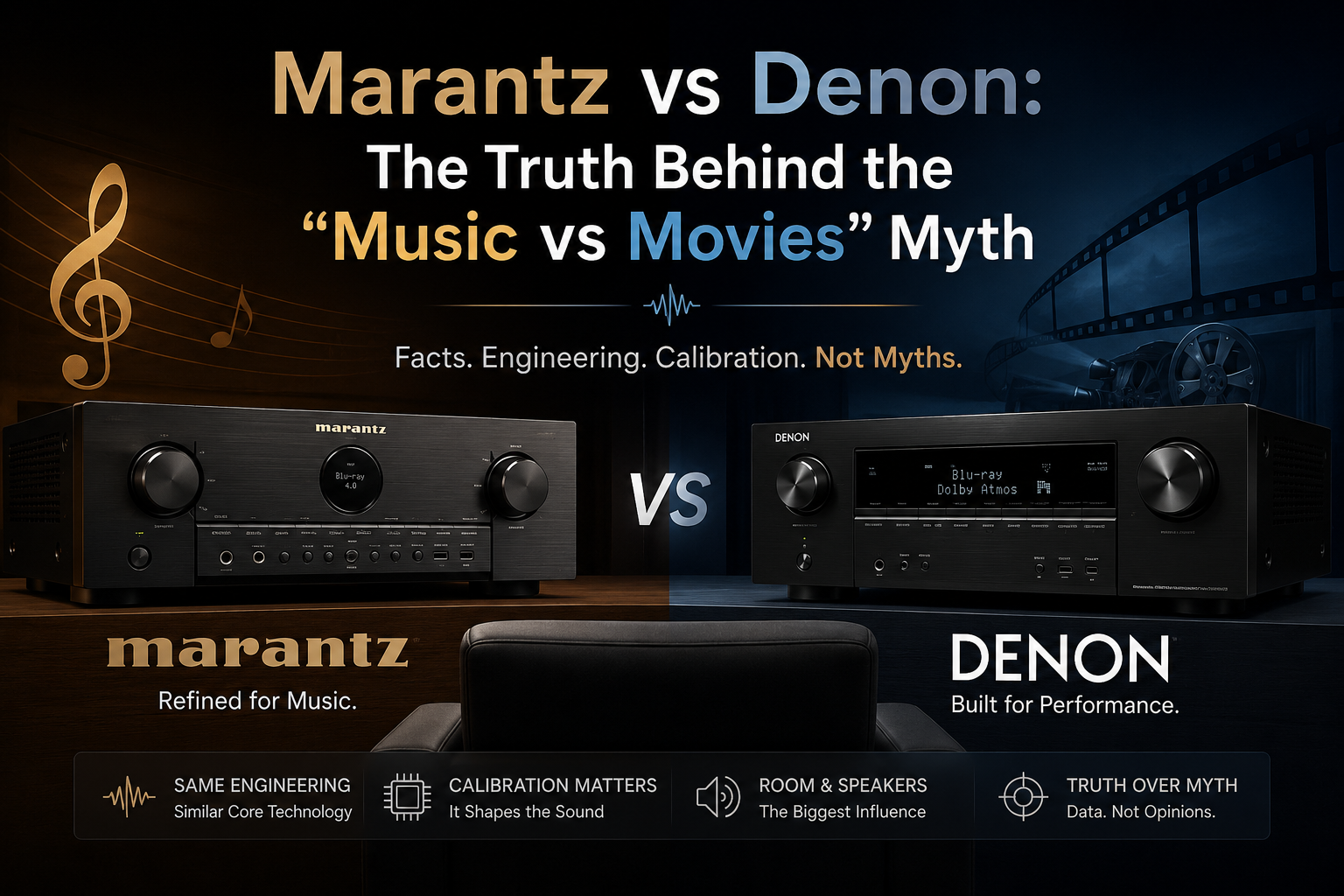
Marantz vs Denon: The Real Technical Difference
The music-versus-movies myth, examined from the measurement bench rather than the showroom floor.
Marantz vs Denon is one of the first questions I hear before a home cinema project begins, and it almost always arrives in the same sentence: Marantz is for music, Denon is for movies. It is not true in the way people mean it. A difference between the two does exist, it is real, it is documented by the manufacturer, and it is measurable. But it is not a music-versus-movies difference, and it is far smaller than the three things that genuinely decide how a room sounds: the room itself, the loudspeakers, and the calibration decisions made after everything is installed.
This article explains where the belief came from, exactly what is different inside the two boxes, and why that difference stops mattering the moment a room is treated and professionally calibrated.
Where did the “Marantz for music, Denon for movies” idea come from?
It came from brand history and product positioning, not from measurement.
Marantz built its reputation over decades in two-channel hi-fi. Denon built its reputation in multichannel AV. Each brand marketed to the audience it already owned, and each product line reflected that emphasis. That emphasis showed up in three visible ways:
- Feature allocation at a given price. Denon models have historically offered more amplifier channels and higher claimed power output at the same price point, which appeals to a home theatre buyer counting channels.
- Analog stage investment. Marantz has consistently spent more of its bill of materials on the analog output stage and preamp outputs, which appeals to a stereo listener driving external amplifiers.
- Voicing philosophy. Marantz maintains a dedicated internal listening and tuning process and markets a recognisable house character. Denon’s development priorities have been weighted toward decoding, channel count and processing features.
None of this makes one brand a “music” product and the other a “movie” product. It makes them two products designed for two different buyer profiles, developed under common ownership since the two companies merged in 2002. Both now sit within Sound United, which became part of HARMAN International in September 2025 and operates as a standalone business unit. The brands remain separately engineered and separately positioned, but they are not rivals from different worlds.
What do Denon and Marantz actually share inside the box?
More than most buyers realise. At matched tiers, the two brands commonly share platform engineering. In practice that means the same HDMI and video handling, the same core decoding and object rendering for Dolby Atmos and DTS:X, the same bass management architecture, and the same licensed room correction platform running identical mathematics.
This is the important part. Every operation that shapes what you hear as “cinema sound” — decoding, object rendering, crossover and LFE routing, time alignment, room correction — happens in the digital domain, and at matched tiers that digital domain is common to both brands. Nothing in the digital signal path is tuned for movies on one and music on the other.
One caution, because this is where lazy advice fails buyers: shared platform does not mean identical models. Correction tier, Dirac Live availability, number of independent subwoofer outputs, preamp output configuration and amplifier section all vary by model. A specific Denon and a specific Marantz must still be compared line by line. The brand name tells you almost nothing; the model specification tells you everything.
What is the one real technical difference between them?
There are two, and they both sit at the very end of the signal path. The first is documented by Marantz itself, and it is the single most useful fact in this entire debate.
1. The DAC filter — and why this is the heart of the myth
Every digital-to-analog converter needs a reconstruction filter. Digital audio carries repeated ultrasonic copies of the signal as a by-product of sampling, and a filter removes them before the signal reaches the analog stage. Both brands have this. Neither one outputs an unfiltered signal. The difference is the shape of that filter.
On current Marantz models this shape is exposed as a menu option called DAC Filter, and Marantz publishes what each setting does:
| Setting | Filter type | Marantz’s own description |
|---|---|---|
| Filter 1 (factory default) |
Short-delay slow roll-off | The recommended setting to enjoy the Marantz sound |
| Filter 2 | Sharp roll-off | The recommended setting for bench test measurements |
Read that table again, because it settles the argument. The “Marantz sound” is a factory default menu setting, and the manufacturer itself recommends a different setting when you want to measure the product accurately.
The engineering behind it is straightforward. A slow roll-off filter attenuates gently as it approaches the Nyquist limit. That gentleness has two consequences: it reduces pre-ringing in the time domain, which is the sonic character owners describe as smooth or relaxed, and it produces measurable attenuation in the top octave at standard sample rates, along with less rejection of ultrasonic image content. A sharp roll-off filter does the reverse: flatter in-band response and stronger rejection, at the cost of more ringing around the transition.
Neither is “wrong.” They are two valid trade-offs from the same textbook. But one of them is a deliberate, mild treble softening applied at the factory — and on models that do not expose the setting in a menu, that behaviour is simply fixed in firmware, which is precisely why so many listeners came to hear Marantz as the warmer brand without ever knowing why. Denon’s AV receivers do not present an equivalent filter menu.
Marantz publishes this setting in its own support documentation. It is not a rumour, an audiophile theory, or a review-site opinion.
2. The analog output stage
After the filter comes the analog buffer and gain stage. Marantz uses discrete surface-mount current-feedback modules it calls HDAM (Hyper Dynamic Amplifier Module) in place of integrated op-amps, with stated design goals of wide bandwidth, high slew rate and low applied negative feedback. Denon uses conventional integrated op-amp stages engineered to the same functional specification with a different cost and performance emphasis.
This is a genuine engineering difference, and it is also a narrow one. It shows up in bandwidth above the audible range, in distortion residue and in output impedance. It does not show up as a “music curve” or a “movie curve,” because no such thing is designed into either product.
Most buyers choose the electronics first and think about the room afterwards. In a properly engineered cinema, that order is reversed — the room, the layout and the acoustic design come first, and the processor is selected to serve them.
Discuss your room before you choose equipment →Does the receiver change the sound more than the room does?
No. It is not close, and the gap is not a matter of opinion.
Below a room’s transition frequency, an untreated room routinely produces response peaks and cancellation nulls of 15 to 20 dB at the listening position. Moving a seat by 30 centimetres can change bass response by 10 dB. Seat-to-seat variation across a single row in an untreated room commonly runs 6 to 10 dB.
Two measurements from our own work, both taken with a calibrated microphone in REW:
Now set those numbers against a DAC filter or an analog output stage, whose in-band deviation from flat is a fraction of a decibel. The room is doing something one to two orders of magnitude larger than anything the receiver’s output section contributes.
Two identical receivers in two different rooms will sound more different from each other than a Denon and a Marantz in the same room.
A buyer choosing between the two brands to solve a tonal problem is adjusting the smallest available variable while the largest one goes untouched.
Why does auto-calibration make the two brands seem to sound different?
Because the correction engine is the same, but the settings people leave switched on afterwards are not.
At matched tiers both brands run the same room correction platform with the same measurement microphone type and the same filter generation. Where the results diverge is in the post-calibration defaults that most owners never revisit:
- Dynamic EQ applies loudness compensation referenced to cinema reference level, and is enabled by default after auto-calibration. Below reference level — which is where nearly all music listening happens — it adds substantial low and high frequency boost. Owners describe the result as big, cinematic or boomy, and then credit it to the brand.
- Dynamic Volume compresses dynamic range. Useful for late-night viewing, wrong for music.
- Target curve selection. The Reference target applies a gentle roll-off in the top octave, intended for cinema-mixed content in an acoustically treated room. A flat target is also available. Both options exist on both brands.
- The Marantz DAC filter from Section 03, which stays at its softened factory default unless someone deliberately changes it.
Two people run auto-calibration in two different rooms, leave different defaults enabled, and conclude that one brand is warmer than the other. The brand contributed almost nothing to that outcome.
What changes when a calibrator sets the target curve by hand?
This is the part the myth ignores entirely. Auto-calibration proposes. A calibrator decides.
On a professionally calibrated system, the following are set from measured data rather than accepted from an automatic routine:
- Filter and processing defaults are normalised first. On Marantz, that means selecting the measurement-flat filter setting before any measurement is taken, so the system is characterised honestly rather than through a factory voicing.
- Crossover per speaker, derived from the measured in-room low-frequency limit, not from the manufacturer’s driver specification.
- Subwoofer phase, delay and level, aligned to the main channels through the crossover region rather than set by ear.
- A seat-averaged target curve, defined deliberately with a chosen low-frequency slope and top-octave behaviour, rather than a single-position result.
- Where to cut and where to boost, decided case by case against headroom and driver limits.
- Verification, by re-measuring in REW and confirming the result against the intended target rather than trusting the on-screen display.
Once that curve is defined, measured and verified, the contribution of the DAC filter and the analog stage sits inside the measurement noise. If a client wants a warmer presentation, we build it into the target curve with a controlled high-frequency slope and correct low-frequency weight. If they want more clarity, we adjust tonal balance without pushing the system into harshness.
The target curve is the voicing. It is an engineering decision made in your room, not a characteristic you buy at a shop.
Where does calibration reach its limits?
This matters as much as what calibration can do, and it is where inexperienced setup causes real damage.
EQ is not free. Every decibel of boost consumes amplifier and driver headroom and raises distortion at high output. A system EQ’d flat on a graph at low volume can compress, distort or protect itself at reference level. And a null caused by room cancellation cannot be filled with EQ at all — the energy is being destroyed by the room, so adding electrical power only heats the voice coil.
Correct practice is a sequence, not a slider:
- Select speakers and processing appropriate to the room volume and target output
- Place speakers and subwoofers by measurement, not by furniture layout
- Treat the room so the decay behaviour is correct before any EQ is applied
- Set crossovers, distances, levels, phase and subwoofer integration
- Apply EQ and target curve conservatively, cutting by preference
- Verify by re-measurement, then confirm by listening at reference level
Anyone who tells you a receiver’s auto-calibration will “fix the room” has skipped steps 2, 3 and 6. That is the actual difference between a good system and a great one, and it has nothing to do with the logo on the front panel.
So how should you actually choose between Denon and Marantz?
Choose on system requirements, in this order:
- Channel count and processing capability you need now, and in three years
- Internal amplification or external power amplification
- Which room correction platform you or your calibrator will actually use
- Number of independent subwoofer outputs
- Preamp output configuration, including balanced outputs for long cable runs to an amplifier rack
- Input, output and source requirements
- Service and parts support in India
Nowhere on that list is “music or movies.” If a dealer opens with that framing, they are selling you a brand story instead of designing a system.
At reference level, the debate ends on its own
In a reference-level system — ₹50 lakh and above — the receiver’s internal amplifiers are not in the signal path at all, because external power amplification drives the loudspeakers. The unit becomes a processor doing four jobs: decoding, bass management, time alignment and room correction. All four are digital, and all four are shared architecture.
What matters at that point is the preamp output section, channel count, processing capability and I/O. Output stage engineering does matter here, but as a preamp-drive question into long balanced cable runs. It is still not a music-versus-movies question.
The receiver is one of the last decisions in a properly planned home cinema, not the first. It follows the room, the speaker layout, the acoustic design and the amplification strategy. Reverse that order and no processor will save the result.
Frequently Asked Questions
Is Marantz better than Denon for music?
Not inherently. Marantz applies a slow roll-off DAC filter by default and uses discrete HDAM analog output modules, which together create a slightly softer top-end character out of the box. Both are engineering choices, not music-specific tuning. On current Marantz models the filter is a user-selectable menu setting, and once a room is treated and a target curve is set by measurement, the difference falls inside the measurement noise.
Do Denon and Marantz use the same room correction?
On matched-tier models they use the same licensed room correction platform running the same mathematics on the same measurement data. However, the correction tier and whether Dirac Live is supported vary by model, so each unit must still be checked individually rather than assumed from the brand name.
What is the DAC Filter setting on a Marantz receiver?
It is a menu option on current Marantz models that selects the digital reconstruction filter inside the converter. Filter 1 is the default short-delay slow roll-off setting that Marantz associates with its house sound. Filter 2 is a sharp roll-off setting that Marantz itself recommends for bench measurement. Filter 2 is the correct starting point before professional calibration.
Does a Denon receiver output a raw unfiltered signal?
No. Every digital-to-analog converter requires reconstruction filtering to remove ultrasonic image content, and both brands have it. The difference is the shape of that filter and the design of the analog buffer stage after it, not the presence or absence of filtering.
What is HDAM in a Marantz receiver?
HDAM stands for Hyper Dynamic Amplifier Module. It is a discrete surface-mount amplifier module Marantz uses in the analog stage after the DAC in place of an integrated op-amp. The stated design goals are wide bandwidth, high slew rate and low applied negative feedback.
Will switching from Denon to Marantz fix my bass problem?
Almost certainly not. Bass problems are caused by room modes, speaker and subwoofer placement, and seating position, which routinely produce response swings of 15 to 20 dB at the listening seat. No receiver analog stage can offset that, and no receiver change will.
Can calibration boost any frequency to make the response flat?
No. Every decibel of boost consumes amplifier and driver headroom and raises distortion at high output. A null caused by room cancellation cannot be filled with EQ at all. Correct practice is to cut where energy is excessive, correct the cause of a null by placement or treatment, and reserve boost for narrow, well-understood cases.
Does the receiver brand matter in a ₹50 lakh home cinema?
Less than most buyers expect. At that level the internal amplifiers are bypassed in favour of external power amplification, so the unit functions as a processor. Selection is driven by channel count, processing capability, preamp output configuration including balanced outputs, and input and output requirements.
The logo matters less than the engineering behind the system
The Marantz versus Denon debate survives because it gives buyers something simple to decide, and deciding feels like progress. But it focuses attention on a variable worth a fraction of a decibel while ignoring variables worth twenty.
Marantz does not automatically make a system musical. Denon does not automatically make a system cinematic. If two systems in the same room sound different, the cause is almost always the target curve, the crossover points, the subwoofer integration, the speaker placement or the acoustic treatment. Change any one of those and the result changes audibly. Change the brand on the front panel and, in a properly calibrated room, it usually does not.
Engineer the room. Define the curve. Then select the processor that serves the system.
A home cinema is a designed system, not a shopping list. If you are planning a room in Madurai, Tamil Nadu or anywhere in South India, the conversation should start with the space — not the equipment.
Discuss Your Project on WhatsApp →
Leave a Reply